
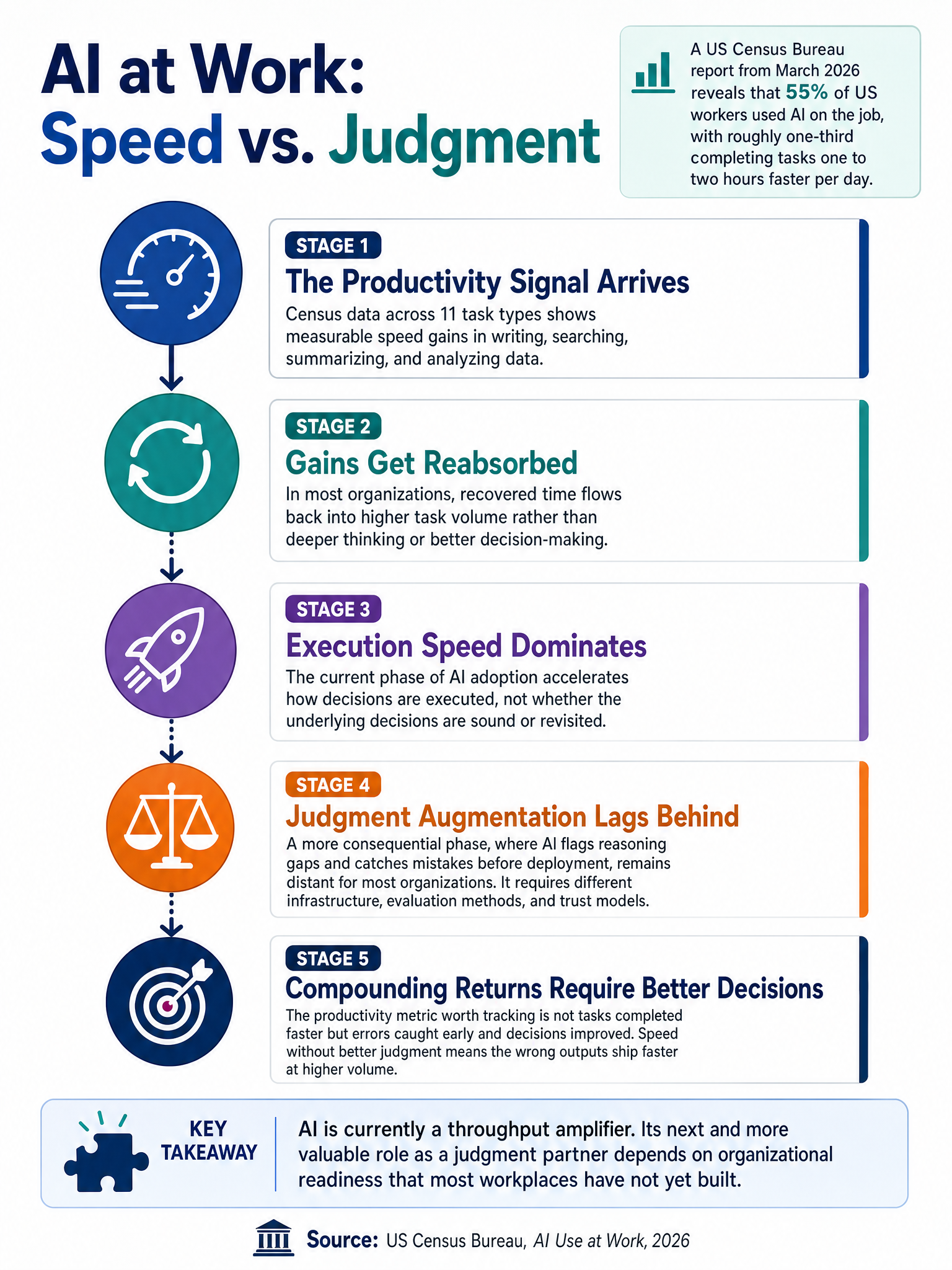
US Census Bureau March 2026 data: 55% of workers used AI on the job, one-third completed tasks 1-2 hours faster, and what the productivity gain data actually means for how organizations are using AI
The Census Bureau Just Told Us Something We Already Knew But Won’t Act On
The US Census Bureau published data this week from its March 2026 Household Trends and Outlook Pulse Survey, and one number jumped out at me: 55% of US workers reported using AI on the job. About a third of those workers said they completed tasks one to two hours faster as a result.
I want to sit with that for a moment, because the number is both genuinely impressive and almost completely misread by everyone sharing it.
Where the Time Is Actually Going
One to two hours per day, recovered across millions of workers, is not a small thing. At scale, that is an extraordinary amount of reclaimed human capacity. If even a fraction of that time went toward harder problems, better decisions, or work that actually requires judgment, we would be seeing a different kind of transformation story than the one playing out in most organizations right now.
But here is what I see in practice. The time does not go toward harder problems. It gets reabsorbed into more volume. More emails sent. More reports generated. More tickets closed. The productivity gain gets immediately converted into throughput, not quality. Organizations treat AI like a faster treadmill, not a thinking partner.
That is not a technology failure. That is a management failure.
What the 55% Number Actually Tells Us
The survey asked about 11 specific tasks, covering things like searching for technical information and drafting communications. The breadth of that list matters. When you ask people whether they used AI for at least one of eleven tasks in the past week, 55% adoption is a real number but not necessarily a deep one. It includes the person who ran one search through an AI tool and the person who has fully restructured their workflow around it.
The more revealing data point is the one-third figure. Of those using AI, only about 33% reported meaningful time savings. That gap between adoption and meaningful impact is where the real conversation should be happening. Organizations are measuring whether people are using the tools, not whether they are using them well.
The Throughput Trap
I have watched this pattern repeat across different teams and industries. A new efficiency tool appears. Adoption numbers climb. Leadership celebrates the adoption numbers. Nobody asks what the recovered time is funding.
When AI helps a content writer produce drafts twice as fast, the natural organizational response is to ask for twice as many drafts, not to ask the writer to spend the saved time on strategy or audience research. The incentive structure of most organizations does not reward thinking. It rewards output. So AI becomes an output accelerator, and the deeper productivity potential gets left on the table.
This is not pessimism. It is a design problem, and design problems have solutions.
What Good Deployment Actually Looks Like
The organizations getting more out of AI than just speed are the ones that explicitly protect what the saved time goes toward. They are treating recovered time as a budget, not a windfall. Before a team adopts a new AI workflow, someone decides in advance what the time savings are for. If it is not worth protecting, it probably will not be protected.
This is a governance and culture question more than a technology question. The tooling is mature enough. What most organizations are still missing is any coherent answer to the question: faster at what, toward what end?
The Census Bureau data is a reasonable signal that AI adoption at work is real and widespread. But I would not read it as a productivity transformation story yet. It is closer to the beginning of one, if organizations decide to treat it that way.
The tech is not the hard part anymore.
Sources & Further Reading
#AIatWork #ArtificialIntelligence #FutureOfWork #Productivity #MLEngineering