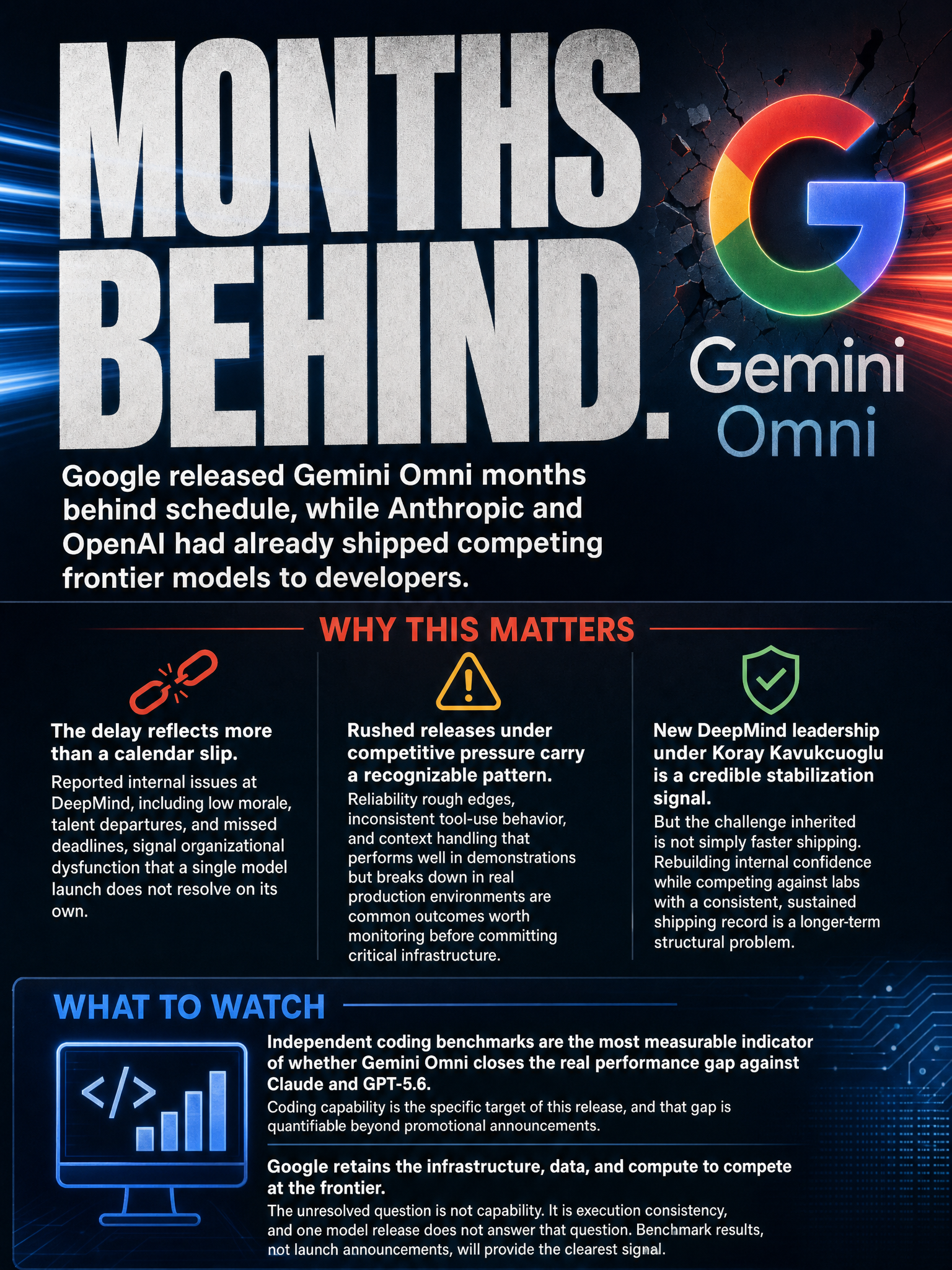
Google Gemini Omni launch under new DeepMind leadership after missed 3.5 Pro deadlines and what it means for builders evaluating Google’s model reliability
Google Dropped Gemini Omni. The Timing Tells You Everything.
When a company misses one deadline, that’s a scheduling problem. When it misses two in a row on its most-watched product while competitors are shipping, that’s a signal about something deeper.
Google just launched Gemini Omni under new DeepMind leadership, with Koray Kavukcuoglu now at the helm after Demis Hassabis stepped back from the role. The model looks capable. The circumstances around it look messy. And if you’re a builder deciding whether to anchor your stack to Google’s models, both things matter.
The Deadline Problem
Gemini 3.5 Pro was shown off at Google I/O in May with a promise to ship “next month.” It missed June. It missed mid-July. Google walked into August, the heart of developer planning season, without a frontier model release while Anthropic’s Mythos and OpenAI’s GPT-5.6 were already in developers’ hands.
According to a Fortune investigation published August 10, the delays weren’t just schedule slippage. They came alongside low morale, a talent exodus, and internal friction that had been building for a while. That context matters because it means the problem wasn’t a technical blocker that got resolved. It was an organizational one. Gemini Omni shipping now doesn’t automatically mean that’s fixed.
What the Leadership Shift Actually Means
Kavukcuoglu was previously a senior research figure at DeepMind, so this isn’t an outsider coming in to clean house. CNBC reported on August 12 that he inherits a direct race to catch OpenAI and Anthropic, with Google having gone most of 2026 without unveiling a frontier model.
New leadership can change priorities and inject energy. It can also take six to twelve months before the structural changes that actually improve output velocity show up in what ships. Builders who need reliability in their toolchain should be honest with themselves about which phase Google is in right now.
Where Gemini Omni Actually Stands
The model is real. From what’s surfaced so far, Google is specifically targeting coding capabilities, which is the area where Anthropic and OpenAI have been pulling ahead in developer perception. That’s a smart place to compete. Developers make infrastructure decisions based partly on benchmark trust and partly on whether a model holds up in their actual workflow.
The honest assessment is that Gemini Omni enters a field where Anthropic keeps stretching context windows and safety tooling, OpenAI still leads in developer mindshare, and Meta is giving away increasingly capable Llama models that undercut everyone on price. Catching up on one capability axis doesn’t close a perception gap.
What Builders Should Actually Do
I’d be cautious about treating Gemini Omni as a solved problem for teams that need predictable model behavior and stable API access. Not because the model is bad, but because the org that ships the model also maintains it, updates it, and sets deprecation timelines. When the Fortune piece describes staff burnout and missed internal commitments, that’s relevant to every question about what support looks like six months from now.
That said, writing Google off entirely is also the wrong read. They have infrastructure advantages nobody else has, and Kavukcuoglu has real credibility inside the research community. The Google Gemini API managed agents update that dropped alongside Omni, including the 3.6 Flash hooks, suggests the team is still moving. This isn’t a company in freefall. It’s a company that had a rough stretch and is now trying to demonstrate it’s past it.
The difference between “recovering” and “recovered” is time and sustained output. One model launch doesn’t answer that question. The next three to six months of reliability, performance updates, and whether the team stabilizes will tell you far more than the announcement did.
🔍
If you’re evaluating models for production right now, I’d run Gemini Omni seriously in your benchmarks. But I’d also weight the organizational signal. Model quality and org stability aren’t the same variable, and right now they’re pointing in different directions at Google.
The smart move is to keep your abstraction layer thin enough that you can move if you need to.
Sources
#GoogleDeepMind #GeminiOmni #AIEngineering #MachineLearning #LLMs