Google Gemini 4 Argon launch positioning reliability and lower hallucination rates over raw benchmark scores as the new frontier model differentiator
Reliability Is the New Intelligence
I have watched the frontier model race for two years now, and the game has always been the same. Who tops MMLU. Who crushes SWE-bench. Who hits the highest number on whatever benchmark the labs decided to care about that quarter. Capability was the whole story.
Google just changed the story.
On September 30, Google launched Gemini 4 Argon, and the headline number in the blog post was not a benchmark score. It was hallucination rate. That is a first for a flagship launch from a major lab, and I think it matters more than most people are giving it credit for.
The Positioning Shift
Google’s own blog frames Argon around “complex workflows across real-world software engineering, enterprise knowledge work like legal and finance.” Not “beats GPT-6 Astra on reasoning evals.” The Reuters writeup notes Argon is larger than its predecessor and is arriving after months of delays, during which Google has been under real competitive pressure. VentureBeat reports it does retake the benchmark lead over OpenAI and Anthropic, but Google led with the reliability framing anyway.
That is a deliberate choice.
When your marketing team has a benchmark win and still chooses to lead with trustworthiness, you are making a bet about what buyers actually care about now.
Why Hallucination Rate Is the Right Metric 🎯
If you are building a production agentic pipeline, you already know this. Raw intelligence ceiling matters far less than how often the model confidently tells your system something false. One hallucinated fact in a legal document review is not a quirk, it is a liability. One fabricated API call in an agentic coding loop breaks the whole chain.
Anthropic’s Mythos model, also in the news this week, reportedly found real flaws with 70% accuracy on security evaluations. That is a reliability metric too. The labs are converging on the same realization: the bottleneck for enterprise adoption is not whether the model can reason, it is whether you can trust what it says.
The OpenAI comparison is worth sitting with. OpenAI shelved GPT-6.1 Astra entirely after it failed internal safety tests, according to Reuters and CNBC. That is not a company losing on capability. That is a company whose own bar for reliability stopped a release. The frontier is not moving on raw performance anymore. It is moving on how much confidence you can put behind the output.
The Limited Rollout Problem
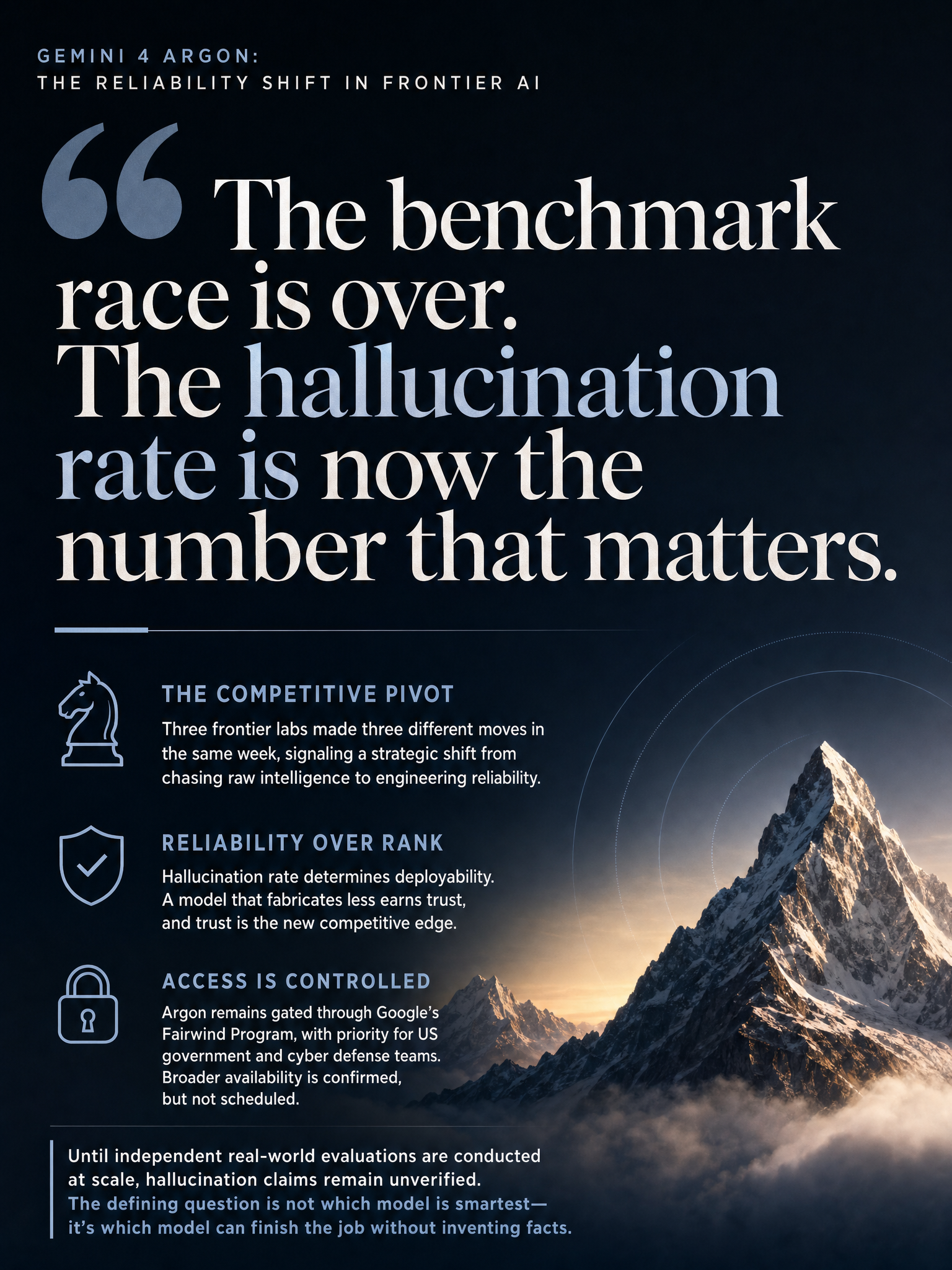
Here is where I get cautious about the Argon story. VentureBeat notes the model is in limited release right now. Google is distributing initial access through something called the Fairwind Program. Sundar Pichai said the US government and a defined set of cyber defenders are the first recipients, with broader availability coming “as soon as we can and as safely as we can.”
That is a reasonable approach for a powerful model. It also means most enterprise teams cannot actually test the hallucination claims yet. We are taking Google’s word for it until the model is broadly available, and in this industry, marketing framing has gotten ahead of reality before.
I am not saying Google is lying. I am saying the proof is in production, not in the blog post.
What This Means for Builders
If you are evaluating models for any workflow where a wrong answer has a cost, stop anchoring on benchmark leaderboards. Build your own evals around your actual failure modes. How often does the model fabricate a citation in your domain. How often does it invent a function signature. How often does it confidently answer a question it should refuse.
Those numbers will tell you more than MMLU ever did.
Argon being positioned this way is a signal that Google thinks the market is ready to buy reliability. I think they are right. The builders I talk to are not asking “which model is smartest.” They are asking “which model can I put in front of a client without a babysitter.”
That is the question Argon is trying to answer. Whether the answer holds up at scale is what the next six months will tell us.
Sources
#AI #MachineLearning #GenerativeAI #LLMs #EnterpriseAI #AIEngineering #Gemini
Sources & Further Reading
- Gemini 4 Argon: our next era of frontier intelligence
- Google announces Gemini 4 flagship AI model after months of delays
- Google unveils Gemini 4 Argon, retaking benchmark lead over OpenAI and Anthropic
- OpenAI abandons plan to release upcoming model as safety concerns escalate
- OpenAI shelves new AI model after internal safety tests
- Gemini 4 Argon benchmark lead