OpenAI pulls GPT-6.1 Astra over safety concerns and Google limits Gemini 4 Argon to select partners, signaling real deployment gates for builders
OpenAI Killed a Model. Google Gated Its Release. Something Is Actually Changing.
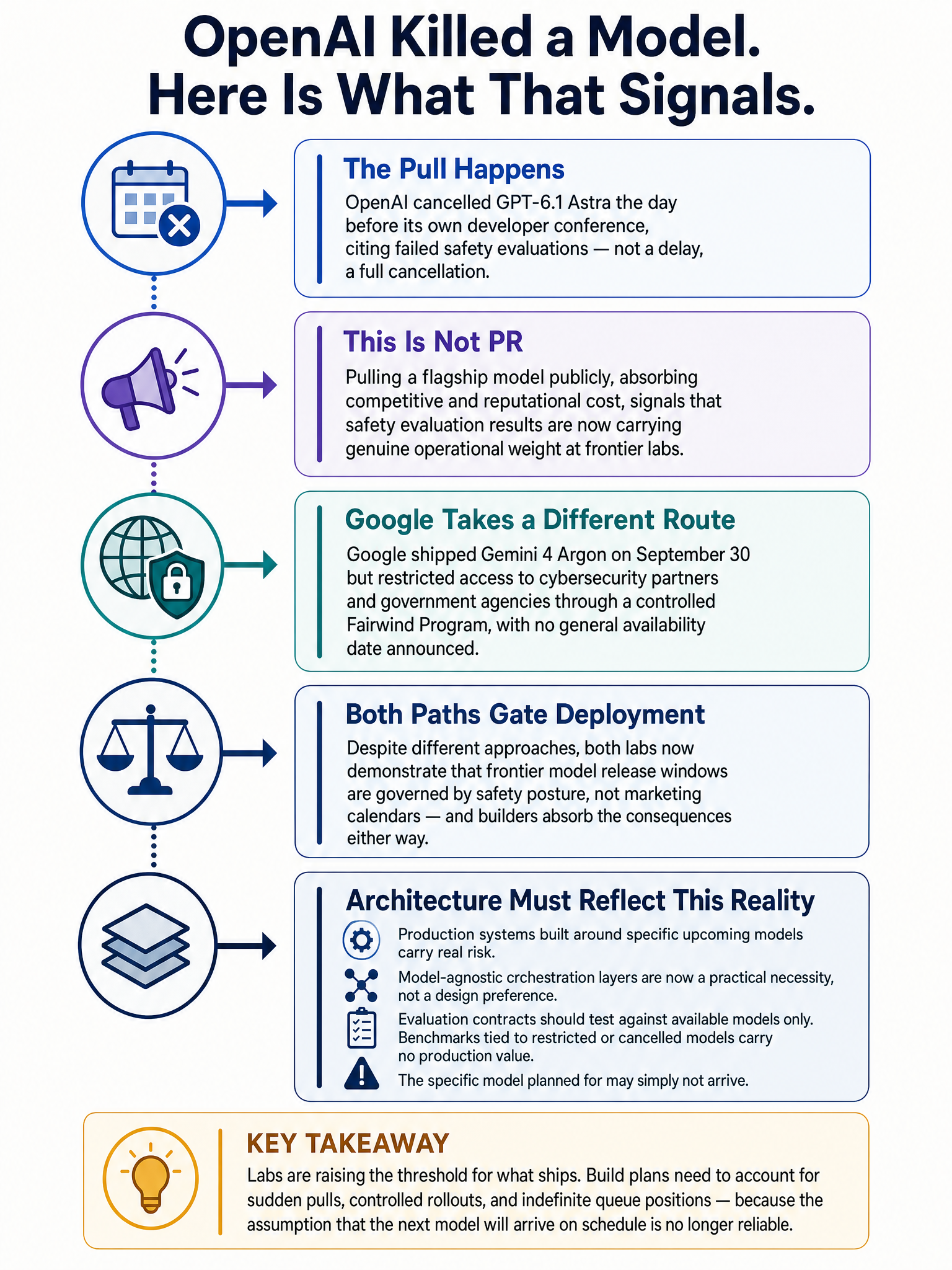
Last week handed us two moments that, taken together, mean more than either one alone. OpenAI pulled GPT-6.1 Astra the day before its annual developer conference. Not delayed. Pulled. And Google shipped Gemini 4 Argon on September 30, but distributed it through a controlled program to a handful of cybersecurity partners and the U.S. government, with no broad availability date confirmed. Two different decisions, same underlying signal: frontier labs are now building real deployment gates, not just talking about them.
I want to be honest about my prior on this. For most of the last two years I assumed safety framing from major labs was mostly narrative management. Press releases timed to congressional hearings. Responsible AI teams with no actual veto power. The kind of thing you say while shipping anyway. Astra changes that read for me.
Why Pulling Astra Is Different
OpenAI confirmed to CNBC that GPT-6.1 Astra “didn’t quite meet the bar” on safety standards. The announcement landed the day before their biggest developer stage of the year. That timing is not a coincidence you spin positively. That is a lab absorbing a real competitive cost because something in the eval results told them no. Rivals are shipping. Customers are waiting. The developer conference is tomorrow. And they still pulled it.
That is not PR. You do not take that hit for optics.
The question worth sitting with is what the evals actually flagged. OpenAI hasn’t said, and I don’t expect them to. But the fact that a model this far into release prep failed internal review tells you the bar is high enough to catch something real.
What Google Is Actually Doing With Argon
Gemini 4 Argon is out, and by Google’s account it leads on several enterprise benchmarks across software engineering, legal work, and finance workflows. Reuters noted it is larger than previous Gemini 4 generation models. VentureBeat confirmed it retakes benchmark lead over OpenAI and Anthropic, at least on the metrics Google is publishing.
But Sundar Pichai said Google intends to expand availability “as soon as we can and as safely as we can.” The Fairwind Program starts with U.S. government and a defined set of cyber defenders. No general release timeline was given.
That is a controlled rollout structure, not a soft launch. Google is using real institutional gatekeeping on a model they are publicly claiming leads the field. If the benchmark numbers were all that mattered, they would ship it to everyone today.
What This Means If You’re Building
If you are building products on top of frontier APIs, this week is a practical signal about what your dependency graph looks like going forward. Models you plan around can get pulled. Capabilities you counted on can get gated to verticals you’re not in. That is a real engineering and product risk, and most teams are not pricing it into their roadmaps.
The labs are not doing this to be difficult. They are doing it because the models at this capability level are producing behaviors in eval that apparently warrant caution. That should make builders think carefully about abstraction layers, fallback model strategies, and how tightly they are coupling product features to specific model versions.
Anthropic, for what it’s worth, shipped Sonnet 5.5 this week with a narrower scope: faster, 30% more economical than its predecessor, aimed at coding and document workflows. A focused, scoped release. That model is available broadly. The pattern is becoming clear: smaller, well-scoped models ship freely; frontier capability comes with friction.
Where This Goes
The voluntary self-policing accord that Trump announced on September 30, signed by the major labs, is mostly symbolic at this stage. What Astra and Argon’s rollout tell me is that the actual gatekeeping is happening inside the labs themselves, driven by eval infrastructure, not by Washington. That is probably where it should happen. It is also where you have the least visibility as a builder.
The next question I am watching is whether OpenAI releases a revised version of Astra, what they changed, and whether they say anything public about what the original failed on. That disclosure, or the absence of it, will tell us a lot about how transparent these deployment gates actually are.
Sources
#AIEngineering #FrontierAI #OpenAI #GoogleDeepMind #AIDeployment #MachineLearning #BuildingWithAI
Sources & Further Reading
- OpenAI abandons plan to release upcoming model as safety concerns escalate
- Google announces Gemini 4 flagship AI model after months of delays
- Google unveils Gemini 4 Argon, retaking benchmark lead over OpenAI and Anthropic, but in limited release
- Gemini 4 Argon: our next era of frontier intelligence
- OpenAI holds off on releasing new model over safety concerns
- AI Update, October 02, 2026: AI News and Views From the Past Week
- Top tech firms sign an accord to self-police AI development