Gartner 2026 AI Hype Cycle shifts framing from model capability to operational control, and what it means for builders in production
The Gartner Hype Cycle just reframed the entire AI conversation, and I think it’s the most honest thing the industry has produced this year.
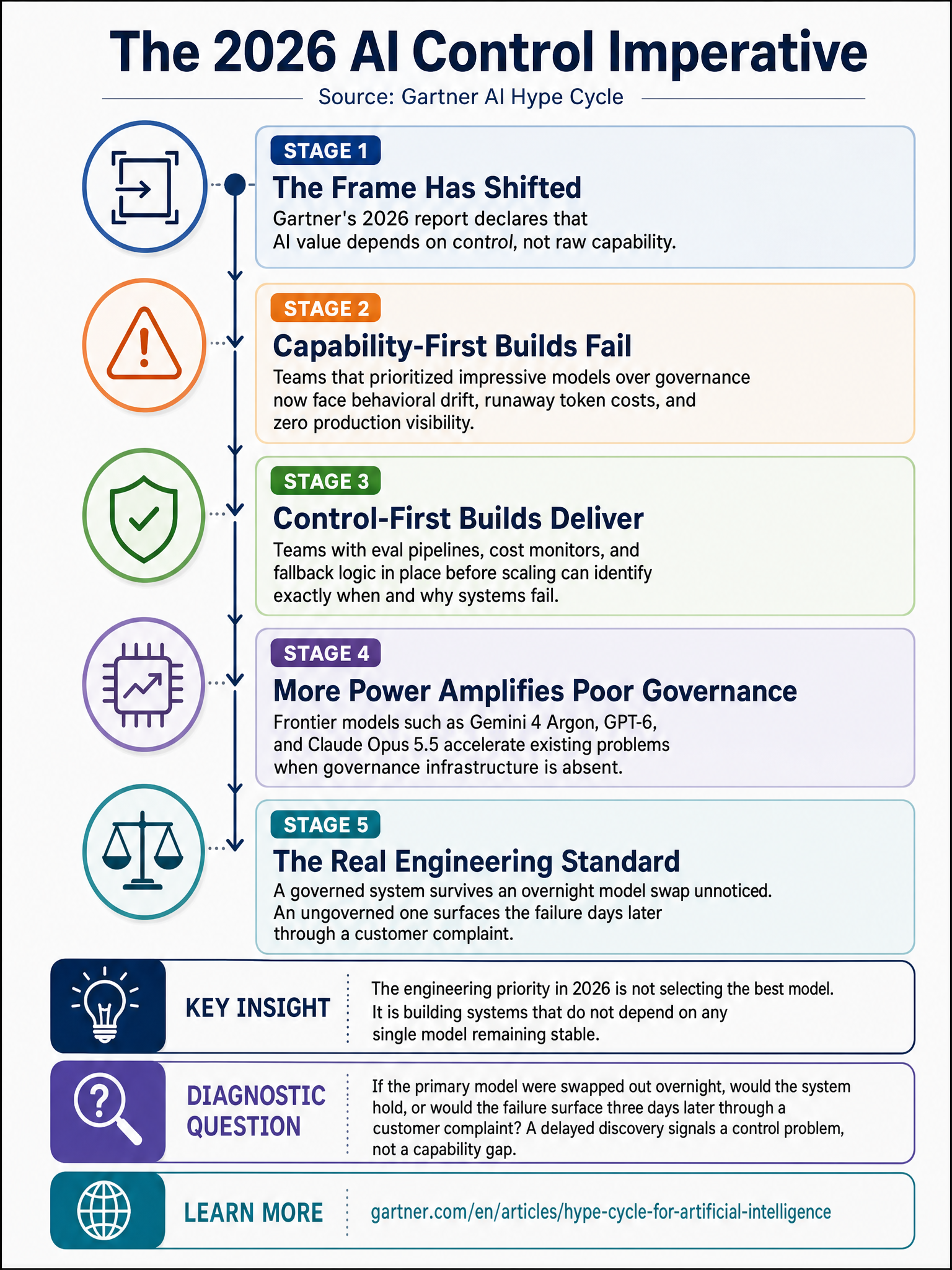
The 2026 report, published October 1st, makes a clean break from how we’ve talked about AI value for the past three years. The thesis is direct: AI value increasingly depends on knowing what your systems do, what they cost, and how you govern them. Not on which model tops the latest coding benchmark. Not on parameter counts. Not on who announced the biggest context window this quarter.
Control. That’s the word Gartner is centering. And if you’ve been building in production, you already know why.
Why This Shift Matters
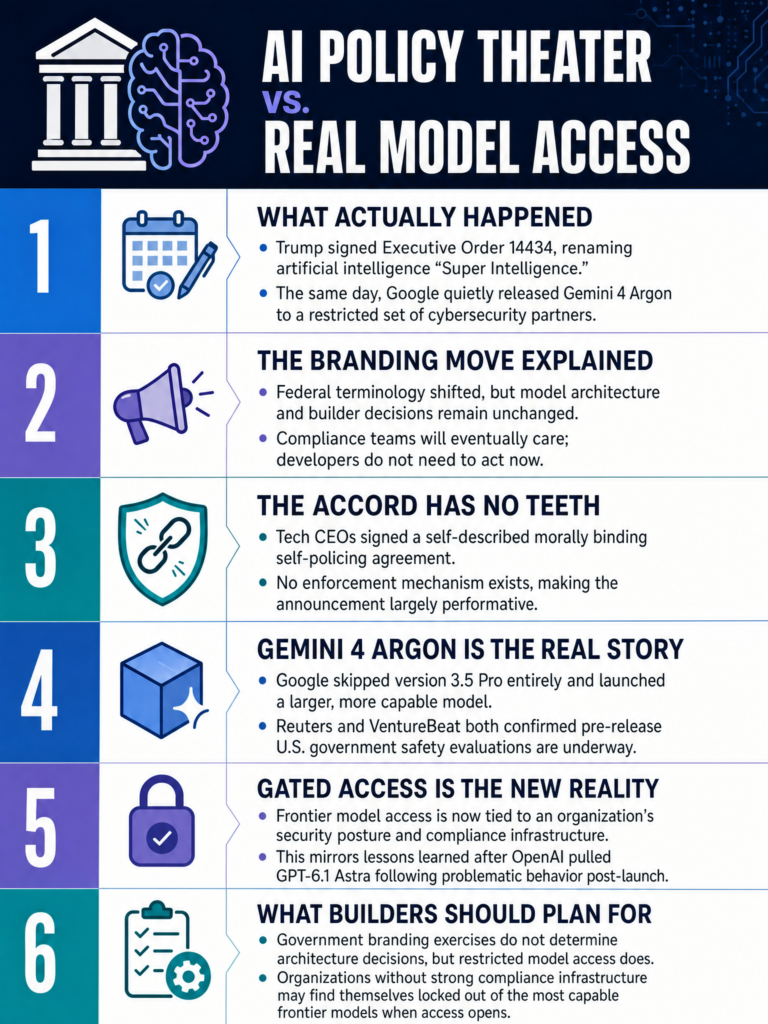
The timing is pointed. Google just announced Gemini 4 Argon, described by Reuters as larger than its previous “Pro” models and positioned to compete with Anthropic’s Opus 5.5 and OpenAI’s Astra on coding and cyber benchmarks. Limited release, phased rollout, government safety evaluations first. Another frontier model, more benchmark comparisons, more labs racing to claim the top spot.
Meanwhile Gartner is saying: that’s not where value lives anymore.
I believe them. The benchmark race has become a distraction mechanism. Labs need it for fundraising and press cycles. Builders don’t need it for shipping.
What Production Actually Looks Like
The teams I’ve watched deliver real value in 2026 share a common trait. They built control infrastructure before they scaled. Eval pipelines that run on every deployment. Cost monitors with actual alerting. Fallback logic that degrades gracefully when a model misbehaves. They can tell you, with specificity, when their system fails and what it costs per thousand requests.
The teams that are struggling optimized for demo quality. They chased the latest frontier model each quarter, swapped APIs, re-tuned prompts, and shipped fast. They have impressive outputs in controlled settings and no visibility into what’s happening at scale.
That gap, between demo quality and production control, is exactly what Gartner is naming.
The Governance Problem Nobody Wants to Talk About
There’s a reason “control” is uncomfortable language for the AI industry. Control means accountability. If you know what your system is doing and it does something bad, you own that. Many teams have implicitly preferred the ambiguity of “the model did it.”
Governance frameworks, cost attribution, audit trails, failure mode documentation. These aren’t glamorous. They don’t generate LinkedIn impressions. But they are the difference between a proof of concept and a system someone can actually depend on.
Gartner putting this at the center of the 2026 cycle is an acknowledgment that the industry has been avoiding the unglamorous work.
What Builders Should Actually Do With This
If you’re a builder reading a Gartner report and waiting for permission to prioritize operational tooling over model chasing, here it is.
Build evals before you scale. Instrument your costs at the request level. Define what failure looks like for your specific use case and write tests for it. Document your fallback behavior. Know your p99 latency and what happens when you breach it.
None of this is new engineering wisdom. It’s just engineering. The novelty is that the AI field is finally being pushed to apply it.
Google launching Gemini 4 Argon to a handful of cybersecurity partners before general release is actually a reasonable model for this. Staged rollouts with controlled feedback loops. That’s operational discipline, not a capability announcement.
The Real Takeaway
The labs will keep shipping models. Benchmarks will keep changing. The frontier will keep moving. None of that stops.
What Gartner is saying, and what I’d say more plainly, is that the builders who win the next two years won’t be the ones who adopted the best model. They’ll be the ones who built the best systems around whatever model was available. That’s a skill set. It’s learnable. It doesn’t require a research budget.
The hype cycle has a trough of disillusionment for a reason. We’re in it. The way out is control.
Sources
#AIEngineering #MachineLearning #ProductionAI #MLOps #ArtificialIntelligence