Trump Executive Order 14434 renaming AI to ‘Super Intelligence’ alongside Google Gemini 4 Argon gated launch and what both signal for builders in production
The Week Washington Renamed AI and Google Quietly Shipped What Matters
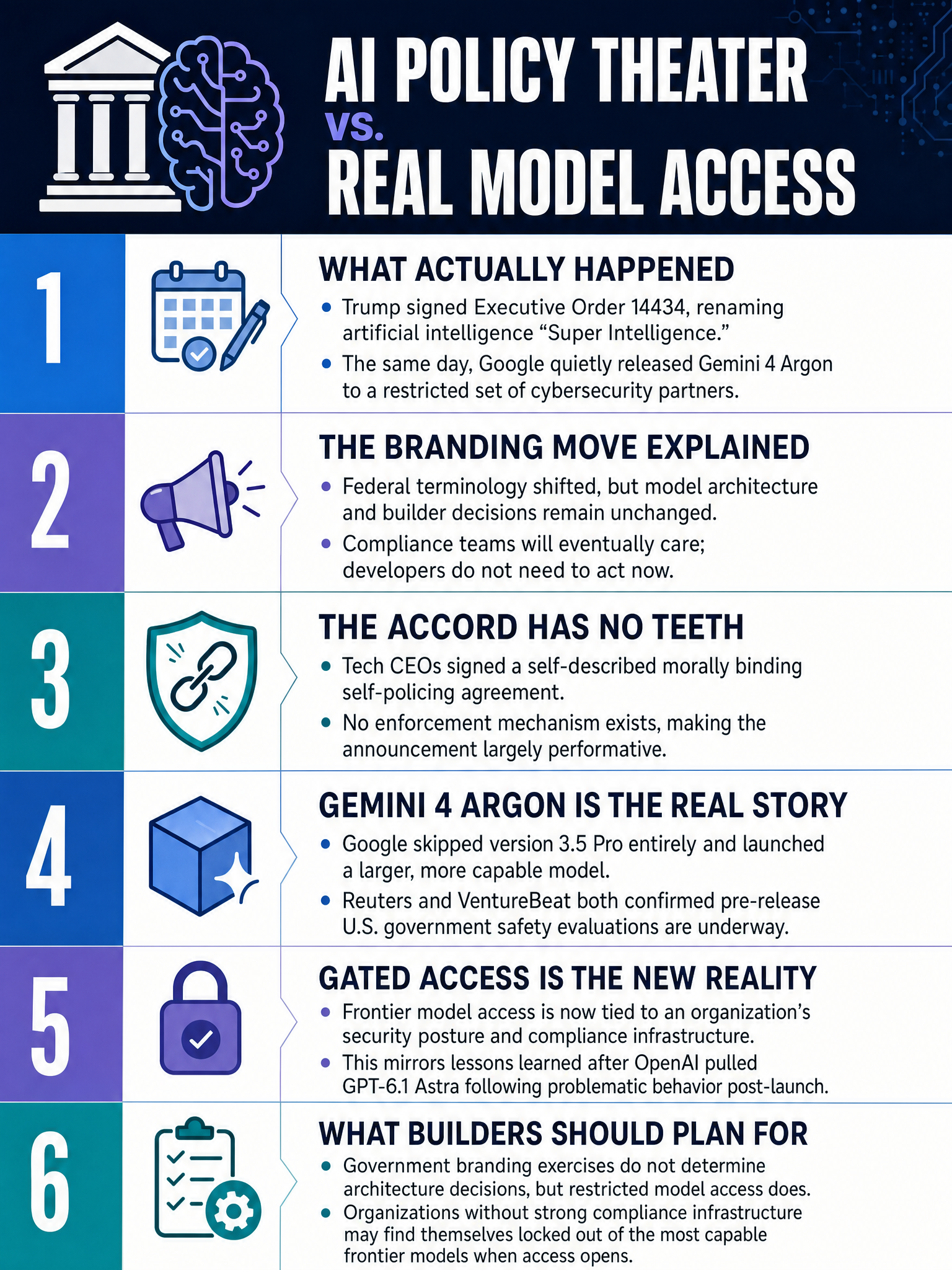
On September 29, 2026, the White House held a photo op with Jensen Huang on Trump’s right and Sundar Pichai somewhere in the room, and the headline that came out of it was that the United States government officially renamed artificial intelligence to “Super Intelligence.” Executive Order 14434, titled “Inaugurating the Era of Super Intelligence,” directs all executive departments and agencies to use the term “Super Intelligence” (SI) going forward, and kicks off a review of the federal statutory definition of AI to propose conforming amendments across existing law. That is the kind of thing that sounds enormous and is mostly theater. But buried underneath that theater was something builders actually need to pay attention to.
The Same Day, Google Shipped
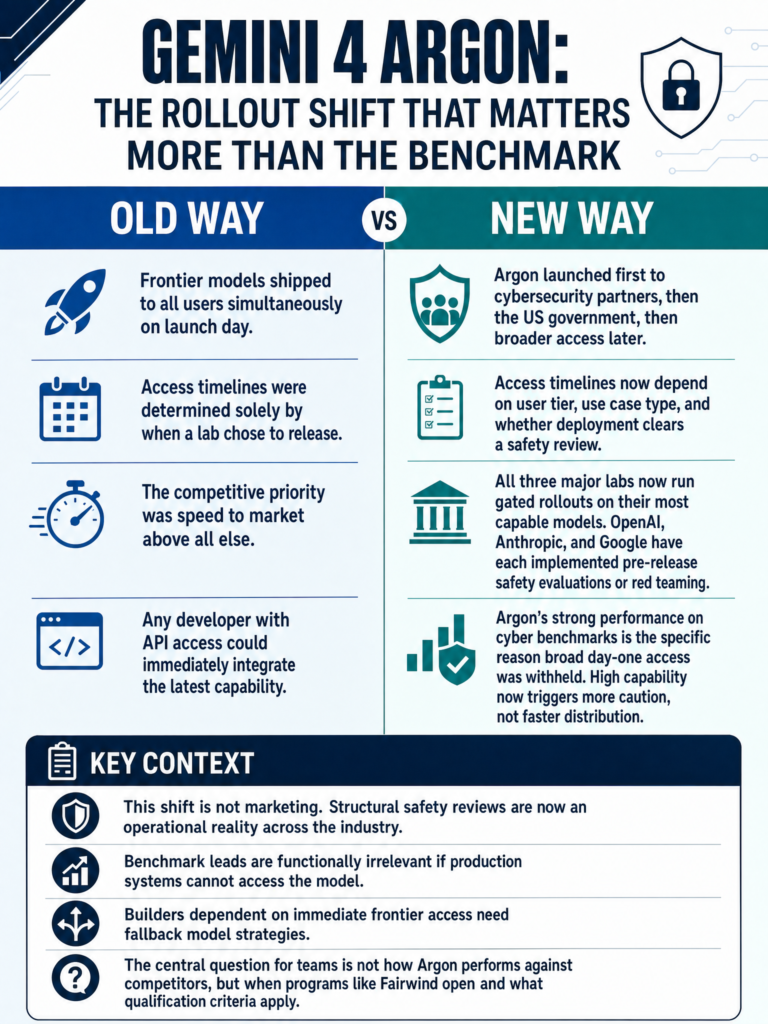
While Trump was getting tech CEOs to sign what the Guardian described as a “morally binding” self-policing accord with no enforcement mechanism, Google announced Gemini 4 Argon. Reuters and VentureBeat both confirmed it. Argon is the flagship model anchoring the Gemini 4 generation, and it is larger than Google’s previous Pro-tier models. On coding and cyber benchmarks, Google claims it matches OpenAI’s Astra and Anthropic’s Opus. Those are frontier-level comparisons.
Here is the part that matters for production engineers: you cannot have it yet.
Google is rolling Argon out first to trusted cybersecurity partners. It is running pre-release safety evaluations with the U.S. government before any public release, and Google has not provided a timeline for when that changes. VentureBeat noted that the timing is pointed, given that Google has been under pressure to prove it can compete at the top of the model market and not just win on infrastructure and cheaper Flash-tier models. Alphabet shares rose about 1.7% in extended trading after the announcement, then pulled back after Bloomberg reported internal employee skepticism about the model.
What the Rebranding Actually Changes
Legally, a fair amount. Wiley’s analysis from October 2 points out that EO 14434 triggers a review of existing federal statutes that reference “artificial intelligence” and will eventually require conforming amendments. That means procurement language, compliance requirements, and regulatory filings that currently reference AI may need to be reclassified under SI definitions once federal agencies finish the review process. If you are building anything that touches federal contracts or regulated industries, your legal team needs to flag this now, not when the conforming amendments land.
Practically, in terms of how models work or what you can build, the rebranding changes nothing. A transformer is still a transformer.
The accord itself is a softer story. Trump announced that top AI companies signed an agreement to “self-police” development. No enforcement mechanism was attached. The Guardian’s coverage described it as vague. NPR confirmed it happened. What it actually commits signatories to is unclear, which is itself a data point about how this administration intends to govern AI, which is to say, loosely.
What Gated Releases Signal for the Ecosystem
Argon is not the first frontier model to ship in restricted phases, but the specific gating here is worth noting. Starting with cybersecurity partners and looping in government safety evaluations before public access is a different posture than the typical API waitlist. It suggests Google is either genuinely cautious about Argon’s capabilities in adversarial contexts, or it is using a government-first rollout to build regulatory goodwill at a moment when the White House is literally rewriting how the federal government categorizes AI. Probably both.
For builders, this pattern is becoming the norm at the frontier. Gartner’s October 2026 Hype Cycle update put it plainly: AI value increasingly depends on knowing what systems do, what they cost, and how to govern them, with control ahead of raw capability in terms of what drives production value. That framing fits Argon’s rollout exactly. The most capable model is not the most accessible one.
What Builders Should Do Right Now
Stop waiting for Argon. It may be months before you can touch it, and OpenAI’s GPT-6.1 Sol just shipped while Astra development was halted, per Micro Center’s roundup from October 2. The frontier is moving in multiple directions simultaneously.
Watch the SI definitional review. When federal agencies propose a new statutory definition for Super Intelligence, it will shape procurement, liability, and compliance language for years. The comment period will matter.
Treat gated launches as signals. When a top-tier model ships only to security partners and government reviewers, that tells you something about where the risk surface is. Your threat modeling should update accordingly.
The White House got its photo op. Google got its benchmark headlines. The builders who stay ahead of both will be the ones who read past the press release.
Sources
#AIEngineering #MachineLearning #GenerativeAI #FederalAI #GeminiAI #BuildersInAI
Sources & Further Reading
- Executive Order Rebrands AI as “Super Intelligence” and Signals Potential Federal Legislative Changes
- Trump AI deal rebrands ‘artificial intelligence’ as ‘superintelligence’
- Trump says top tech firms have signed accord to ‘self-police’ AI
- Google announces Gemini 4 flagship AI model after months of delays
- Google unveils Gemini 4 Argon, retaking benchmark lead over OpenAI and Anthropic, but in limited release
- This Week in AI: OpenAI, Anthropic, Google Push New Models and Features
- Gartner Hype Cycle for Artificial Intelligence
- Does Google’s new model catch up to OpenAI, Anthropic at the frontier?