Wes Moore bipartisan governors AI coalition as a signal of federal governance vacuum and what state-level regulatory fragmentation means for builders in production
When Governors Fill the Void
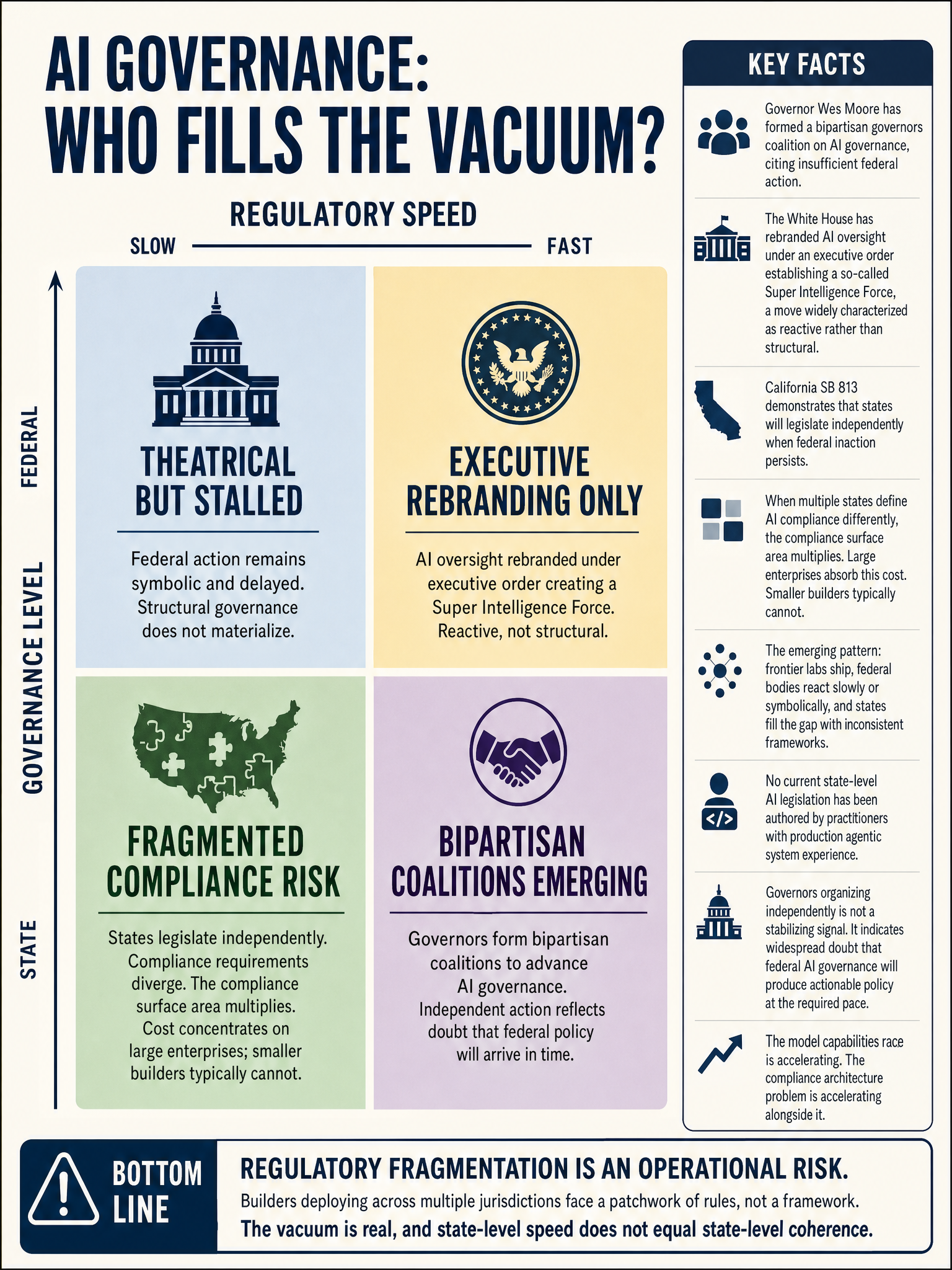
Wes Moore didn’t form a bipartisan governors coalition on AI because he had nothing better to do. He did it because the federal government is, functionally, absent from the room where the real decisions are being made. That’s the story. Not the model releases, not the branding exercise in Washington. The story is that state-level executives are now organizing to govern technology that frontier labs are shipping faster than any regulatory body can process it.
That should stop you cold if you’re building anything in production right now.
The Federal Picture Is Genuinely Strange
The White House rebranded AI as “Super Intelligence” via executive order and stood up something called the “Super Intelligence Force” to oversee policy. I’m not editorializing there. That’s what happened. Meanwhile, OpenAI pulled back a next-generation model release due to insufficient safeguards, Google finally shipped Gemini 4 Argon after months of delays (comparable to OpenAI’s Astra and Anthropic’s Opus on coding and cyber benchmarks, per Reuters), and Anthropic continues pushing the research frontier.
The labs are moving. Washington is naming task forces.
The governors aren’t waiting. Moore’s coalition is bipartisan, which matters more than people are giving it credit for. This isn’t a blue-state regulatory reflex. This is executives from across the political spectrum looking at the same vacuum and drawing the same conclusion.
What Regulatory Fragmentation Actually Costs Builders
Here’s what nobody wants to say plainly: if this coalition model takes hold, you’re looking at a patchwork of state-level AI rules that will make GDPR compliance look simple. California already has its own AI frameworks in motion. If 10 or 15 governors independently develop AI governance structures without federal coordination, a production system deployed nationally becomes a compliance nightmare by default.
For teams shipping real products, that means legal review overhead on deployment decisions that used to be engineering calls. It means data handling rules that vary by state. It means your fine-tuned model that’s perfectly legal in one jurisdiction may not be in another.
The Bank of England’s governor Andrew Bailey flagged something adjacent to this on the financial side, warning that the AI boom could trigger market shocks. The systemic risk framing is starting to appear across institutions, not just tech policy circles.
What Moore’s Move Actually Signals
The coalition isn’t the problem. The coalition is a symptom. When state governors feel compelled to organize around a technology issue, it’s because they’ve concluded that waiting for federal action will leave them exposed. That’s a rational read of the current situation.
What it signals for builders is that the rules of the road are going to be written at multiple levels, by multiple actors, on different timelines. The federal “Super Intelligence Force” may eventually produce something coherent. Or it may not. Either way, the state-level activity is already in motion and won’t pause to wait for alignment from above.
If you’re in production, you need someone on your team who is actually tracking state AI legislation, not just watching the federal headlines.
What I’d Do Right Now
Get explicit about where your system operates and what data it touches in each state. Start building compliance documentation as a first-class artifact, not an afterthought. And watch Moore’s coalition closely. The states that join, and the principles they organize around, will be early signals of where the real regulatory pressure lands.
The federal government named a force. The governors are forming one. The difference is that one of those things will actually affect your next deployment.
Sources & Further Reading
#AIPolicy #MachineLearning #AIRegulation #BuildingWithAI #ProductionAI