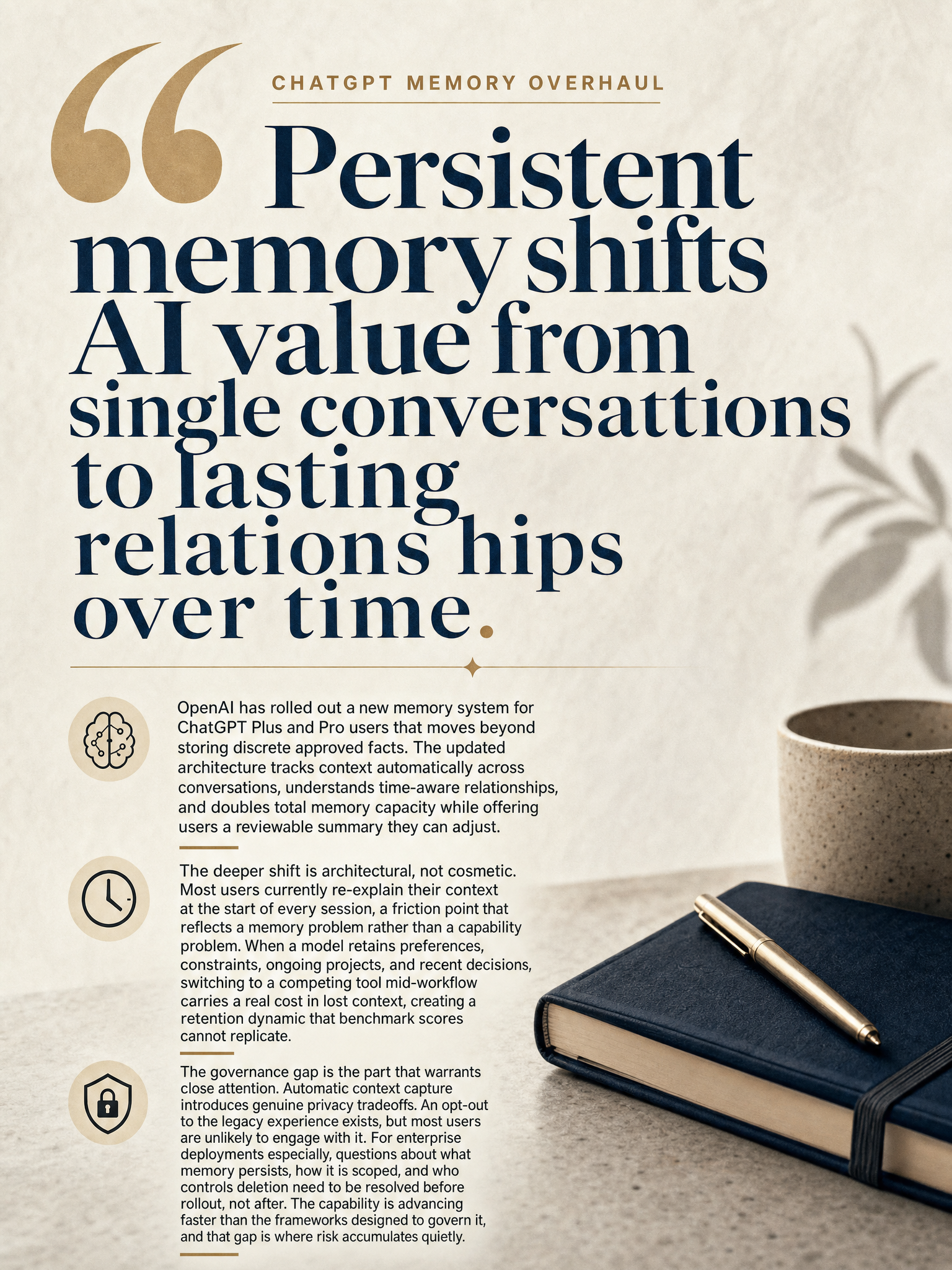
OpenAI launches new ChatGPT memory system with automatic context tracking, time-aware relationships, and 2x memory capacity for Plus and Pro users
ChatGPT Just Got a Memory Upgrade That Actually Changes How the Product Works
Most AI product announcements are noise. A new benchmark score, a slightly bigger context window, a marketing blog post dressed up as a technical deep-dive. This one is different, and I want to explain why I think it deserves more attention than it’s getting in the usual “AI news” cycle.
OpenAI rolled out a new memory system to ChatGPT Plus and Pro users in the US this week. Sam Altman flagged it simply as a “big upgrade to ChatGPT memory.” That undersells it considerably.
Why the Old System Was a Dead End
The original saved memories feature was basically a notepad. You explicitly told ChatGPT something, it stored a discrete fact, and it could recall that fact later. Name, job title, preferred programming language. Fine for party tricks, useless for anything resembling a real working relationship with a tool.
The core problem was that memory was manual and flat. You had to curate it yourself, and it had no understanding of time or changing context. That’s not how useful memory works.
What Actually Changed
The new system tracks context automatically, without you having to flag anything for storage. More interesting to me is the time-aware reasoning piece. OpenAI gave a concrete example worth paying attention to: if you told ChatGPT you were planning a trip in July, the old system would just hold “trip in July” as a static fact. The new system understands that after August, that trip is in the past. It updates context as time moves forward.
That is a fundamentally different architecture for memory. It’s not a lookup table anymore.
They also doubled the memory capacity for Plus and Pro users, and added a memory summary interface where you can review what the system has retained and steer it if something is wrong. That last part matters for trust. Opaque memory is worse than no memory, because you don’t know what false context is shaping your answers.
The Real Problem This Solves
Personalization has always been the missing layer in consumer LLM products. The raw capability numbers keep climbing, but most users still re-explain their context every single session. Who they are, what project they’re working on, what constraints apply. It’s friction that accumulates.
That friction is also why so many power users build elaborate system prompts and paste them in at the start of every conversation. It works, but it’s a workaround for a missing product feature. This new system is OpenAI taking a real swing at solving that structurally.
I’d also note the timing here. Anthropic’s internal data, shared publicly this week, shows Claude is accelerating AI development internally at a remarkable pace, with Anthropic engineers shipping 8x as much code per quarter now compared to their 2021-2025 baseline. The competitive pressure is real. OpenAI shipping product improvements at this pace makes sense in that context.
What I’m Watching
The memory summary and steering interface is the thing I’ll be testing most carefully. The question isn’t whether ChatGPT can now retain more context. It’s whether the retained context is accurate and whether the model actually uses it coherently across sessions without hallucinating details about your past conversations.
Automatic memory is only better than manual memory if it’s more reliable. If the system confidently “remembers” something you never said, that’s worse than starting fresh.
The rollout is US-only for Plus and Pro right now. Users who prefer the legacy system can switch back in settings, which is the right call. Don’t force the behavior on people who’ve built workflows around the old model.
I think this is the most consequential ChatGPT product change since the introduction of custom instructions. Not because the underlying model got smarter, but because it gets closer to the thing AI assistants have always promised to be: a tool that actually knows you.
That promise has been mostly marketing for three years. This is the first version of the feature that has a real shot at delivering on it.
🧠
Sources & Further Reading
#ChatGPT #OpenAI #AIProducts #MachineLearning #ArtificialIntelligence