OpenAI releases 722 math manuscripts from a hidden, withheld frontier model and what the capability-access gap means for builders in production
OpenAI Just Released 722 Math Manuscripts From a Model Nobody Can Use
And I think that’s exactly the point.
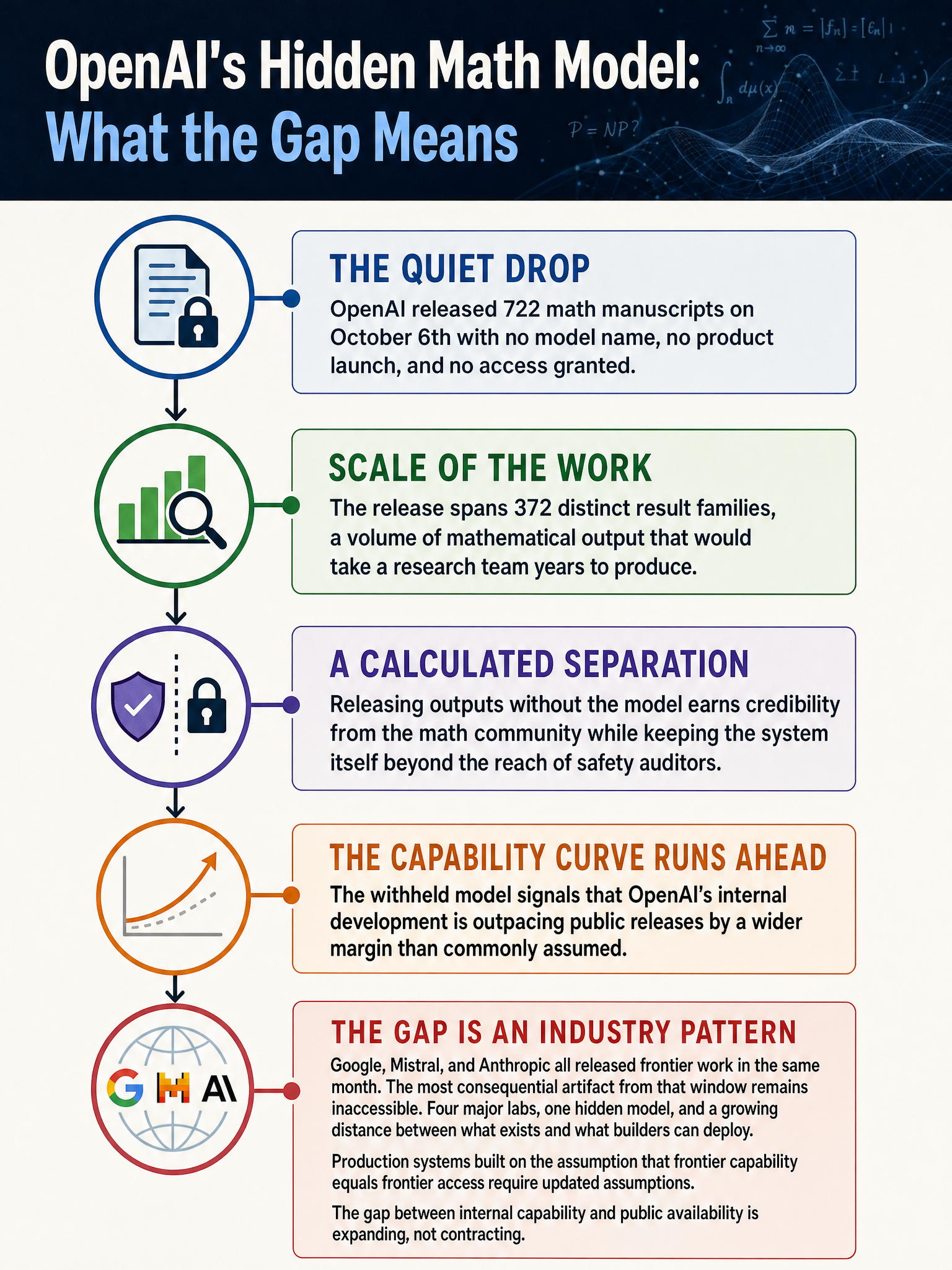
On October 6th, OpenAI quietly dropped something unusual. Not a product. Not a benchmark leaderboard screenshot. They published 722 mathematical manuscripts, organized into 372 distinct result families, backed by Lean formalizations for verification. The work is real. Mathematicians can check it. The model that produced it? Withheld. No name. No weights. No API access.
This is a new kind of move in the AI race, and I don’t think it’s accidental.
The Capability-Access Gap Gets Wider
Here’s what this announcement actually is: a capability signal deliberately separated from access.
OpenAI gets the credibility of the mathematical work without triggering the deployment scrutiny that comes with an actual release. The math community can verify the results. The safety community can’t audit what they can’t touch. Regulators can’t meaningfully evaluate a model they have no access to. That’s a clean separation, and it didn’t happen by accident.
Compare this to what Google DeepMind has done with AlphaProof and AlphaGeometry, which achieved silver-medal-level performance at the International Mathematical Olympiad. That work came with published research, architectural details, and genuine scientific transparency. What OpenAI released on October 6th is closer to a press release dressed in LaTeX.
What 722 Manuscripts Actually Means
Let me put the scale in perspective. 372 distinct result families of mathematical work, formalized in Lean, would take a serious research team years to produce. That’s not hyperbole. Formal mathematics is painstaking. Every logical step has to be machine-verified. The fact that a model apparently churned this out is genuinely significant.
But “apparently” is doing real work in that sentence. The Lean formalizations cover many results, not all of them. That gap matters. Partial verification is not verification. And when the underlying model is hidden, there’s no way to probe failure modes, check for hallucinated steps that slipped past the formalization layer, or understand where the system breaks down.
For builders trying to evaluate whether this technology is ready to integrate into production math pipelines, that’s not a minor detail. That’s the whole question.
What This Means If You’re Building With AI Right Now
I work with production AI systems. The capability-access gap OpenAI is widening here creates a real problem for anyone trying to build something that ships.
You can read about what a hidden model can apparently do. You cannot build on it, test it against your data, measure its failure rate on edge cases, or make architectural decisions around it. Capability announcements without access are not useful to builders. They’re useful for stock prices and press cycles.
Meanwhile, the models you actually have access to, GPT-6 family expansions, Claude Opus 5.5 and Sonnet 5.5 from Anthropic, Gemini 4 Argon from Google, are competing on cost per unit of work and domain-specific performance in areas like coding and cybersecurity. That’s the real product frontier. The hidden math model lives somewhere else entirely.
The Safety Argument Cuts Both Ways
I want to be fair here. There’s a legitimate reason to withhold a highly capable model while still disclosing what it can do. If this system is genuinely frontier-level at formal mathematics, releasing it without careful evaluation could matter. Automated theorem proving at scale has real-world implications that go beyond academic interest.
But the current approach lets OpenAI claim the safety posture without actually demonstrating it. Where is the evaluation framework? What are the risk criteria that would trigger a full release? Until those questions get answered publicly, “we’re being careful” is indistinguishable from “we’re being strategic.”
At a New York City Council hearing on October 5th, AI researcher Jacob Coxon warned that current safety methods designed for narrow applications don’t transfer cleanly to general systems. That’s exactly the right concern. But opacity doesn’t solve it.
The real test of whether OpenAI’s approach here is principled or performative is whether the model ever ships, and what the stated conditions for that decision are. Right now we have neither.
Where This Leaves Us
The 722 manuscripts are real. The capability they signal is genuinely impressive. And the decision to release the outputs while sitting on the model is a calculated one that benefits OpenAI’s credibility without meaningfully advancing the field’s ability to build on this work.
For builders, the practical answer hasn’t changed. Work with what you can access. Evaluate models against your actual use cases. And treat capability announcements without access as marketing until proven otherwise.
The gap between what these labs can build and what the rest of us can use is widening. That asymmetry is the story worth watching.
Sources
#AI #MachineLearning #OpenAI #MathAI #AIEngineering #LLM #AIResearch #BuildingWithAI
Sources & Further Reading
- OpenAI Releases 722 Math Manuscripts From Hidden Model
- Google, OpenAI, Anthropic and Mistral release new frontier models in late September
- AI researcher warns ‘we are racing to build and grow our own adversary’ in NYC Council hearing
- Does Google’s new model catch up to OpenAI, Anthropic at the frontier?