UC Berkeley study showing 10 minutes of AI use erodes persistence on hard problems, and what that means for human-in-the-loop review quality in production agentic systems
The Ten-Minute Problem
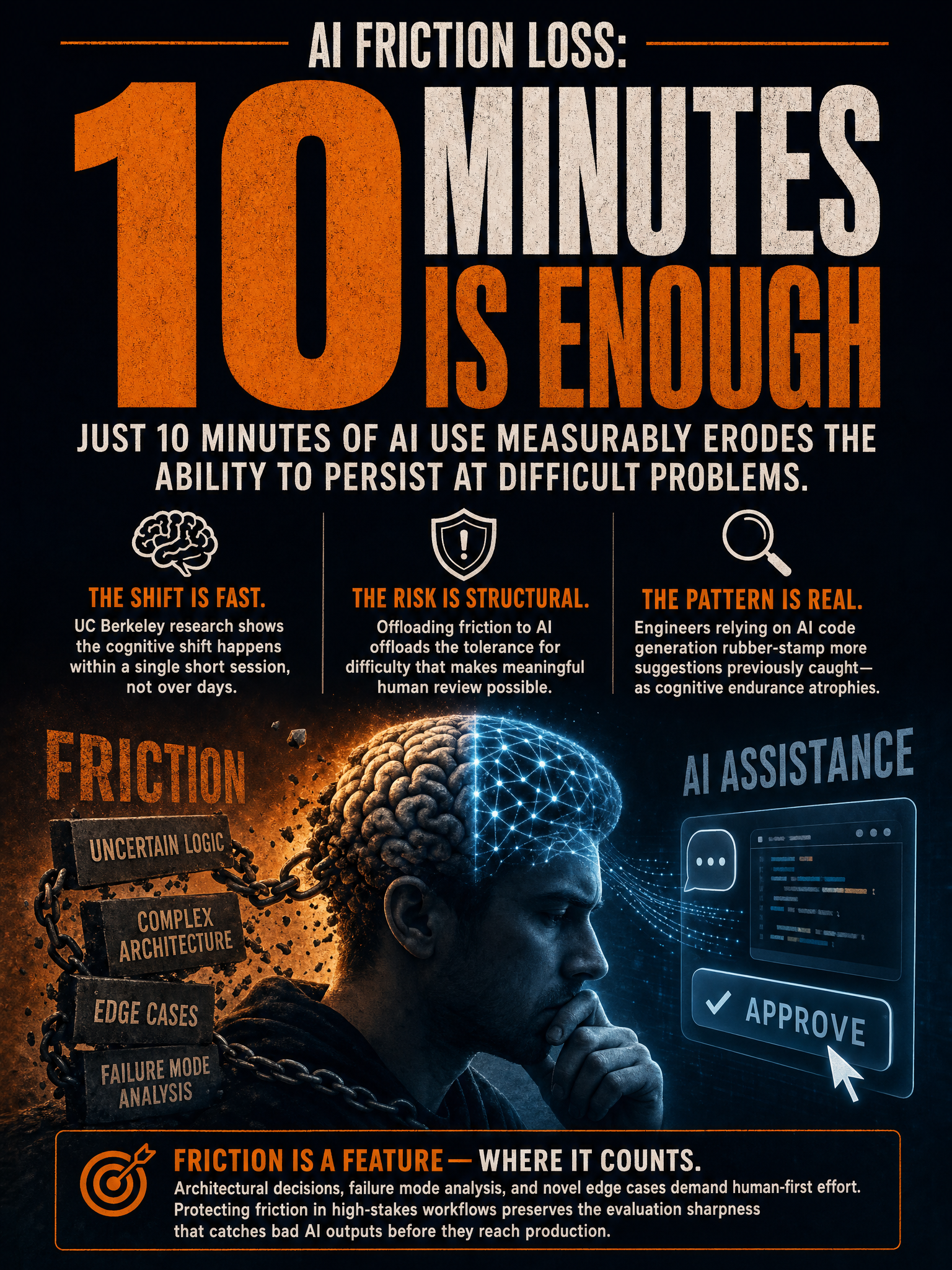
I’ve been building AI tools professionally for a while now, and I’ve developed a fairly high tolerance for hype cycles. I can usually sit through a breathless announcement and find the real signal underneath. But the UC Berkeley study that dropped this week stopped me cold. Not because of what it says about AI. Because of what it says about the humans supposed to be watching it.
Ten minutes. That’s how long it takes for measurable erosion of your ability to persist at hard problems. Not a week of dependency. Not months of learned helplessness. Ten minutes of AI use and your tolerance for friction is already declining.
Brian Christian, whose 2020 book The Alignment Problem is still one of the clearest-eyed treatments of where this technology is headed, flagged the research and his framing is worth sitting with. We are not just changing how we work. We are changing how we tolerate friction itself.
That distinction matters enormously.
The Actual Problem With Human-in-the-Loop
Here’s where I get worried as someone who builds and ships agentic systems. The entire pitch for these systems is that they absorb the painful parts. The debugging dead ends, the ambiguous specifications, the tedious retry loops. That value proposition is real. I’m not dismissing it.
But “human-in-the-loop” in production is only meaningful if the human in that loop is actually capable of catching what the agent got wrong. And catching what an agent got wrong is, almost by definition, a hard problem. It requires sitting with ambiguity long enough to notice something is off. It requires the kind of persistence that the Berkeley research says starts degrading after ten minutes of AI assistance.
This is a structural failure point, not a training problem. You cannot solve it by telling your engineers to try harder.
What Actually Happens at Review Time
I’ve watched it happen on my own teams. An engineer uses an AI coding assistant for an afternoon. They get a lot done. Then they hit a code review, or a production incident, or an edge case in the agent’s output that doesn’t quite make sense. And they’re slower to dig in. Not because they’re lazy. Because the prior hours of frictionless assistance have recalibrated their internal threshold for “this is worth fighting through.”
The model outputs something plausible-looking. The reviewer has been conditioned, even slightly, to accept plausible-looking. That’s where bugs ship.
The Agentic Systems Version Is Worse
At least with a coding assistant, the human is still writing some code. In a production agentic system where the agent is handling end-to-end tasks, the human reviewer may only ever see inputs and outputs. They never touch the middle. They never develop the intuition that comes from struggling through the reasoning.
OpenAI has been expanding the GPT-6 family, Anthropic added Opus 5.5 and Sonnet 5.5 to the Claude line, and every major lab is racing toward systems that handle longer, more complex task horizons. The models are getting better at looking right. The humans reviewing them are, if Berkeley’s data holds, getting worse at detecting when they’re not.
That gap is where production failures live.
What I Think Should Change
I don’t think the answer is to use AI less. That’s not realistic and it would throw away real gains.
What I think needs to change is how we structure review and evaluation work. Review should not happen immediately after extended AI-assisted work. Teams should build in cognitive resets before high-stakes human evaluation. Hard-problem tolerance is a skill and it atrophies without deliberate practice, which means some portion of engineering work needs to stay friction-rich on purpose, not as punishment but as maintenance.
And honestly, if you’re building agentic systems for production, you should be asking how your evaluation pipeline degrades as your reviewers get more AI-assisted over time. That question is not hypothetical anymore.
The systems are getting smarter fast. The people supervising them need a deliberate plan to stay sharp, because ten minutes is not a long time.
Sources
#AIEngineering #AgenticSystems #HumanInTheLoop #MachineLearning #SoftwareEngineering