Meta frontier model launch and Reflection AI Beam 501B release as signals of an expanding frontier model market and what it means for builders in production
The Frontier Is Getting Crowded. Good.
Two major model releases dropped this week, and neither one came from OpenAI or Anthropic. If you’ve been watching this space closely, you already know the market has been shifting for a while. But this week felt different. This week felt like the shift becoming structural.
Meta launched a new family of frontier-class AI models, positioning them directly against the established labs. Same week, Reflection AI released Beam, a 501 billion parameter model built for coding, reasoning, and agent workflows. Two launches. One week. Neither from the companies that have dominated the conversation for the past two years.
Pay attention to what that means.
The Architecture Story Is the Real Story
Beam is getting a lot of “DeepSeek of the West” comparisons, and I understand why. But the headline parameter count misses the more interesting detail. Beam uses a mixture-of-experts architecture, so while the total model is 501 billion parameters, only 23 billion are activated at inference time. That ratio matters enormously for anyone trying to self-host a capable frontier model.
This is not a benchmark stunt. A model you can actually run on your own infrastructure at a compute cost that doesn’t require a venture round to sustain is a fundamentally different product from one you access exclusively through someone else’s API. Reflection is targeting builders who need control over their stack. That’s a real market.
What Meta Brings
Meta’s move is less architecturally novel but strategically significant. They have distribution, open-weight history, and a developer community that the newer labs have to earn. Competing at the frontier level directly against OpenAI and Anthropic signals that Meta is serious about not ceding the high-capability tier to the API-first incumbents.
Combined with the price compression already happening, this matters. OpenAI and Anthropic have both cut model costs as the competitive pressure builds. The Wall Street Journal noted that OpenAI is gaining ground on Anthropic in market share after Anthropic faced repeated outages from Claude Code demand in spring 2026. When the frontier is contested, the incumbents move on price and the challengers move on architecture. Builders win either way.
What Builders Should Actually Do With This
The AWS team put it plainly in their September 2026 builder roundup: model performance is no longer the only question. Customers weigh cost against benefit for their specific use case. That framing is exactly right, and it becomes more true as the model pool expands.
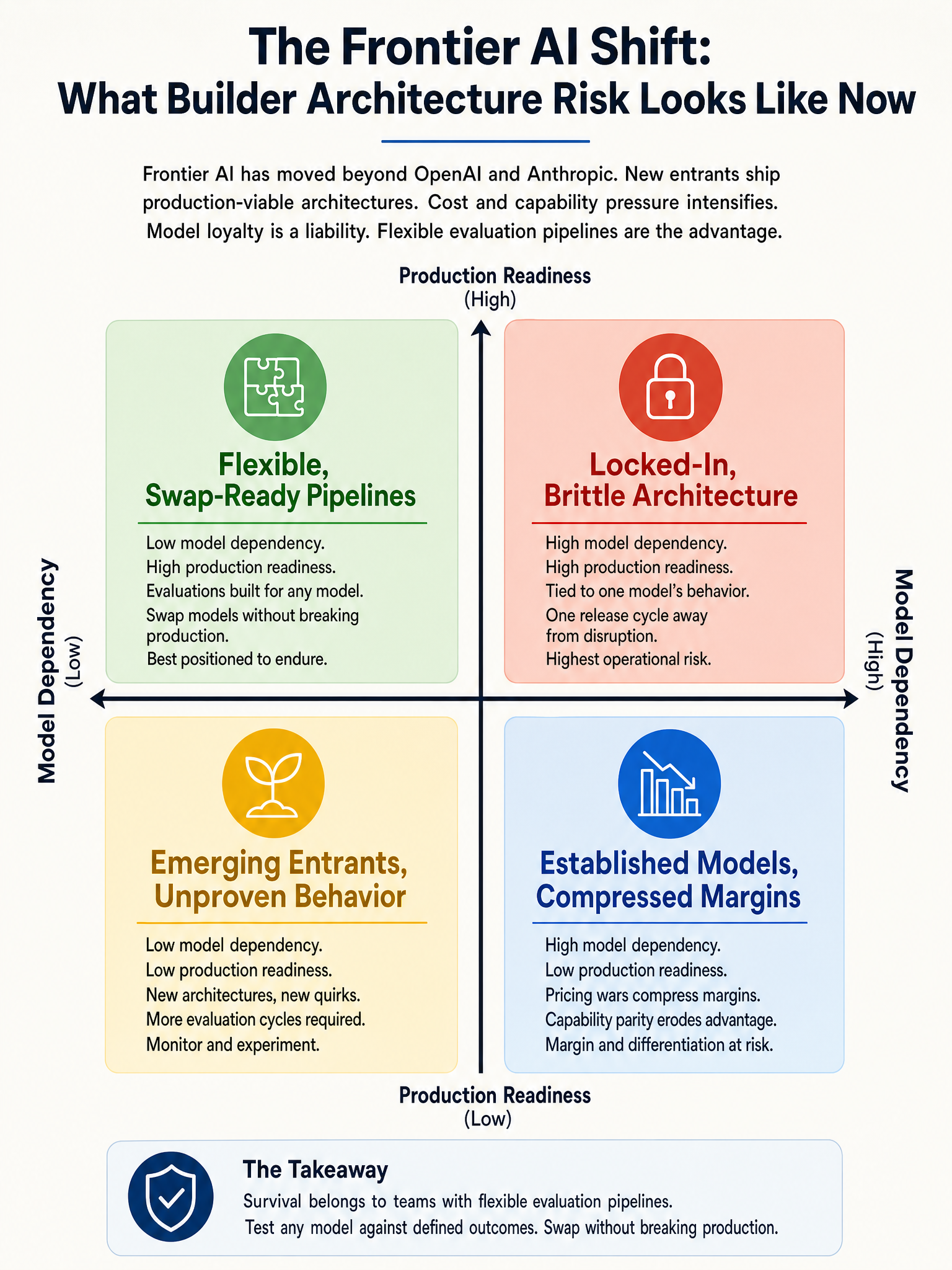
A few things I’d watch. First, Beam is still in final safety testing and on a waitlist. The benchmark story comes before the production story, so verify your own eval before you build a dependency. Second, self-hosting a 501B model is still an infrastructure commitment, even if inference only touches 23B parameters. Understand your hardware requirements before you fall in love with the architecture. Third, with more viable frontier models available, your vendor lock-in risk decreases, but your evaluation overhead increases. That’s a fair trade, but you have to actually do the work.
The Broader Signal
There’s a version of this story where two model releases in one week is just noise in a crowded market. I don’t read it that way. The pattern here is capable models shipping with architectures specifically designed for production deployment outside of the major API providers. That’s a different intent than “release model, publish benchmarks, compete for API revenue.”
The frontier model market is expanding because the economics are expanding. More capable open-weight and self-hostable models mean more builders who can run serious AI infrastructure without the margins going to API providers. That’s not a threat to the incumbents tomorrow, but it’s a structural shift that accumulates.
The next 18 months of production AI decisions will look different from the last 18 because the option set is genuinely wider. Plan accordingly.
Sources & Further Reading
#AI #MachineLearning #LLM #AIEngineering #MLOps #OpenSource #GenerativeAI