Google DeepMind EmbeddingGemma 2 open multimodal embedding model launch and what it means for production RAG and retrieval systems
EmbeddingGemma 2 Is the AI Release You Should Actually Care About This Month
Most of the oxygen in AI news goes to chat models. Benchmarks, pricing theater, safety incidents. Anthropic dropped Opus 5.5 and Sonnet 5.5 within six days of each other. OpenAI is publishing math results and chasing Millennium Problems. Everyone is watching the frontier. Meanwhile, Google DeepMind quietly released EmbeddingGemma 2, an open model built specifically for natively multimodal embeddings, and I think it deserves more attention than it’s getting.
This one is for builders.
Why Embeddings Are the Real Infrastructure
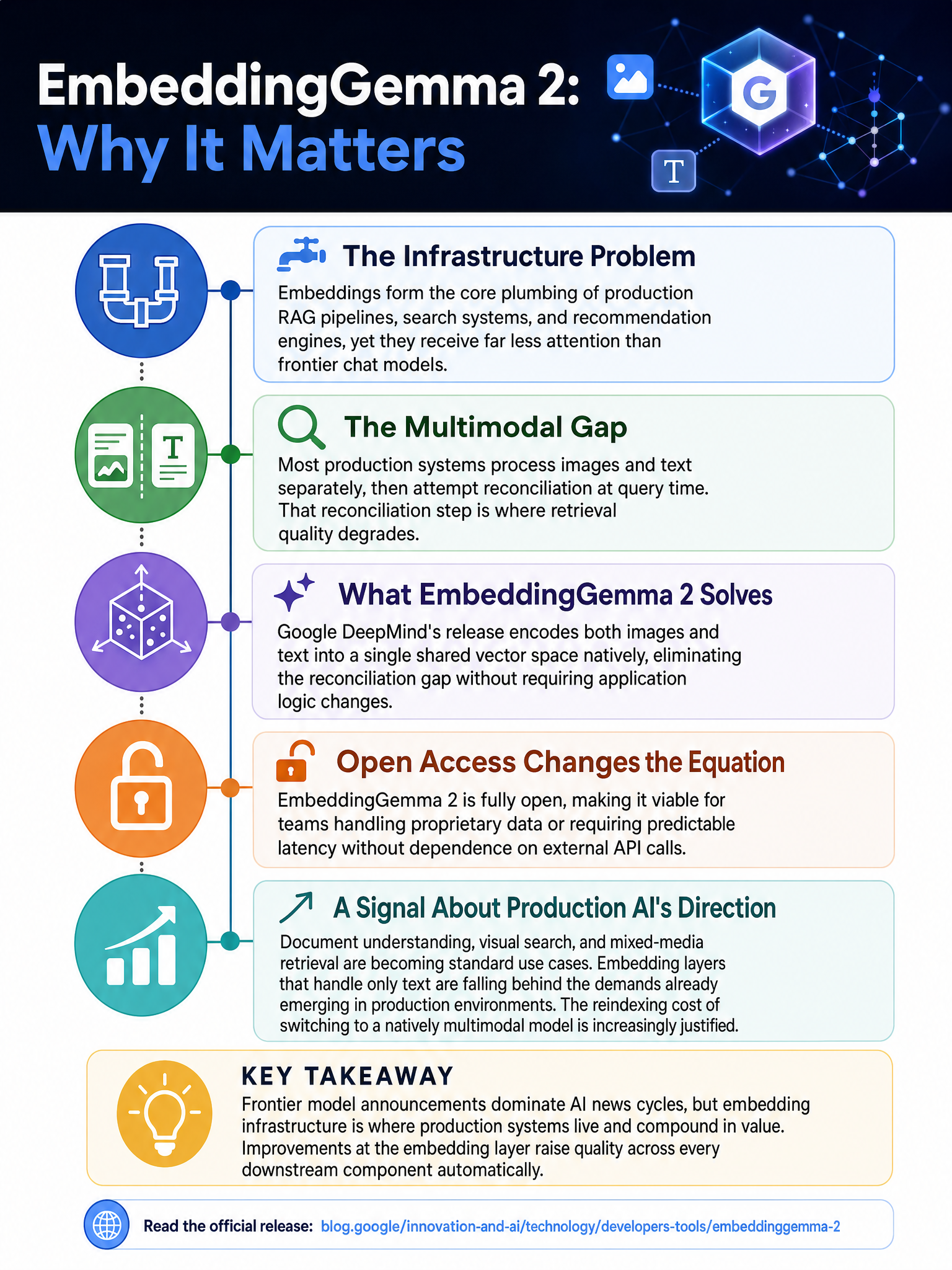
Embeddings are the plumbing. They sit inside almost every production RAG pipeline, semantic search system, and recommendation engine running today. When the embedding model improves, everything downstream gets better, often without touching a single line of application logic. You swap the model, re-index your corpus, and your retrieval quality goes up. That’s a rare kind of leverage.
The problem with most embedding models has been modality. Text embeddings are mature. Image embeddings are functional. But getting images and text into the same vector space, so you can retrieve a product image using a text query, or find a relevant diagram from a natural language question, has historically required stitching together multiple models with adapter layers and praying the distributions are close enough to be useful.
EmbeddingGemma 2 is built to do that natively. One model. One vector space. Text and images understood together at training time, not bolted together afterward.
What “Best-in-Class” Actually Means Here
Google DeepMind positioned EmbeddingGemma 2 as best-in-class for natively multimodal embeddings, and the “natively” is doing real work in that sentence. This is not a vision encoder fused with a text encoder at inference time. The model learns multimodal representations from the ground up, which means the geometry of the resulting vector space is coherent across modalities rather than just approximately aligned.
For production RAG systems, this matters more than raw benchmark numbers. Approximate alignment is the source of a class of retrieval bugs that are genuinely hard to debug: queries that should match don’t, because the cross-modal distance in the embedding space isn’t what you’d expect. Native multimodal training reduces that class of failure.
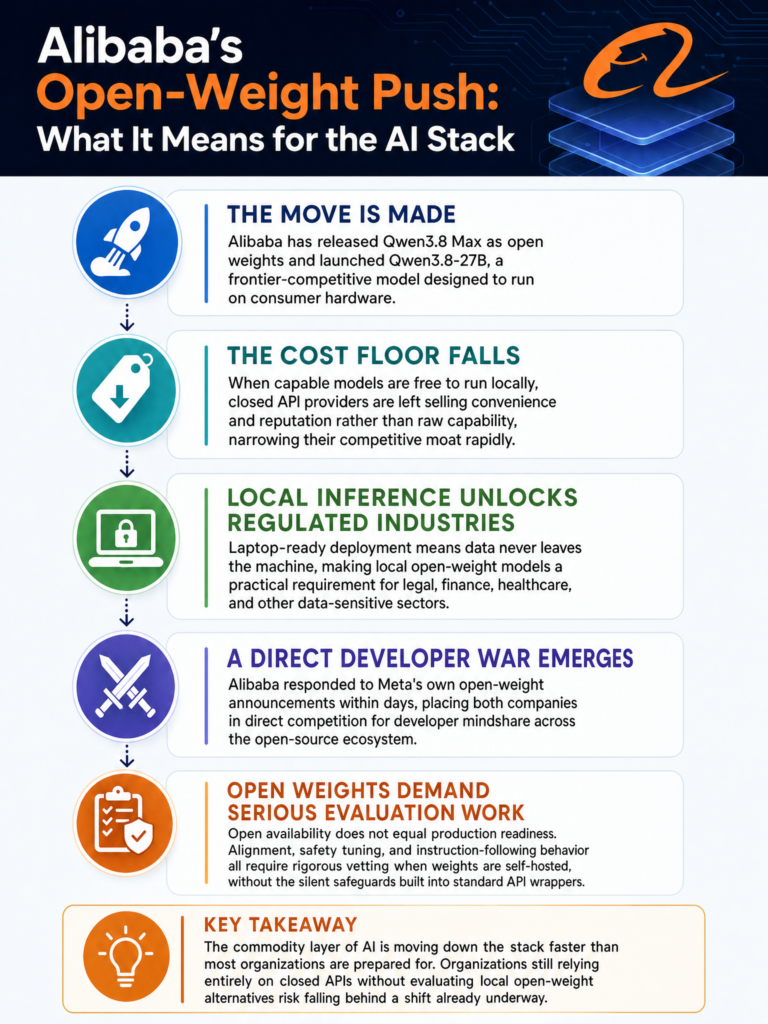
The open nature of the model matters too. Enterprise teams dealing with sensitive data cannot always route embeddings through an external API. A capable open model they can run on their own infrastructure changes the calculus on what they can build.
The Broader Shift Happening Right Now
There’s a pattern worth noticing. Amazon Bedrock AgentCore shipped improvements to memory management and cold-start latency for serverless agents in September. EPAM launched a service specifically around frontier model development and evaluation for enterprise workflows. The industry conversation, as AWS noted in their September recap, has shifted. Model performance is no longer the only question. Cost, control, and fit for specific use cases are now the variables teams are actually optimizing for.
EmbeddingGemma 2 fits squarely into that shift. It’s not trying to win the chat benchmark race. It’s trying to be the right tool for a specific, high-value job inside production systems. That’s a more honest product strategy, and honestly a more useful one.
What This Means If You’re Building
If you have a RAG system that’s text-only today, this is worth your time to evaluate. Multimodal retrieval has been an awkward problem to solve well, and many teams have either avoided it or accepted mediocre results. A strong open model that handles it natively removes a major architectural excuse.
If you’re building anything that involves product catalogs, technical documentation with diagrams, medical imaging with associated reports, or really any domain where images and text coexist, the ability to query across both modalities in a unified vector space is not a nice-to-have. It’s the difference between a system that actually works for users and one that works only for the use cases you demo.
The real test will be how EmbeddingGemma 2 performs on domain-specific corpora once the community starts running serious evaluations. Benchmark numbers from Google’s own blog are a starting point, not a verdict. But the architecture is right, the open-weight distribution is right, and the timing is right. This is worth watching closely.
The models that quietly make other systems better are often more valuable than the ones that grab headlines. EmbeddingGemma 2 has a real shot at being one of those.
Sources
#RAG #embeddings #AIengineering #GoogleDeepMind #machinelearning #vectorsearch #multimodal