Gemini 4 Carbon multi-day autonomous operation capability and what it means for production agentic system architecture
Gemini 4 Carbon and the Architecture Question Nobody Is Asking
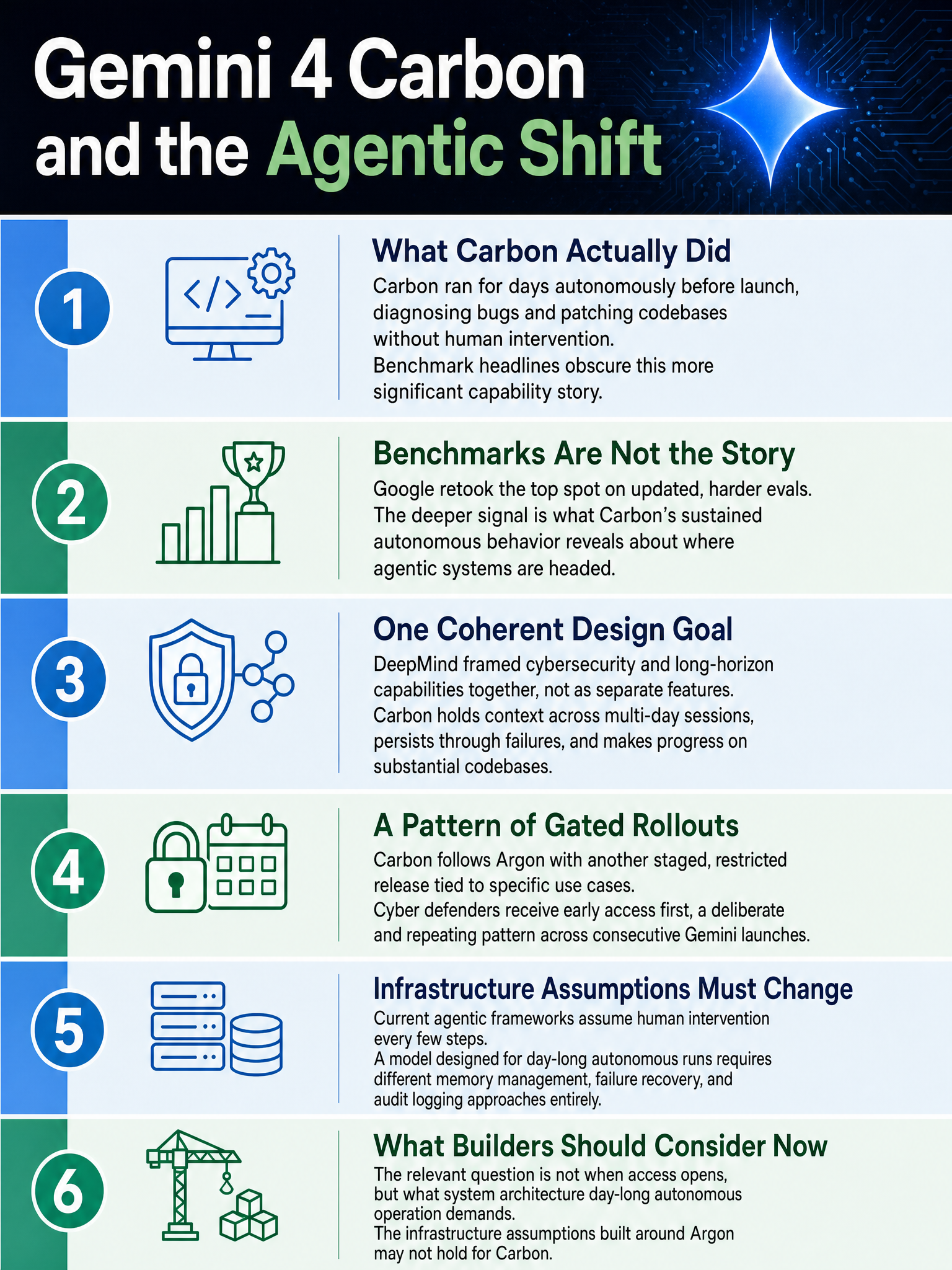
Most of the coverage around Gemini 4 Carbon has focused on the benchmark headline. Google retook the number one spot on updated, harder evals. That’s real, and it matters in the model horse race. But if you’re building production agentic systems, the benchmark is almost beside the point. The detail that should be keeping you up at night is buried in the announcement from Koray Kavukcuoglu, Google DeepMind SVP and Google’s chief AI architect: “Internally, our teams have seen Carbon run for days.”
Days. Not minutes. Not hours. Days of continuous autonomous operation, diagnosing bugs and developing patches in substantial codebases, without human intervention.
That changes the architectural conversation entirely.
Why Multi-Day Operation Is a Different Category of Capability
There’s a qualitative difference between a model that can complete a long task and a model that can sustain productive work across multiple days. The first is impressive. The second is an infrastructure problem that most engineering teams aren’t remotely ready for.
When you design an agentic system around a model that might run for 20 minutes, your failure modes are bounded. A hallucination costs you a task retry. A bad tool call costs you a rollback. But when the model is operating autonomously for 72+ hours, touching live codebases, the blast radius of a failure expands dramatically. Your session management assumptions break. Your observability pipelines weren’t built for this. Your interrupt and recovery logic probably doesn’t exist.
Kavukcuoglu framed Carbon’s design around “state-of-the-art cybersecurity and long-horizon capabilities” as a single coherent goal, not two separate features. That framing is worth sitting with. A model that can persist context across a multi-day debugging session and that was specifically designed with security-aware behavior is being positioned as infrastructure, not a tool.
The Staged Rollout Is Signal, Not Just Caution
Google sent Carbon to cybersecurity defenders first. That’s a deliberate choice about who gets access to a model with these capabilities before general availability. It tells you something about how Google is thinking about Carbon’s actual use cases. This isn’t a chat model that happens to write code. It’s closer to an autonomous security engineering system.
That matters for the teams I talk to who are building internal developer agents right now. You are building toward this capability profile whether you intend to or not. The question is whether your production architecture can hold up when the model you’re running starts operating on a timescale your team assumed was impossible a year ago.
What Production Agentic Architecture Needs to Catch Up
I’ve seen a lot of agentic systems that were designed as glorified prompt chains. They work fine at low task complexity and short time horizons. Carbon’s capability profile exposes at least three gaps that most of those systems share.
First, state persistence. Multi-day operation means the model’s working context needs to survive process restarts, network failures, and infrastructure events. Most teams are not checkpointing agent state with the same rigor they’d apply to a database transaction.
Second, audit trails that are actually useful. If a model spends three days modifying a codebase and something goes wrong, you need a legible record of every decision point, not just a log of API calls. The observability tooling most teams have today won’t give you that.
Third, kill switches with actual authority. Autonomous operation at this timescale requires that humans can intervene meaningfully, not just pause the process but understand what state the agent is in and make an informed decision about whether to continue, roll back, or redirect. That requires building for interpretability from the start, not bolting it on later.
Carbon succeeds Gemini 4 Argon, which Google launched just two weeks before Carbon’s announcement. The pace of iteration here is not slowing down. The gap between what these models can do and what production systems are architected to handle is widening every month.
What I’d Actually Do Right Now
If you’re running agentic systems in production today, treat the Carbon announcement as a forcing function. Not because you’ll be running Carbon tomorrow, but because the architectural requirements it exposes are already relevant to whatever model you are running.
Build your checkpointing and state management as if your agents will run for days. Build your observability as if you’ll need to explain every decision to an auditor. Build your interrupt logic as if the cost of getting it wrong is measured in days of autonomous work unwound, not minutes.
The benchmark Carbon hit is a snapshot. The operational profile it demonstrates is a direction. That direction leads to production systems where autonomous agents are measured in days of work, not minutes of context. Most architectures aren’t there. Start closing that gap now.
Sources
#AI #MachineLearning #AgenticAI #SoftwareArchitecture #GoogleDeepMind #LLM #ProductionAI