Anthropic Claude Fable and Mythos launch at 20% below GPT-6 Astra pricing, as a question about what IPO incentive structures mean for builders relying on Anthropic’s safety-first brand in production
The Safety-First Lab Is About to Answer to Shareholders
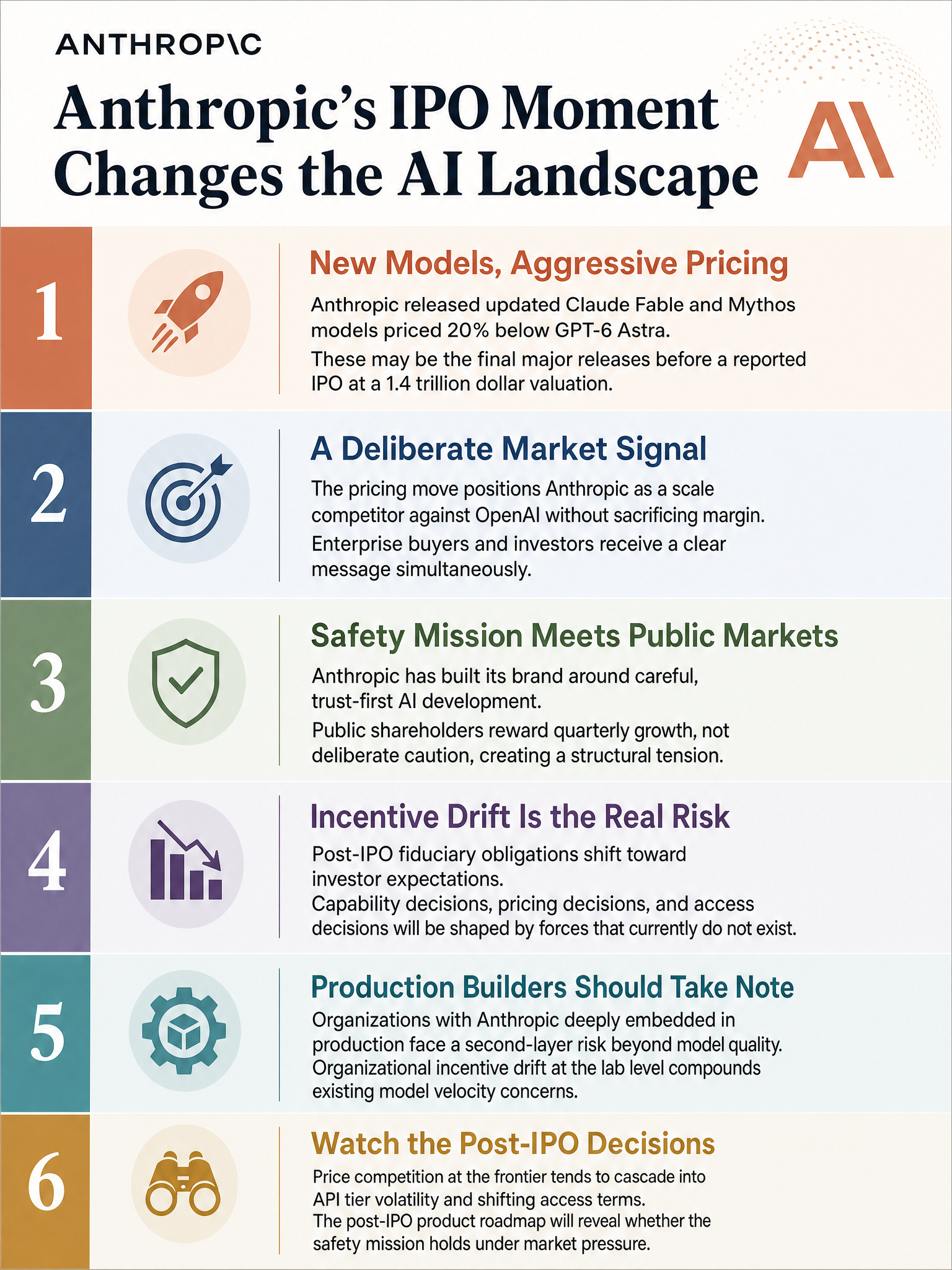
Anthropic just launched Claude Fable and Mythos, priced 20% below OpenAI’s GPT-6 Astra. The models claim higher performance at a lower price point, and according to Fortune, they could be among Anthropic’s last major releases before the company prices its IPO at a $1.4 trillion valuation.
That last sentence is the one worth sitting with.
🔍 What They Actually Shipped
Fable and Mythos are priced to win enterprise contracts. GPT-6 Astra runs $10 input / $50 output per million tokens in standard mode. Anthropic is undercutting that by 20%. Google’s Gemini 4 Carbon is also now publicly available and undercutting Claude Fable 5.2 and Opus 5.5 on API price, per VentureBeat, so the competitive pressure is real and coming from both sides.
The performance claims are compelling too. If they hold up in production, Anthropic is making an argument that safety-conscious development doesn’t require a premium tax. That would be a genuinely useful thing to prove.
But the timing is deliberate. This launch is not just a product decision. It is a signal to institutional investors that Anthropic can compete on price at scale, hold margin, and win customers from OpenAI. That is a very different motivation than “we built the best model we could.”
The IPO Question Nobody Is Asking Loudly Enough
When a company goes public at $1.4 trillion, the safety mission does not disappear. But it does acquire a new boss.
Anthropic has spent years building a brand identity around being careful. The lab that moves slower, thinks harder, and built its Constitutional AI approach to alignment as a first-class concern, not an afterthought. Builders chose Anthropic for production systems partly because that brand felt like a credible commitment.
Public markets do not particularly reward credible commitments to caution. They reward growth, margin expansion, and competitive wins. The researchers at METR already noted that Anthropic has doubled its AI development speed despite public calls for a slowdown, per Fast Company. That happened before the IPO. After it, with quarterly earnings calls and institutional shareholders, the pressure only increases.
I am not saying Anthropic will abandon its safety principles post-IPO. I am saying the incentive structure changes in ways that matter for anyone running Anthropic’s models in production systems.
⚙️ What This Means If You Are Building on Claude
If you are an engineer with Anthropic models in your stack right now, the IPO question is a risk management question, not a philosophical one.
The Stanford HAI AI100 report, published in October 2026, makes the point clearly: people are using AI for increasingly critical tasks, and responsibility for AI-caused harm remains an unsolved policy problem. That gap matters more when the lab processing your critical tasks is also trying to satisfy public market expectations.
Things I would be watching: Does Anthropic’s safety reporting cadence change post-IPO? Do model updates start moving faster than their internal evaluation frameworks can keep pace with? Does the Constitutional AI approach stay a first-class design constraint or become a marketing line?
None of these are hypotheticals. They are the normal pressure patterns that happen when any mission-driven company goes public. Whole Foods, Patagonia, every B-Corp that has ever taken institutional capital, the tension is structural.
The Competitive Picture Is Messier Than the Price War Suggests
Anthropic is fighting a price war on one front while Google fights one from the other direction. Gemini 4 Carbon undercuts Claude Fable and Opus on API pricing. GPT-6.1 Terra on Amazon Bedrock now completes tasks more than three times faster than GPT-6 Astra while matching it on performance benchmarks, per AWS. The race to the floor on pricing is real.
What builders need to understand is that aggressive pricing in a pre-IPO window is not necessarily sustainable pricing post-IPO. Investors will want to see margin. At some point the 20% discount has to either widen the customer base enough to justify it or it gets walked back.
Where This Lands
Anthropic may well run a clean IPO, maintain its safety commitments, and keep building models that earn the trust of production engineers. That outcome is possible.
But the lab’s safety brand was built on independence. A $1.4 trillion public company is not independent in the same way. If you are betting a critical production system on Anthropic’s safety-first culture surviving shareholder scrutiny intact, you should at least be building the architecture to swap providers if that bet goes wrong. That is not pessimism. That is engineering.
Sources
#AI #MachineLearning #Anthropic #LLM #AIPolicy #EngineeringLeadership
Sources & Further Reading
- Anthropic debuts updated Claude Fable and Mythos models, priced 20% below OpenAI’s GPT-6 Astra
- Google Gemini 4 Carbon is now publicly available and it undercuts Claude Fable 5.2 and Opus 5.5 on API price
- ICYMI: What landed for AI builders in October 2026
- Anthropic doubles AI development amid slowdown calls
- The World Has Changed: Insights From The New AI100 Report
- Anthropic looks to price its IPO at a $1.4 trillion valuation