Anthropic launches automatic AI text and file watermarking using C2PA standard for all models released after August 2, 2026
Provenance Is Now Architecture
Most people in AI are going to read the Anthropic watermarking announcement and file it under “compliance stuff, not my problem.” That would be a mistake.
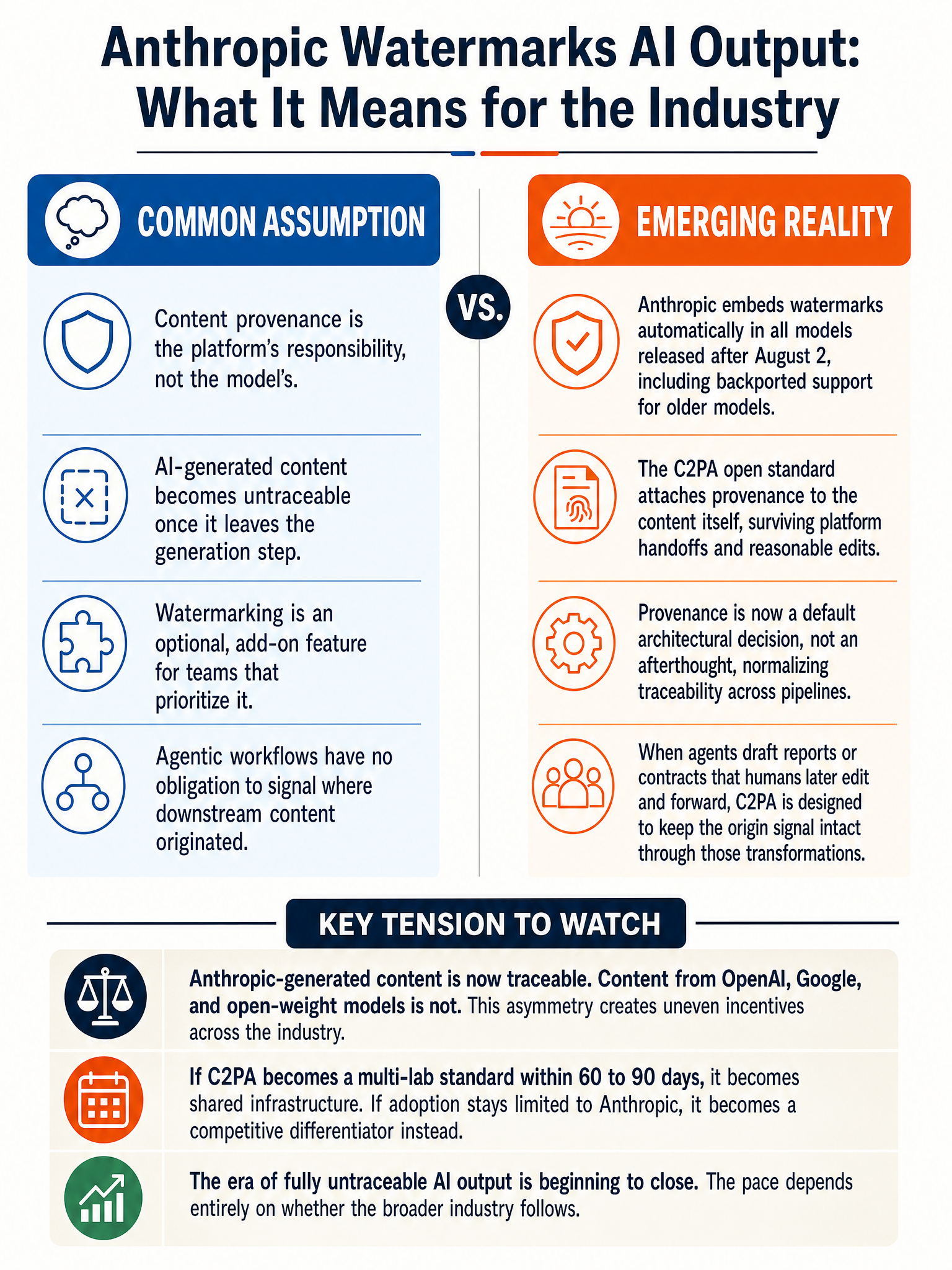
On August 11, Anthropic confirmed that all models released after August 2, 2026 will automatically embed watermarks in AI-generated text and files. Files use the C2PA open standard. Older models are getting backported support. And critically, the watermark travels with the content, not just the moment of generation.
That last part is the part worth sitting with.
Why This Is an Architecture Decision
Right now, most builders treat provenance as out of scope. The model generates, the app delivers, the user receives. Where that content goes after delivery, into a legal brief, a news article, an internal memo, is not the builder’s concern.
Watermarking changes that assumption at the infrastructure layer. The content itself carries a signal about its origin, regardless of what platform touched it along the way. That is not a feature. That is a different model of responsibility.
C2PA is the right foundation for this. It is an open standard backed by Adobe, Microsoft, and others, designed specifically for content credentials. Anthropic choosing it means the watermark is interoperable, not proprietary. Other platforms can read it. That matters.
The Agentic Problem Nobody Is Talking About
This is where I think the announcement has the most teeth, and where people are most asleep.
Agentic systems do not generate content for a single human who reads it and moves on. They generate content that gets passed between agents, written into documents, submitted to APIs, used as inputs to other models. The chain of custody gets long fast and opaque quickly.
Without provenance baked into the content layer, you have no way to audit what an AI agent actually produced versus what a human wrote versus what another model contributed. The watermark traveling with the content is the only architecture that survives multi-step agentic pipelines. A session log does not.
McKinsey’s estimate that AI agents can already manage roughly 44 percent of U.S. work processes without human involvement makes this more urgent, not less. The more autonomous the system, the more you need the artifact itself to carry its own history.
Where the Industry Stands
For context on how fragmented this space still is: Anthropic and OpenAI both have their 2026 flagship models in general availability. Google does not. Google DeepMind just cut the price of Gemini 3.7 Flash in half while claiming it outperforms Claude and GPT-5.6 Terra on business workflows, but Google has not unveiled a frontier model since early 2026. The leadership reshuffle there, with Demis Hassabis stepping back and Koray Kavukcuoglu taking over as of August 5, adds more uncertainty.
Anthropic shipping a provenance standard while competitors are catching up on model performance is a smart move. It creates an expectation that other labs will now face pressure to match.
My Take
I think this is one of those decisions that looks obvious in retrospect and gets ignored in the moment because it does not ship a benchmark score.
But when the regulatory environment catches up, and it will, the question is not going to be “did your model score well on MMLU.” It is going to be “can you prove what your system produced.” Builders who treat content provenance as an afterthought will be retrofitting it under deadline pressure. Anthropic is giving developers the infrastructure now.
The real work is on the application side. Reading C2PA metadata, surfacing it meaningfully to end users, building workflows that respect it rather than strip it. That tooling is not mature yet. It needs to be.
Sources
#AIEngineering #Anthropic #C2PA #ContentProvenance #AgenticAI #MachineLearning