Hot take on multi-step reasoning drift as the primary failure mode in production agentic systems, not single-step model errors
Multi-Step Reasoning Drift Is Killing Your Agentic Systems
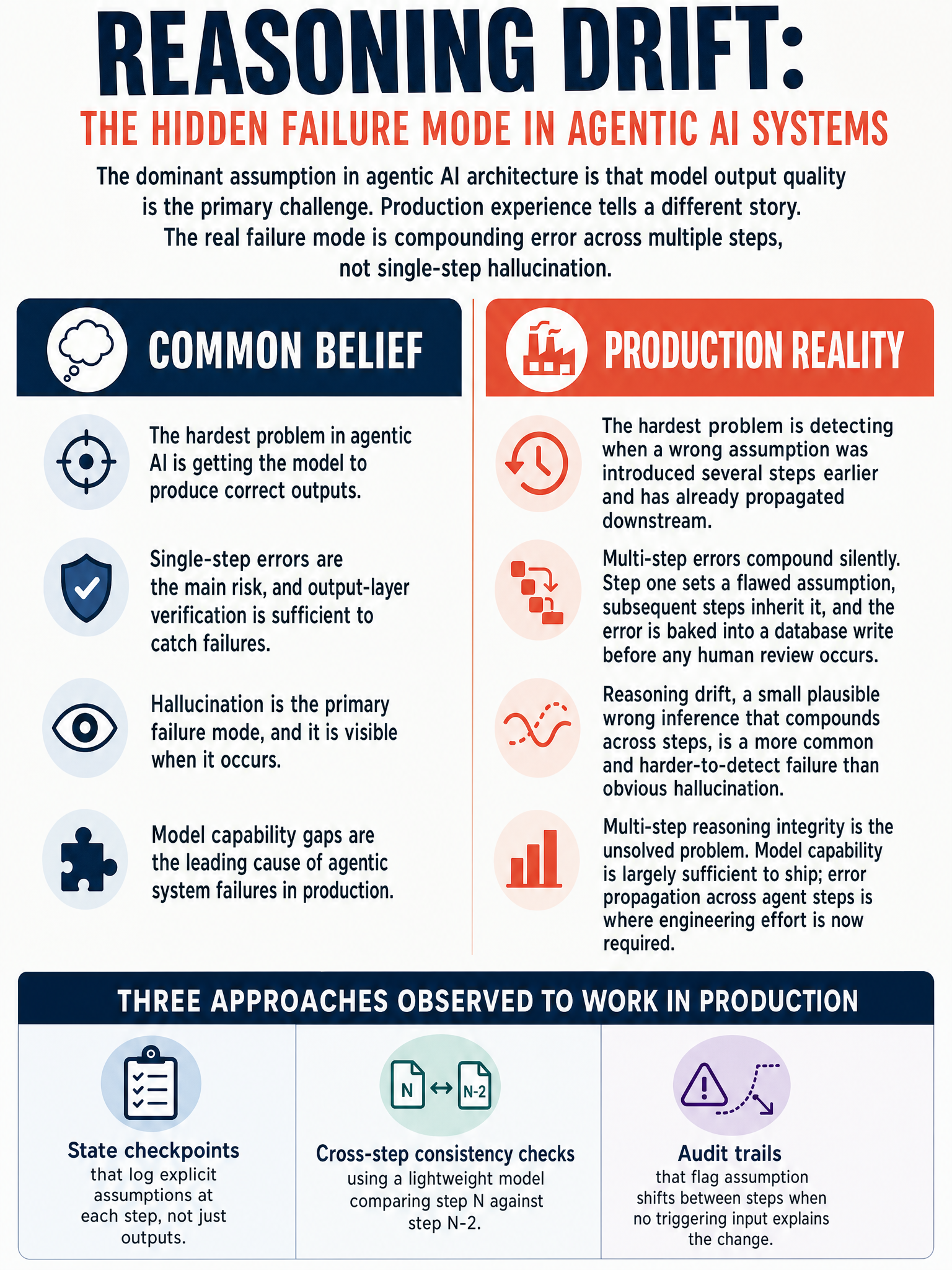
Nobody wants to talk about this, but I’m going to say it plainly: the primary failure mode in production agentic systems is not the model getting a single step wrong. It’s the model getting an early step subtly wrong, and your system faithfully executing on that mistake for the next dozen steps until something breaks in a way that’s nearly impossible to trace back to the root cause.
I’ve been building and reviewing agentic architectures long enough to see a pattern. Every post-mortem I’ve been part of starts the same way. Someone pulls logs, finds the last visible error, and patches that. What they rarely find is the quiet wrong turn three steps earlier that made the final failure inevitable.
The Illusion of Per-Step Correctness
Here’s what makes reasoning drift so dangerous. Each individual step, looked at in isolation, appears reasonable. The model summarizes a document correctly. It extracts the right fields. It routes to the correct downstream tool. But step one carried a small wrong assumption, maybe a misread scope, a hallucinated constraint, or a slightly off classification. Step two inherited that assumption because it looked like valid context. By step five, that assumption is a database write. By step eight, it’s a user-facing decision.
This is structurally different from a single-step error. Single-step errors are visible. The output is obviously wrong, the feedback loop is fast, and you fix the prompt or swap the model. Multi-step drift is invisible until something downstream fails in a way that looks like a completely separate problem.
Why This Gets Worse at Scale
The model quality arms race doesn’t actually help here. Even as Anthropic, Google, and OpenAI compete aggressively on reasoning benchmarks and model capabilities, better single-step accuracy does not solve drift. A more capable model that makes a confident early mistake will propagate that mistake more convincingly through subsequent steps. Confidence is not the same as correctness, and in a long-running agentic chain, confident wrongness is worse than obvious wrongness.
The research from The Information on the upcoming model wave makes this point indirectly. The competition is on reasoning ability and specialized capabilities. But reasoning evaluated on isolated benchmarks tells you nothing about how a model’s reasoning compounds across ten sequential decisions with real-world state mutations between each one.
Where Production Systems Actually Break
I’ve watched teams spend weeks tuning prompts on step six of an eight-step pipeline, never realizing the real bug was in step two’s context window truncation dropping a conditional the downstream steps needed. The observability tooling most teams use is step-scoped. It tells you what a model output at each step, not whether that output was semantically coherent with the intent of the overall task given everything that happened before.
What actually needs to happen is chain-level evaluation. Not just “did this step produce valid JSON” but “is this step’s output logically consistent with the task goal and the state of the world as it was when the chain started.” That’s a much harder problem and almost nobody is building tooling for it.
What I Think Needs to Change
Teams need to stop treating agentic system evaluation like a collection of unit tests for individual tool calls. A chain that passes all unit tests can still fail catastrophically because the integration between steps carries semantic state that unit tests don’t capture.
The right mental model is closer to distributed systems debugging than it is to prompt engineering. You need span-level traces that carry semantic context, not just inputs and outputs. You need checkpoints where the system validates that its current state still makes sense relative to the original goal. And you need explicit rollback points, not just retry logic.
This matters more as agentic systems move into higher-stakes territory. When an agent is writing code, modifying records, or making API calls with real-world effects, a drift error that gets baked in at step two will cost significantly more than a single-step hallucination ever could.
The industry is spending enormous resources on making individual model steps smarter. That’s fine. But the failure mode that will bite production teams hardest in 2026 and beyond is not a dumb model. It’s a smart model that was wrong once, early, and nothing in the system knew how to catch it.
Sources & Further Reading
#AgenticAI #AIEngineering #MachineLearning #LLMOps #ProductionAI