Microsoft reorganizes reporting structure into two segments centered on Agents and Infra, signaling AI as core operating model rather than product feature
Microsoft Just Reorganized Itself Around AI. Here’s Why That’s Not a PR Stunt.
Most people are going to read Microsoft’s latest restructuring as a headline-grabbing signal. A rebranding exercise dressed up as strategy. I think that reading is wrong, and I think it matters quite a bit why it’s wrong.
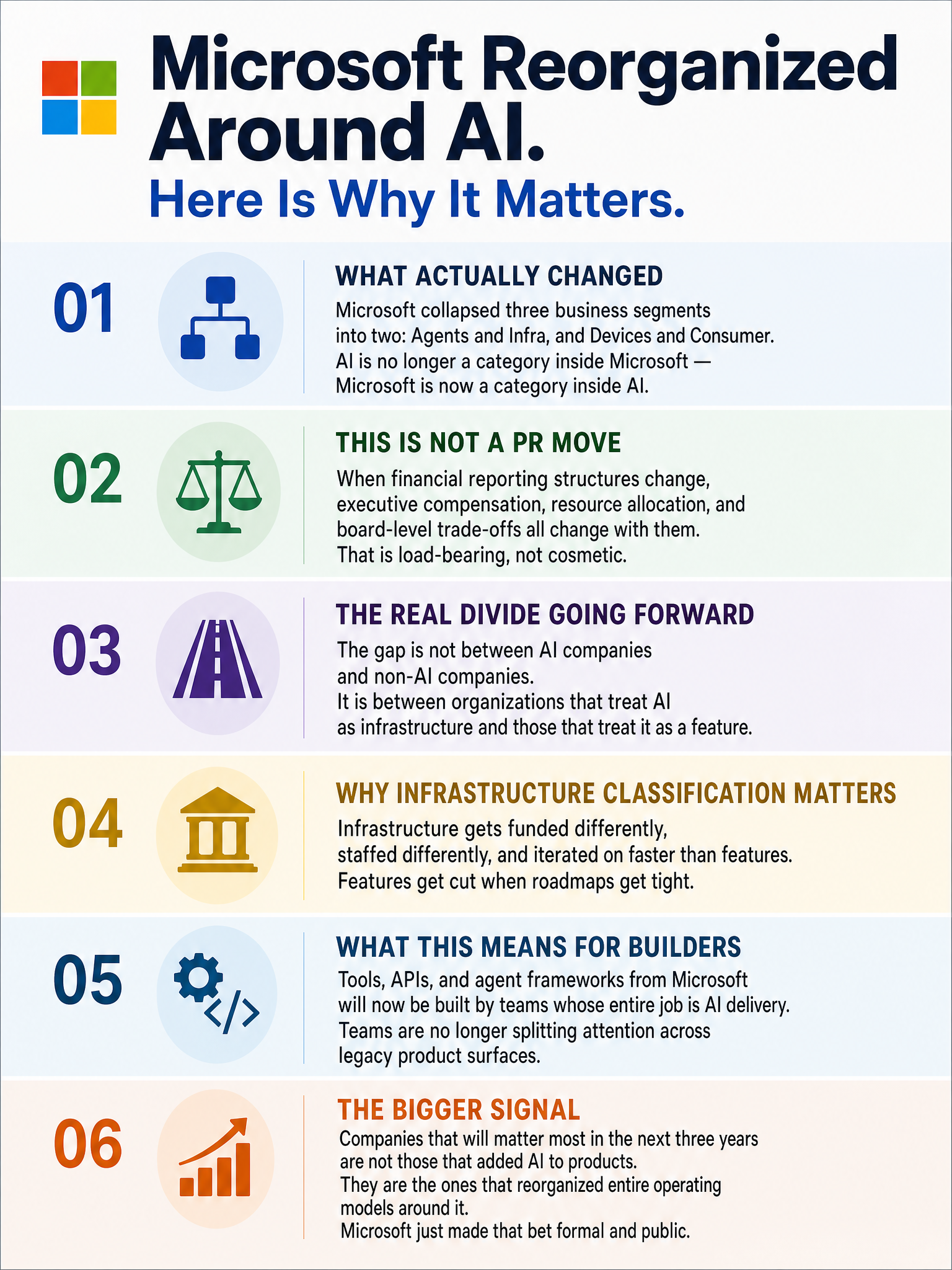
Microsoft just collapsed its three business reporting segments into two: Agents and Infra, and Devices and Consumer. That’s not a product announcement. It’s a fundamental change to how the company accounts for itself.
Why Financial Structure Is the Real Signal
When a company changes how it reports segments, it changes how executives get compensated, how capital gets allocated, and how trade-offs get made at the board level. Financial structure is where strategy becomes real. Everything else is a press release.
The old structure had AI woven through multiple product lines as a feature layer. The new structure treats AI, specifically agents and infrastructure, as the operating core around which everything else orbits. That inversion is the news.
Microsoft’s previous three segments are gone. Two remain. The first and primary one is named after agents and infrastructure. Not “cloud.” Not “productivity.” Agents.
That tells you something.
What “Agents” as a Segment Actually Means
The word agent is doing a lot of work in the industry right now. Everyone is using it. But when Microsoft names a financial reporting segment after the concept, they’re not being metaphorical.
They’re betting that agentic AI, systems that take autonomous multi-step actions rather than respond to prompts, is the durable revenue model. Not Copilot as a chat interface bolted onto Word. Agents as the primary unit of work, billed and tracked accordingly.
This is worth watching against what’s happening in the broader market. Anthropic just pushed out changes specifically designed to stop AI agents from behaving unpredictably when deployed at scale, per CSO Online. Google launched Gemini 3.8 Flash this week, positioning it as infrastructure for scaling AI agents cost-effectively. OpenAI is preparing a model called Astra, which TechCrunch reports is the first model to meet their own “critical cybersecurity threshold,” with stringent deployment controls built in precisely because autonomous capability requires guardrails.
The pattern is consistent. Every major lab is treating agents as the next deployment frontier, not just a research curiosity.
The Competitive Context Right Now
The timing of Microsoft’s restructuring is not accidental. Google is directly challenging on price and performance. Gemini 3.8 Flash launched this week with Google claiming it matches larger Anthropic and OpenAI models at lower cost. Claude Fable 5.1 dropped with meaningful improvements in coding and scientific research according to reporting out of South Korea’s Chosun.
The model tier is commoditizing fast. What isn’t commoditizing is the infrastructure, the tooling, the enterprise trust layer, and the agent orchestration stack. Microsoft just told you with their org chart exactly where they’re placing their bet.
What This Means for Builders
Here’s my honest take. The companies that matter most in the next three years are not the ones with the best base model. That race is effectively a capital war between a handful of players. The companies that matter are the ones building durable workflow integrations on top of agent infrastructure.
Microsoft’s restructuring signals that the enterprise distribution advantage is about to be pointed entirely at agentic workflows. That changes the calculus for every startup building in that space. You are no longer competing with a product feature. You are competing with a reporting segment.
That is a different kind of pressure.
The builders I’d pay attention to right now are the ones designing for agent-to-agent orchestration, building trust and auditability into their systems from day one, and not assuming that whatever the leading model is today will still be leading when they ship. Microsoft just made it structurally harder to ignore that the platform war is already underway.
The companies that treat this as background noise will notice the shift when it’s already too late to position around it.
Sources
#ArtificialIntelligence #MicrosoftAI #AIStrategy #AgenticAI #MLEngineering