Question: Sam Altman’s personal shift to voice-first ChatGPT use and what it means for builders optimizing for text input layers
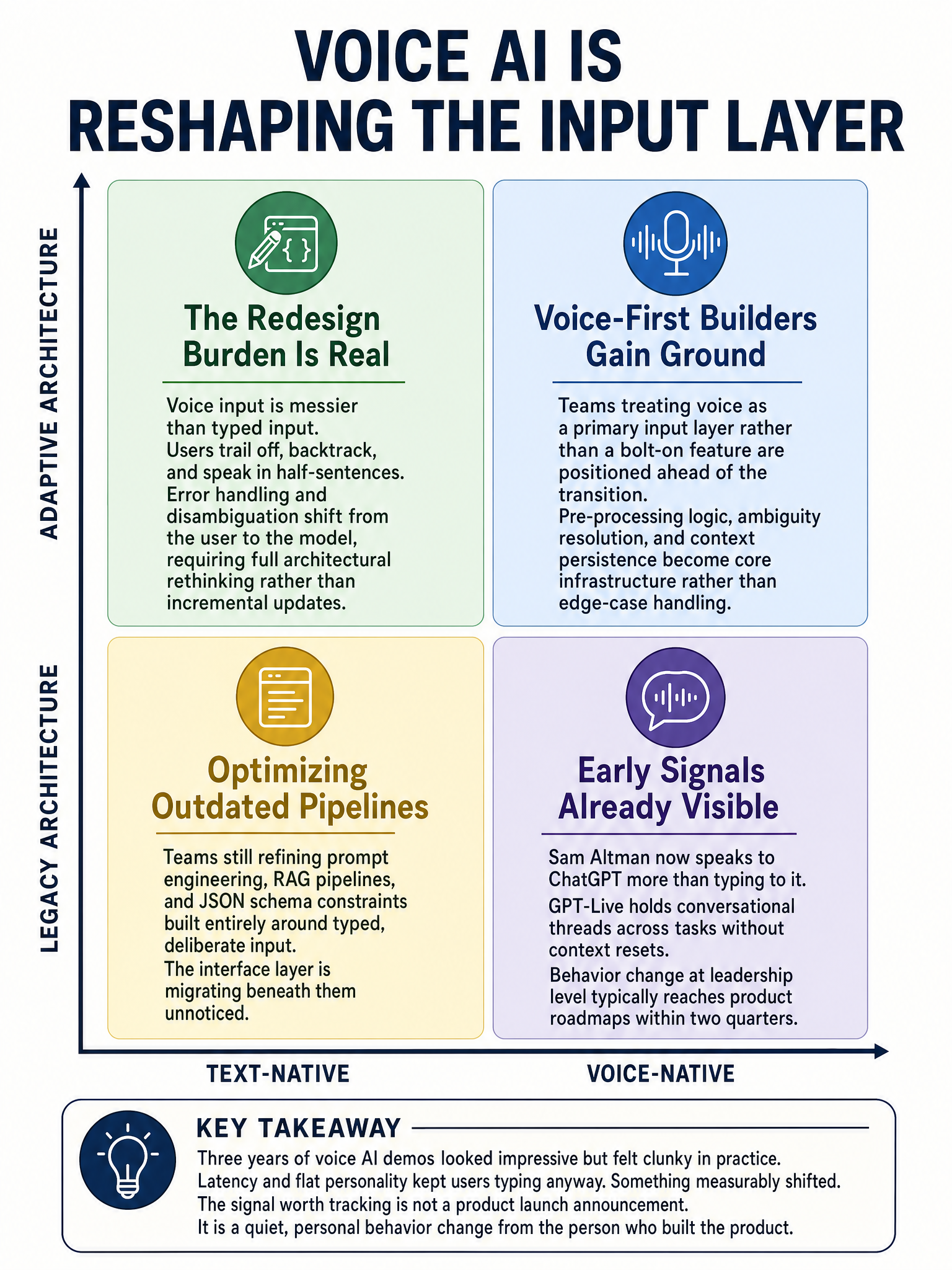
Sam Altman said something last week that I keep coming back to. Not a product announcement, not a benchmark claim. Just this: “i talk to chatgpt more than i type to it at this point. new voice model really crossed a threshold.”
That’s 14,000 likes and counting. And it matters more than most press releases I’ve read this year.
When the person who built the thing tells you they changed how they use it personally, that’s a behavioral signal. Not a marketing one.
The Threshold Problem With Voice AI
I’ve been watching voice interfaces for three years. Every demo looked good. Every real-world integration felt off. The latency was always slightly too long. The personality was always slightly too flat. You’d pull out your phone, start talking, wait, get a response that felt a bit canned, and just type the next thing because it was faster and more reliable.
That friction was the ceiling. And it held for a long time.
Something shifted recently and I felt it too, before Altman’s tweet even dropped.
What GPT-Live Actually Changed
The new GPT-Live model isn’t just faster. OpenAI described it this week as being able to “keep a conversation going while helping with multiple tasks at once, like checking flights, pulling up local weather, and shaping an itinerary in real time.”
That sounds like a feature list until you actually use it. The difference is thread continuity. The model holds context mid-sentence while you change your mind, add a constraint, or backtrack. That’s the part that always broke. Previous voice modes felt like a series of fresh prompts wearing a conversational costume. This one actually follows you.
The latency isn’t just lower. It’s predictable enough that your brain stops bracing for the gap.
What This Means for Builders Optimizing Text Input
Here’s where I get direct, because I think most builders are sleeping on this.
A huge portion of current AI product architecture is built around text as the primary input layer. Chat boxes, prompt editors, structured form inputs that feed into a model call. That’s the stack most teams have optimized. That’s where the UX investment went.
If Altman’s behavioral shift is early signal of a broader one, and I think it is, then the text input box is not the durable interface primitive people are building around. It’s a transitional one.
This doesn’t mean voice replaces text everywhere. Long-form writing, code editing, structured data entry. Text wins those. But exploration, planning, brainstorming, navigation, customer support flows? Voice is going to eat those faster than most product teams are planning for.
If you’re building an AI product right now and voice isn’t in your roadmap for 2025, you should have a clear reason why, not just inertia.
The Signal Nobody Is Talking About
Altman also tweeted this week that usage of agentic products like Codex and ChatGPT Work is up 2.5x in the last week. GPT-5.6 Sol is growing fast enough that he flagged potential infrastructure hiccups, and the inference team is doing what he called “heroic work” to keep up with demand.
That’s a system under real load. And voice adds a different kind of load because it’s session-oriented and latency-sensitive in ways that batch text isn’t. The infrastructure implications are non-trivial.
For builders, that means voice-first features aren’t just a UX decision. They’re an architectural one.
Where I Land
The voice threshold got crossed. Not for everyone, not for every use case. But when the person running the company changes their own daily behavior, that’s not a demo. That’s a product finding product-market fit at the top of the org chart.
If you’re still designing AI products where voice is an afterthought or a stretch goal, I’d rethink that timeline. The window where text-first gives you a moat is closing faster than the roadmaps I’m seeing from most teams reflect.
The builders who treat voice as a first-class input now will have the reps when it matters. Everyone else will be retrofitting.
Sources
#AIproduct #voiceAI #ChatGPT #buildinpublic #LLM #productdesign #OpenAI