xAI Voice Agent Builder launch: single-stack voice agent platform with Grok Voice at $0.05/min
The Ugly Truth About Voice AI Stacks (And Why xAI’s New Platform Might Fix It)
If you have ever built a production voice agent, you know the specific kind of 3am dread that comes with it. Not the “did I push bad code” dread. The “which of my three vendors broke and who do I blame” dread. xAI just shipped something that is aimed directly at that problem, and I think it deserves a closer look than the pricing headlines are getting.
The Three-Vendor Nightmare
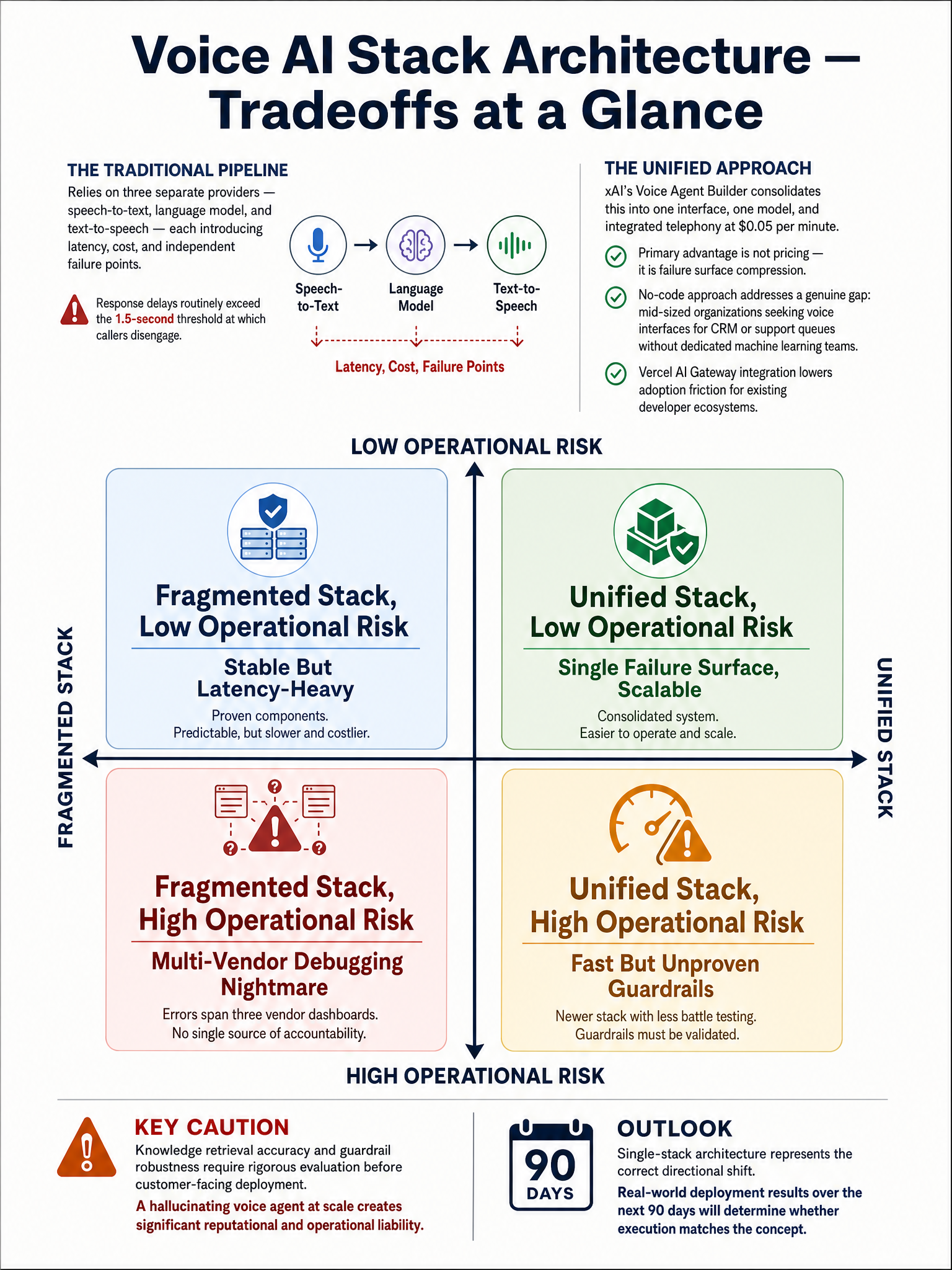
Voice AI has been a duct-tape operation for years. Speech-to-text from one provider. Language model from another. Text-to-speech from a third. Each hop adds latency, adds cost, and adds a new failure surface that you are personally responsible for monitoring, even though none of the vendors are talking to each other.
When something goes wrong, and it will, the debugging process is miserable. Did the transcription mangle the caller’s input? Did the model generate a confusing response? Did TTS mispronounce a product name and throw off the whole conversation? You are chasing ghosts across three dashboards from three teams who each have incentives to blame the others.
This is the actual problem xAI’s Voice Agent Builder is positioning against.
What They Actually Shipped
xAI announced Voice Agent Builder this week in beta, priced at $0.05 per minute, with a free phone number included on every account. According to the announcement, it is built around Grok Voice as a single unified model rather than a pipeline of separate components.
The platform comes with telephony, knowledge retrieval, tools, guardrails, and observability baked in. You can also bring your existing phone numbers, APIs, and MCPs if you have them. The no-code interface means teams without deep ML infrastructure can spin something up without building from scratch.
That $0.05/min price point is notable. Stitched stacks with comparable quality can run $0.10 to $0.20 per minute once you add up STT, LLM tokens, and TTS costs across providers. So this is not just simpler. It is cheaper on the face of it.
The Real Unlock Is Failure Surface Compression
I want to be direct about this because I think most of the coverage is focusing on the wrong thing.
The price matters. But the architecture matters more.
When you run everything through one model on one platform, you get one log, one failure mode taxonomy, and one vendor to call. Observability becomes tractable. Latency drops because you eliminate handoff overhead between pipeline stages. And when something breaks, the debugging path is actually navigable.
xAI put it plainly in their own launch thread: “Every hop adds cost, latency, and new failure modes.” That is not marketing. That is just an accurate description of every multi-vendor voice pipeline I have ever seen in production.
The single-stack approach also means the model can be trained end-to-end on voice tasks rather than having components optimized independently for their narrow slice of the problem. That is a real architectural advantage that shows up in conversation quality, not just in cost spreadsheets.
Where I Would Push Back
Beta is beta. The observability tooling and guardrails they are describing sound solid on paper, but “baked-in observability” on a brand-new platform means you are trusting xAI to surface the right signals. With a multi-vendor stack, you at least have the option to instrument each layer yourself.
There is also the vendor lock-in question. Consolidating onto one platform means your entire voice operation depends on xAI’s uptime, pricing decisions, and model quality trajectory. That is a reasonable trade for most teams right now, but it is a trade.
And Grok Voice has not been in enough production deployments to have a real track record. The model quality question is open.
What to Watch
xAI also announced that Grok voice APIs are now available through Vercel’s AI Gateway, which suggests they are building out the integration surface quickly. That distribution move matters more than the launch day numbers.
For teams evaluating this, the honest test is not “is $0.05/min cheaper than what I pay today.” The test is whether the end-to-end conversation quality holds up under real call volume, with real accents, in real noisy environments. That data will come over the next few months.
If it does hold up, the three-legged stool era of voice AI has a real alternative. And good riddance to it.
#VoiceAI #AIEngineering #xAI #GrokVoice #ConversationalAI #MLOps