xAI Voice Agent Builder single-stack architecture and $0.05/min pricing insight
The Voice AI Problem Nobody Talks About
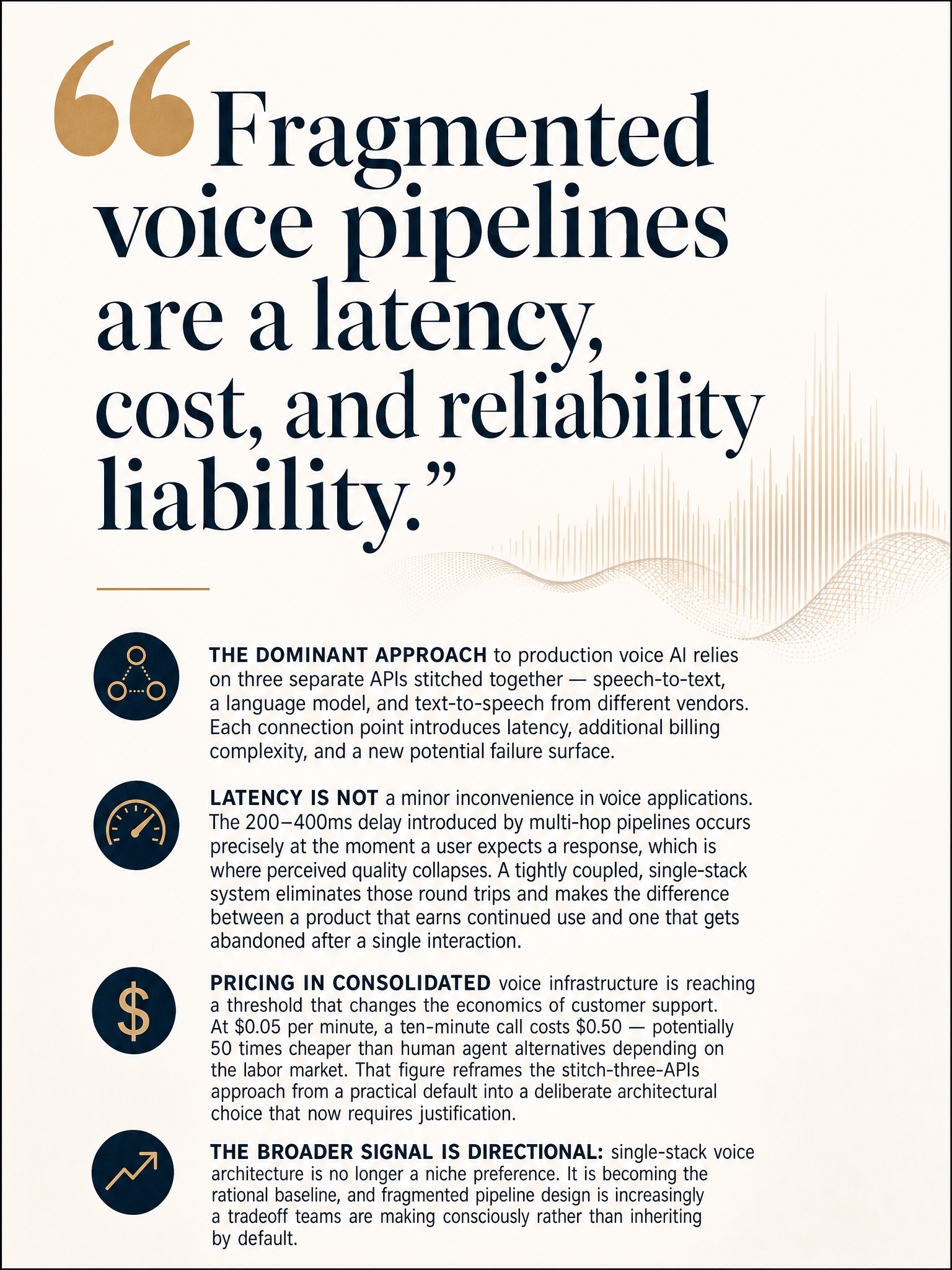
I have built voice pipelines the hard way. Speech-to-text from one vendor, a language model from a second, text-to-speech from a third. It works. Until it doesn’t. And when it breaks at 2am, you get to play a very fun game of “which API is lying to me right now.” Every hop in that chain is a latency hit, a separate billing relationship, and a new place for your on-call rotation to ruin someone’s night.
So when xAI launched Voice Agent Builder at $0.05 per minute, my first reaction wasn’t excitement about the price. It was recognition that they’ve correctly identified the actual problem.
The Three-API Problem Is Real
The standard voice stack in production today looks like this: you call a transcription API, wait for the result, send it to your LLM, wait again, pipe the output to a TTS service, and hope nothing timed out in the middle. According to xAI’s own framing, most voice stacks “stitch together three APIs: speech-to-text, a language model, and text-to-speech, often with each stage hosted by a different provider.” That’s not hyperbole. That’s Tuesday.
Each boundary in that chain adds latency that users notice. A conversation that feels natural sits under 300ms of perceived response delay. Multi-vendor stacks frequently push past that before the model even starts generating tokens.
What xAI Is Actually Shipping
Voice Agent Builder is a no-code platform wrapped around Grok Voice. The pitch is a single interface that handles telephony, knowledge retrieval, tools, guardrails, and observability without requiring you to assemble those pieces yourself. Every account includes a free phone number to get started, which removes one of the more annoying setup costs in early voice prototyping.
The pricing lands at $0.05 per minute. For context, if you’re paying separately for Whisper-class transcription, a capable LLM, and a quality TTS voice, you’re likely spending more than that before you even factor in orchestration infrastructure. Whether the quality of Grok Voice justifies replacing a tuned multi-vendor stack is a legitimate question, but the economics of consolidation make sense on paper.
xAI also notes you can bring your own phone numbers, APIs, and MCP integrations. That’s the right call. Nobody wants to rip out working infrastructure just to use a new platform.
The Integration Story Matters More Than the Price
The $0.05 figure will get the headlines, but the more interesting signal is that xAI is now in the Vercel AI Gateway and Grok Build is running in Railway sandboxes. That’s intentional distribution. They’re not just building a product. They’re embedding into the toolchains developers already use, which is how you get adoption that sticks rather than a feature that looks good in a launch tweet.
I think this is the correct strategy. Voice agents that live only inside a proprietary platform stay toys. Voice agents that slot into existing deployment workflows become infrastructure.
My Honest Assessment
The no-code angle is useful for operators who want to spin up a customer service agent without a team of engineers. I get it. But the more compelling case is for developers who are tired of maintaining glue code across three vendor contracts. If the single-stack latency is genuinely better, and the observability is real rather than a checkbox feature, that’s worth evaluating.
What I want to see before recommending this for anything production-critical is third-party latency benchmarks against a well-tuned multi-vendor stack, and clarity on what “guardrails” actually means in practice. “Guardrails” has become one of those words that can mean anything from actual content filtering to a toggle that blocks profanity.
The direction is right. The pricing is competitive. The test is whether the quality holds at scale or whether this is a clean demo that wobbles under real call volume.
Voice AI is not a solved problem. But the infrastructure layer is becoming one, and that’s the real story here.
Sources
#voiceAI #xAI #GrokVoice #AIengineering #productionAI #developertools