Marc Andreessen on Rogan: AGI milestone already crossed, AI outperforming world-class experts
AGI Apparently Already Happened and Most People Missed It
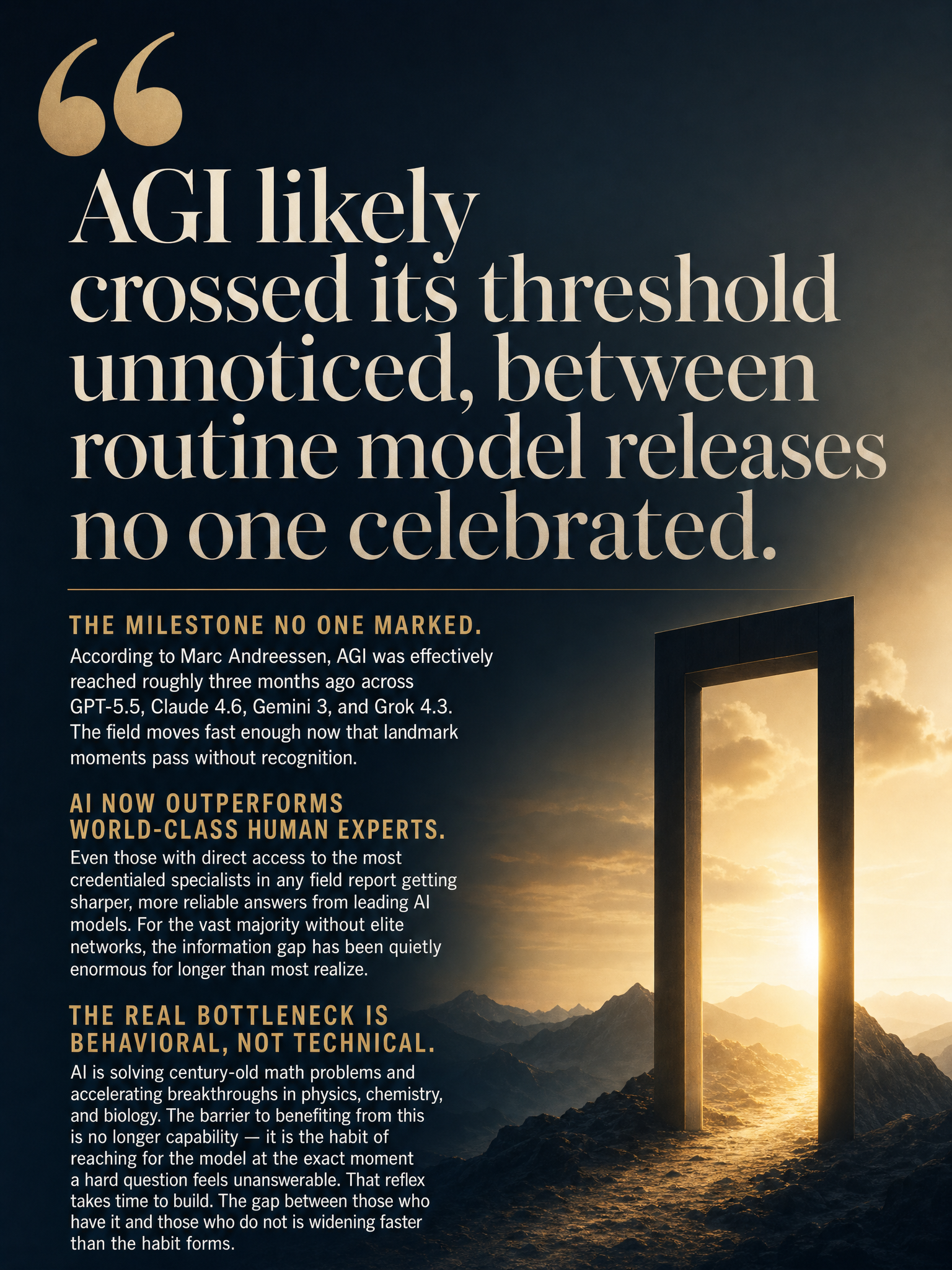
Marc Andreessen sat down with Joe Rogan for over three hours last week and said something I keep turning over in my head. His claim: AGI crossed a meaningful threshold about three months ago, with GPT-5.5, Claude 4.6, Gemini 3, and Grok 4.3. And the reason nobody threw a parade is that the field moves too fast for milestones to even register anymore.
I think he’s right. And that’s a stranger thing to sit with than most people realize.
We Were Waiting for the Wrong Movie
The mental model most people carry around for AGI looks like a movie scene. A dramatic announcement. A robot doing something unmistakably superhuman in front of cameras. We built up this expectation of a before-and-after moment, a line in the sand that everyone would agree on simultaneously.
Instead, it apparently just arrived between routine model releases that the press treated as incremental upgrades. GPT-5.5 dropped. People benchmarked it. Twitter argued about context windows for a week. Then we moved on. That’s the AGI announcement, apparently. That was it.
I find that more believable than uncomfortable. Paradigm shifts rarely announce themselves cleanly. The internet didn’t feel transformative on day one either. It felt like a faster fax machine.
The Expert Benchmark Is the One That Actually Stops Me
The specific claim Andreessen made that I can’t shake is this: for almost any topic, the top AI models now give him better answers than the world-class experts he could personally call. And he can call basically anyone.
That’s not a claim a random person can make. Andreessen has been one of the most connected figures in Silicon Valley for thirty years. If he says AI beats his Rolodex, that’s a meaningful data point, not a humble brag.
Think about what that actually means for the rest of us, who cannot call the world’s leading oncologist, or the top constitutional lawyer, or the physicist who wrote the textbook. We now have something better than what the most connected person in tech had access to five years ago. That gap closing this fast is genuinely hard to process.
Doctors Are Already Using It, Just Quietly
One of the more grounded observations Andreessen made is about medical practice right now, today. He says doctors are already typing patient symptoms into ChatGPT the moment patients stop talking. Some while the patient is still sitting there. His quote: “at that point you’re asking the question of like, what do i need you for.”
That’s not dystopian. That’s practical. Doctors are humans with finite recall who face enormous diagnostic complexity. Of course they’re using the best available tool. The uncomfortable part is just the honesty of admitting it changes the value equation for the visit itself.
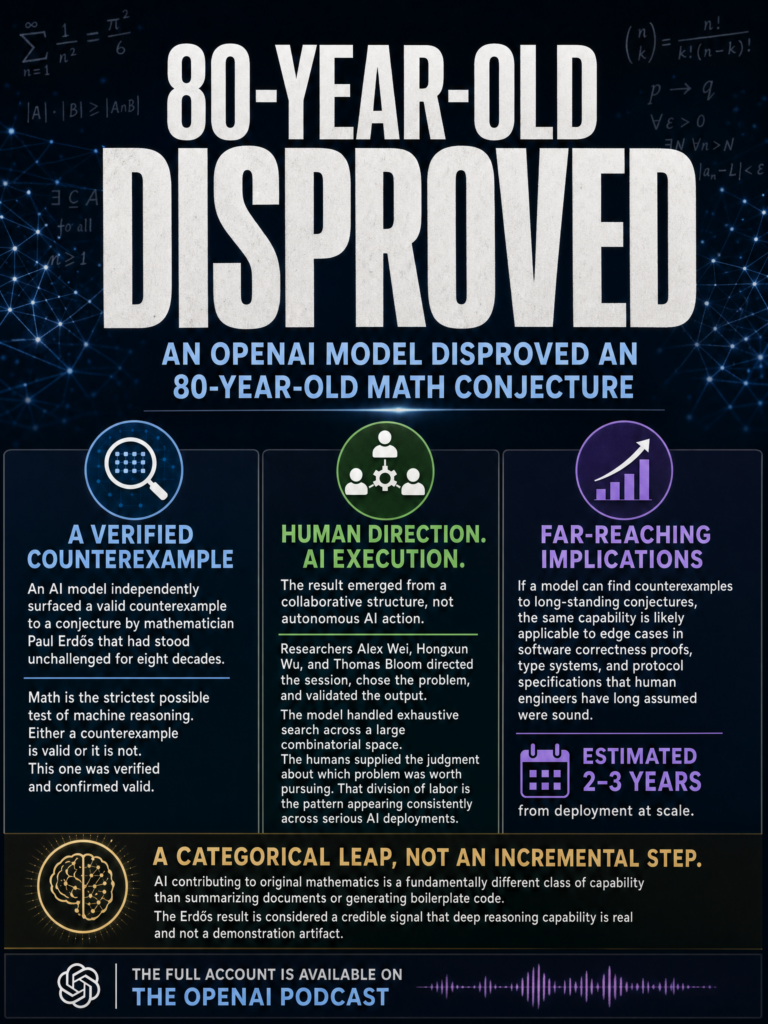
The math and science angle he raised is equally real. AI systems are now solving math problems that sat open for over a hundred years, problems no human mathematician cracked. The same thing is starting to happen in chemistry and biology. If that pattern holds, the next five years in drug discovery look nothing like the previous fifty.
What the Prompting Tricks Tell Us About Where We Actually Are
Andreessen shared a few of his personal AI habits that I found more revealing than they first appear. When something is too complex, he asks for explanations at progressively simpler levels. When he wants to understand a contested topic, he asks the AI to steelman both sides, then decides himself. When something is too sensitive, he frames it as fiction writing.
These are workarounds. Clever ones, but workarounds. And the fact that a billionaire with unlimited access to human experts has developed a personal toolkit of prompt tricks tells you something real: the capability is enormous but the interface is still rough. The models can do almost anything you can describe in plain English. The bottleneck is knowing how to describe it. That’s a solvable problem, but it’s real.
He also mentioned that the best AI-assisted coders in Silicon Valley are now running twenty parallel coding bots simultaneously, reviewing output from one while others generate. Some are calling themselves “AI vampires” because sleeping means twenty workers go idle and productivity drops. Whatever you think of that lifestyle, the economic signal is clear. The value multiplier on a single skilled person has gone vertical.
Where This Actually Lands
I’m not going to tell you Andreessen is definitely right about the three-month AGI timeline. The definition of AGI has always been slippery enough that almost anyone can argue almost anything. What I will say is that the expert-outperformance claim is testable, and in my own experience, it holds more often than I expected it would.
The more important shift is this: whether or not you accept the AGI label, the capability curve crossed some threshold where the old mental models for human expertise and AI assistance stopped being useful. The question isn’t whether to use these tools. It’s whether you’ve built the judgment to use them well.
That judgment is the only skill that doesn’t depreciate right now.
Sources & Further Reading
#AI #AGI #ArtificialIntelligence #MachineLearning #FutureTech