GPT-5.4 drives medicinal chemistry project from literature review to validated experimental result, improving yields in Chan-Lam coupling
GPT-5.4 Just Ran a Real Drug Discovery Experiment. The Results Are Worth Paying Attention To.
I have watched a lot of “AI does science” demos come and go. Most of them are carefully staged. A model generates something plausible-looking, a human expert nods approvingly, and the press release writes itself. What OpenAI published this week with Arcadia Science is different, and the difference matters.
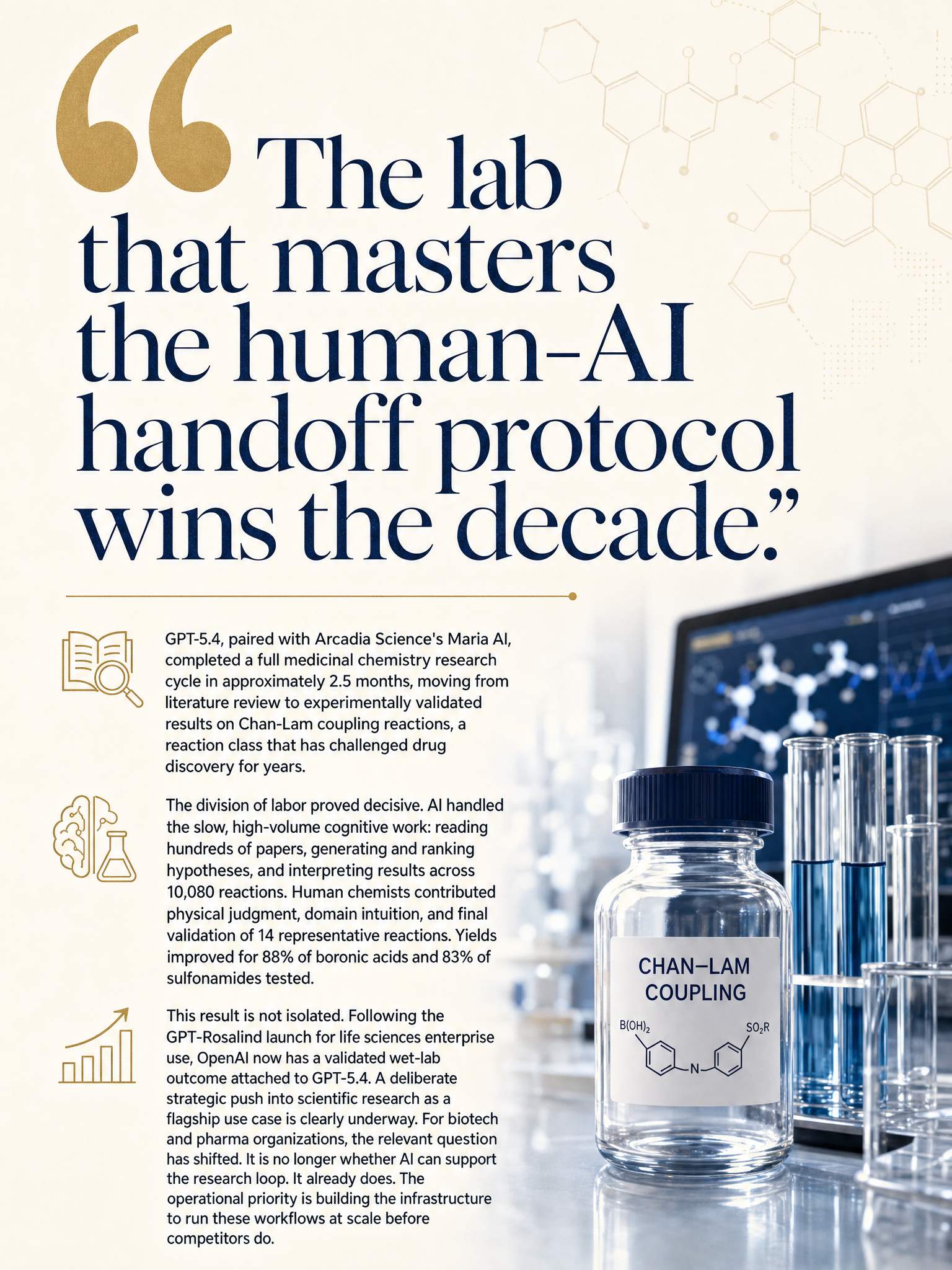
GPT-5.4, paired with Arcadia Science’s Maria AI platform and a specialized chemistry lab, ran a medicinal chemistry project from literature review all the way to a validated experimental result. Not a curated dataset. Not a synthetic benchmark. An actual chemistry problem, solved with actual lab work confirming the answer.
The Chemistry Problem
Chan-Lam coupling is a reaction chemists use to build pharmaceutically relevant molecules. It is genuinely useful in drug discovery, with one stubborn limitation: when primary sulfonamides are involved, yields have historically been low enough to make the method impractical for many applications. That yield problem has constrained what medicinal chemists can build.
That was the target.
What the Model Actually Did
GPT-5.4 reviewed the existing scientific literature on Chan-Lam coupling, generated and ranked research proposals, helped design the experiments, analyzed results as they came in, and proposed follow-up directions. This is not a trivial workflow. Literature synthesis alone across a specialized domain like organometallic coupling chemistry requires handling dense, highly context-dependent information where small distinctions in reagents or conditions carry large consequences.
Human chemists were not bystanders. They steered the work, chose which proposals to actually test, and handled experimental validation. The division of labor here is worth noting honestly: the model did the cognitive heavy lifting on generation and synthesis, the humans did the judgment and the wet lab work.
The Numbers
Maria tested the optimized conditions across 10,080 reactions. Under those conditions, yields improved for 88% of the boronic acids tested and 83% of the sulfonamides tested. Human chemists then validated 14 representative reactions by hand to confirm the computational findings held up at the bench.
The full project took approximately 2.5 months, plus another half-month for the writeup.
That timeline is genuinely fast for a research cycle that includes literature review, hypothesis generation, experimental design, high-throughput testing, and human validation. A traditional grad student-driven project covering the same ground would typically take considerably longer, with no guarantee of reaching a positive result.
Why I Think This Is Different
The thing that separates this from prior “AI in science” announcements is the closed loop. The model was not just predicting outcomes from existing data. It was proposing something unexpected, and that proposal survived contact with physical reality. Chemistry does not grade on a curve. If the yield numbers go up in 10,080 reactions and hold in manual replication, the idea worked.
The unexpected nature of the proposal is also worth sitting with. OpenAI describes it as “an unexpected way to improve a widely used reaction.” If the model had simply retrieved the consensus approach from the literature and repackaged it, that would be automation. Proposing something the field had not converged on, and being right about it, is closer to what we actually mean when we say scientific contribution.
What This Points Toward
Drug discovery has a brutal attrition problem. The cost and time of moving from a chemical idea to a validated synthesis route is a major reason why developing a new drug takes so long and costs so much. If AI systems can meaningfully compress the early-stage chemistry research loop, the downstream effects on what diseases get targeted and how fast, are real.
This is not a claim that AI replaces chemists. The human role in this project was not cosmetic. But it is evidence that the research loop can be restructured, with models handling more of the generation and synthesis work and humans focusing judgment where it actually counts.
The question worth asking now is not whether this can happen. It just did. The question is how broadly it generalizes across reaction types, therapeutic areas, and chemistry problems where the literature is thinner or more ambiguous. That is where the next round of work needs to go.
Sources
#ArtificialIntelligence #DrugDiscovery #MedicinalChemistry #AIResearch #OpenAI #MachineLearning