Anthropic launches Claude Corps, a paid national fellowship placing 1,000 people at US nonprofits to deploy Claude
Claude Corps Is What “AI for Good” Should Have Always Looked Like
Most AI lab philanthropy follows the same script. Announce a fund. Hold a competition. Award grants to a handful of well-connected nonprofits. Put out a press release. Move on. The organizations that actually needed help never had the grant-writing bandwidth to compete, and the ones that won often lacked the technical capacity to deploy anything meaningful. The cycle repeats.
Anthropic just broke the script.
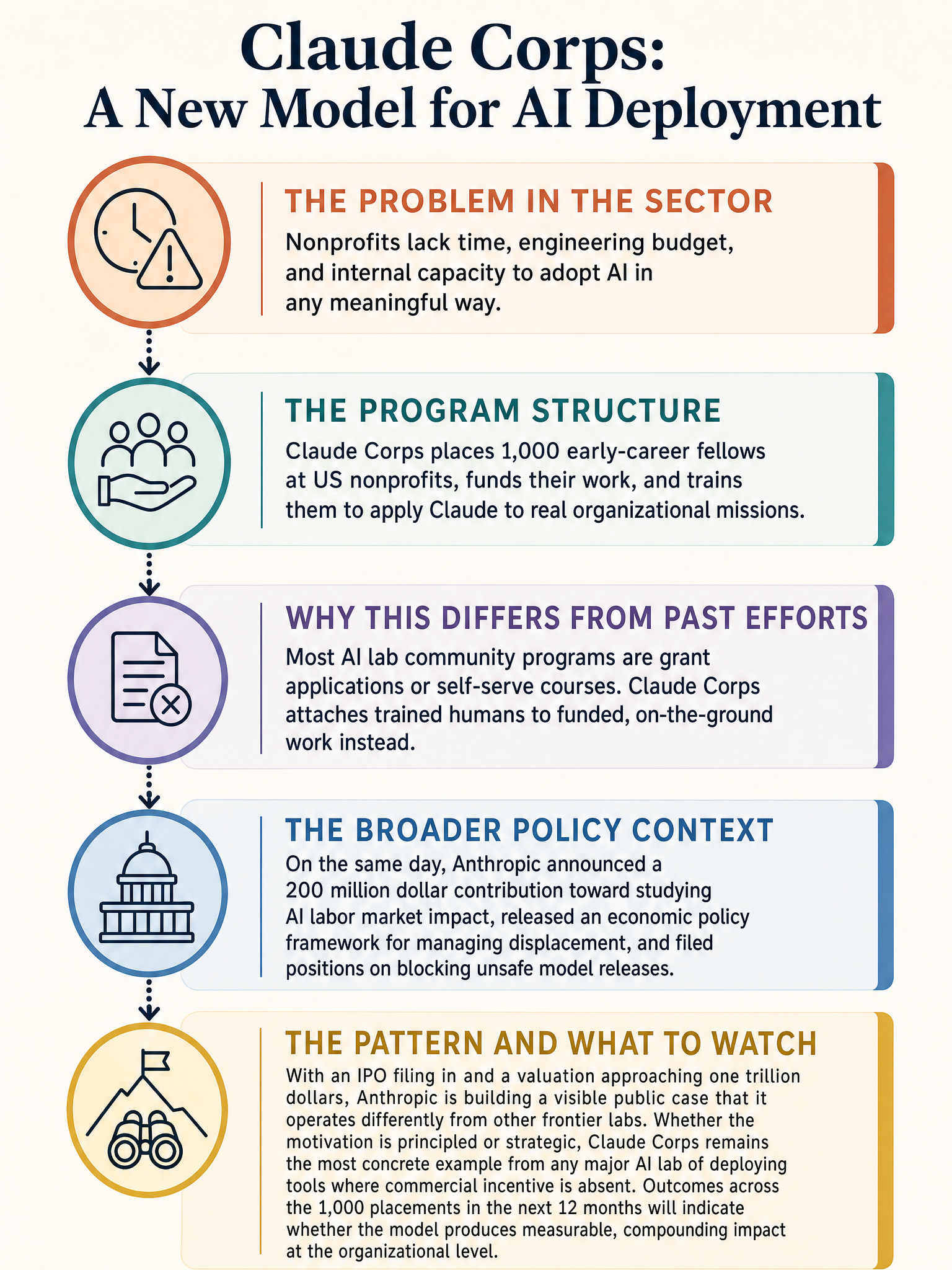
Claude Corps is a $150 million national fellowship program that will place 1,000 people early in their careers at US nonprofits, train them to use Claude, and pay them to do real work. Not hypothetical work. Not pilot work. Actual, mission-driven work at host organizations that have been underserved by every previous wave of tech philanthropy.
I think this is genuinely different, and I want to explain why.
The Structural Problem with Nonprofit AI Adoption
Nonprofits are not slow to adopt AI because their staff lacks intelligence. They are slow because the conditions required for AI experimentation simply do not exist there. There is no budget to hire a machine learning engineer. There is no slack in the calendar to run experiments. There is nobody internally who can bridge the gap between what a model can do and what the organization actually needs.
This is a staffing and capacity problem, not a knowledge problem. Throwing educational content at it does not work. Throwing grant money at it mostly funds the organizations that were already doing well. What actually moves the needle is putting a skilled, trained person inside the building and giving them time to figure out the fit.
That is exactly what Claude Corps does.
What Makes This Model Work
The fellowship structure matters more than the dollar amount. $150 million sounds large, but spread across 1,000 fellowships, it is more about sustainable placement than splashy funding. The value is in the labor, not the check.
Think about what a trained Claude Corps fellow actually brings to a nonprofit. They know the tool. They have time allocated specifically for deployment. They are not trying to squeeze AI experimentation in between their regular job. And when they leave, the organization has seen a real use case in production, not a demo.
That residual knowledge is the actual output here. The nonprofit walks away with documented workflows, staff who watched the process, and something real to build on.
Anthropic also announced this alongside an Economic Policy Framework and a $200 million contribution to a fund for evaluating ideas about AI’s labor market impact. Dario Amodei has written publicly about the gap between how fast AI is advancing and how slowly policy institutions respond to it. Claude Corps reads like a concrete answer to that critique, not just a rhetorical one.
The Cynical Read, and Why I Mostly Reject It
Yes, placing 1,000 Claude users at nonprofits builds familiarity with Claude specifically. Yes, this is brand-building alongside philanthropy. I do not think that makes it wrong.
The cynical read assumes the only way this could matter is if the motivation were purely altruistic. But a program that produces real outcomes for underserved organizations while also building Anthropic’s reputation is better than a program that does neither. The incentives are aligned well enough that I am willing to call it a net positive without requiring sainthood from the people funding it.
What I will watch for is whether the host organizations have meaningful input into how fellows are deployed, or whether this ends up being a top-down implementation exercise. The difference between “we helped you use Claude” and “we listened to what you needed and found where Claude fits” is everything.
Where This Goes
If the program works at 1,000 fellows, the model is repeatable. Other AI labs could build similar programs. Corporate foundations with genuine capacity could fund their own variants. The nonprofit sector could develop a real bench of AI-literate practitioners who move between organizations carrying that knowledge.
That would be a structural shift. One program does not get you there. But it is a real starting point in a space full of announcements that never turn into anything.
Anthropic’s own framing on this is careful. Their post notes that “by themselves, these projects will not be sufficient to meet the challenge of advanced AI.” That is honest. I respect the honesty. The question now is whether the follow-through matches the ambition.
Sources & Further Reading
#AIPolicy #Nonprofits #ClaudeCorps #Anthropic #AIForGood #TechPhilanthropy