Contrarian take on enterprise AI data ownership: who actually captures the value from your model corrections and feedback signals
The Question Nobody Asks Before Signing the AI Contract
You spend six months integrating a third-party model into your core workflow. Your team corrects its mistakes every day. You build prompt chains tuned to your industry. You feed it your proprietary documents, your edge cases, your institutional knowledge. And then you renew the contract, and you do it all again.
Who got richer from that arrangement? Not you.
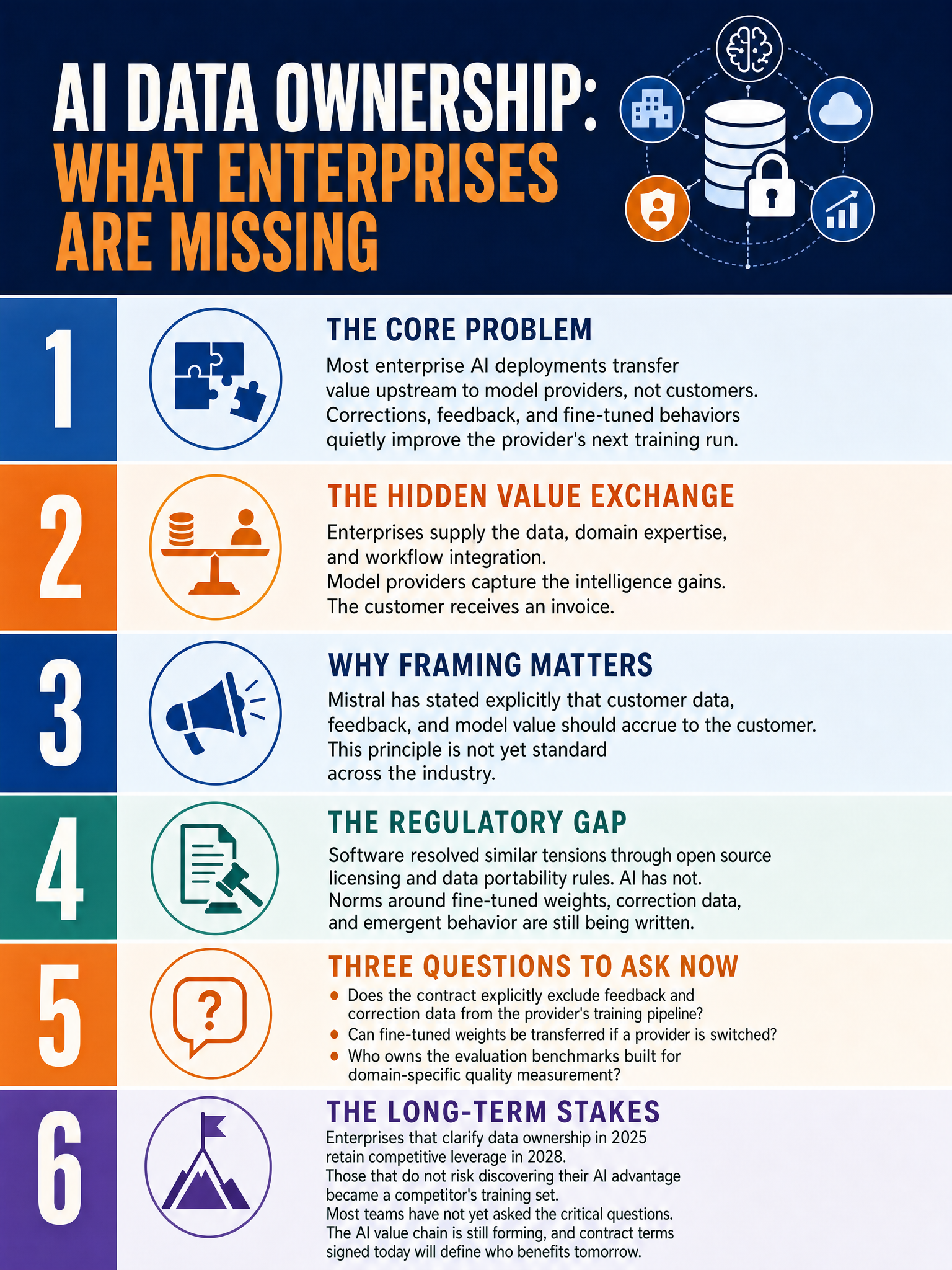
This is the enterprise AI trap that almost nobody talks about. Legal ownership of your data is one thing. What actually happens to the value your team generates, the feedback signals, the corrections, the fine-tuned behaviors, is a completely different question. And most procurement conversations never get there.
Where the Value Actually Goes
Every time a user corrects an AI output, that correction is a signal. Every thumbs-down, every rephrased prompt, every manually overridden result, that is training data. Depending on your contract terms and the provider’s data policies, that signal may flow directly into the model provider’s next training run. Your domain expertise, your team’s judgment, your hard-won corrections become their competitive moat.
This is not hypothetical. The business model of most frontier model providers depends on exactly this feedback loop. You are not just a customer. You are a data source.
Mistral Saying the Quiet Part Out Loud
This week Mistral posted something worth taking seriously. Their statement: “We exist to help enterprises, public institutions, and industries build their own intelligence, so the value created from their data, workflows, feedback, and models accrues to them rather than to model providers.”
That framing is direct and I think it is strategically smart. It names the problem that OpenAI, Anthropic, and Google have every incentive not to name. Whether Mistral fully delivers on that promise in practice is a separate conversation. But they identified the real fault line in enterprise AI, which is not accuracy or latency or cost per token. It is value capture.
The Bridgewater Signal
Mira Murati shared something this week that points in the same direction. Bridgewater partnered with her company Tinker to fine-tune a model on their proprietary financial knowledge, producing a tool that helps their analysts do their jobs better. The key detail is that Bridgewater kept the expertise inside a model they control, not one they’re renting access to from a provider who benefits from their corrections.
That is the model enterprises should be studying. You bring the domain knowledge. You own the fine-tuned artifact. The value stays on your side of the ledger.
What Procurement Teams Keep Missing
Most AI vendor evaluations focus on benchmark scores and price per million tokens. Almost none of them include a clear-eyed audit of the data policy, specifically what happens to interaction data, correction signals, and fine-tuned model weights.
The questions worth asking before you sign anything: Does the provider train on your interaction data by default? Can you opt out, and what does opting out actually cost you in terms of model quality? Do you own any fine-tuned model weights, or are you licensing a black box? If you leave, can you take anything with you?
If the answers are vague, treat that as a data point.
The Practical Path Forward
I am not arguing that every enterprise needs to run its own models on bare metal. That is genuinely impractical for most organizations. What I am arguing is that the choice of provider and the structure of the contract matter enormously and that most enterprises are sleepwalking into arrangements that extract more value than they return.
The providers who will win long-term enterprise relationships are the ones who can credibly say: your feedback makes you smarter, not us. Right now, very few can say that honestly. Mistral is at least framing the problem correctly. Whether the infrastructure and contractual reality backs that up is something every enterprise customer should be verifying, not assuming.
The AI value chain has a leak. Most of the time, it is on your end.
Sources
#EnterpriseAI #AIStrategy #DataOwnership #MLEngineering #AIPolicy