Contrarian take on Google’s three-model Gemini drop (3.6 Flash, 3.5 Flash-Lite, 3.5 Flash Cyber) and what it signals about model launches becoming patches, not events
Model Drops Are the New Patch Notes
Google shipped three models in a single day last week. Gemini 3.6 Flash, Gemini 3.5 Flash-Lite, and Gemini 3.5 Flash Cyber. One announcement post, one morning, done.
Most of the coverage I saw treated this as a breadth play. Google covering more ground, more price points, more use cases. That reading is not wrong, exactly, but it misses something more important about what is actually happening to the industry right now.
🔵 This Is Not a Launch. It Is a Patch.
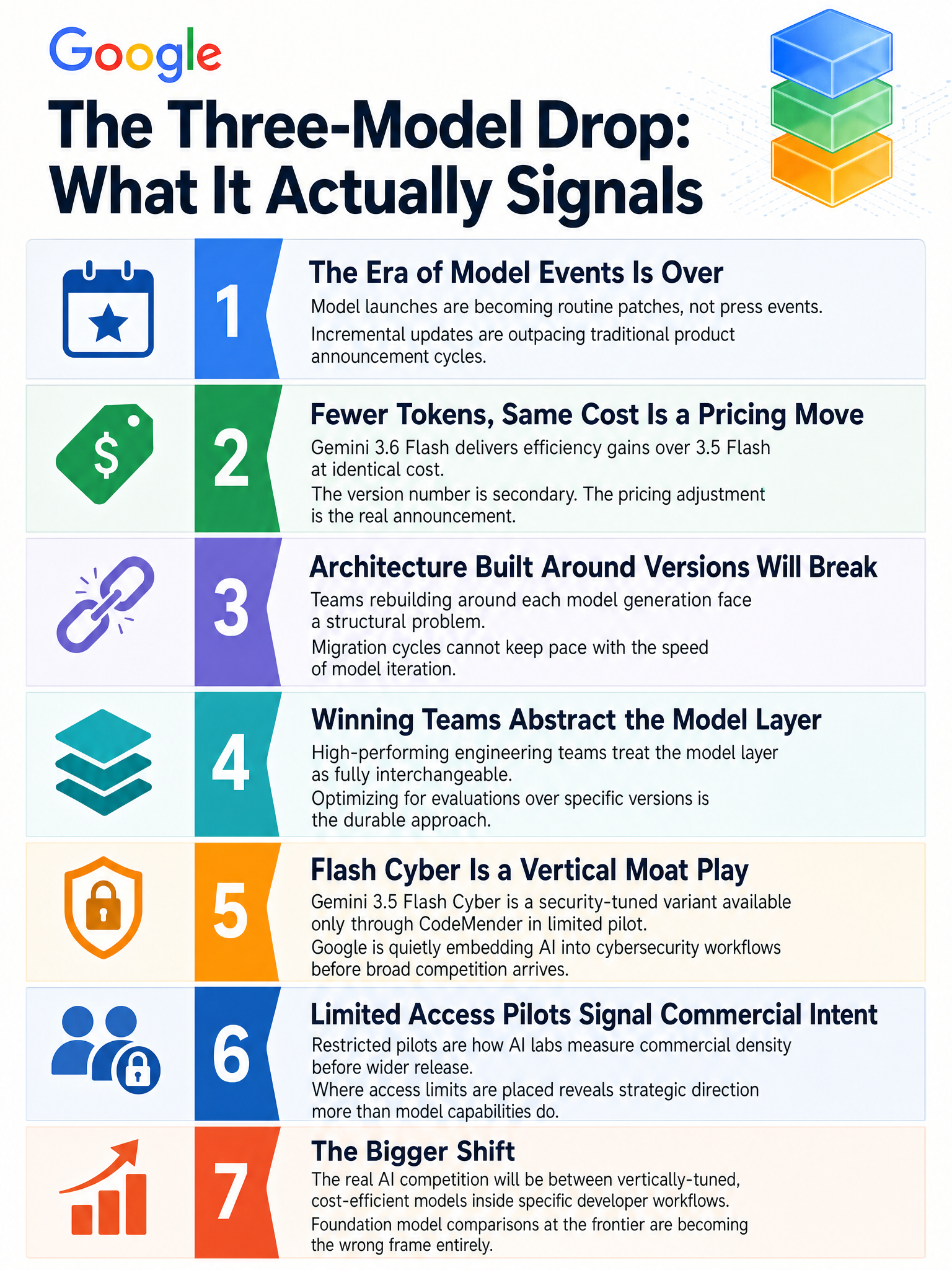
Look at what Google DeepMind actually said about 3.6 Flash: it uses fewer tokens than 3.5 Flash to deliver higher quality work at the exact same cost. That is not a new product. That is an efficiency fix. The version number is cosmetic. What happened here is that developers gave feedback that 3.5 Flash was burning too many tokens, and Google shipped a corrected build. They just called it a new model because that is the convention.
3.5 Flash-Lite is a stripped-down variant for high-volume, low-stakes tasks. 3.5 Flash Cyber is a security-focused fine-tune, available initially only through a limited-access pilot called CodeMender.
Three different packaging decisions, one underlying infrastructure push. This is how mature software platforms operate. It is how they have to operate at this scale.
Why Model Launches Stopped Being Events
Cast your mind back to GPT-3. Or even GPT-4. Those were actual events. Press coverage, waitlists, industry hand-wringing. The model itself was the story.
That era is over. When OpenAI drops a GPT-5.6 Sol update while simultaneously Google is pushing three models and Mistral is announcing an expanded partnership with Microsoft, the individual release collapses under the noise. Nobody can maintain genuine excitement for that cycle at this frequency.
What we are really watching is the commoditization of model capability at the infrastructure layer. These are not moonshots anymore. They are incremental updates dressed in version numbers.
What Builders Should Actually Care About
Here is where my opinion gets sharper. If you are building products on top of these models, the patch-cycle reality is actually good news for stability and bad news for benchmarking culture.
Good news because: a model that ships to address specific developer feedback (token efficiency, production code quality, multimodal reliability) is a model being tuned to real workloads. Google explicitly said 3.6 Flash “builds directly on feedback from 3.5 Flash.” That is a healthy signal.
Bad news because: if you are still making architecture decisions based on benchmark leaderboard positions at launch time, you are optimizing for a snapshot that will be obsolete within weeks. 3.5 Flash Cyber, for example, is specifically built to find vulnerabilities faster than humans can patch them. That is a narrow, deep capability. Evaluating it against a general benchmark is almost meaningless.
The thing builders need to develop is an ongoing eval practice, not a one-time model selection. Pick models based on your workload. Measure continuously. Treat model versions the way you treat library versions.
The Cybersecurity Angle Is Worth Watching Separately
I do not want to bury this. Gemini 3.5 Flash Cyber is Google’s explicit entry into autonomous vulnerability discovery. The framing from the @GoogleAI post is direct: AI models are finding vulnerabilities faster than humans can fix them. That is not marketing language. That is a capability claim with real operational stakes.
OpenAI is in the same race. GPT-5.6 Sol is being positioned partly on cybersecurity performance, with OpenAI reporting 6x fewer successful prompt injections compared to previous models during adversarial testing. Both companies are treating security-specialized models as a distinct product category now, not a feature.
That trajectory matters more than any individual model drop. When AI becomes the primary mechanism for both attacking and defending software systems, the update cadence of these models stops being a developer convenience story and becomes an infrastructure reliability question.
🔵 The Honest Conclusion
Google shipping three models in one day is not impressive because of the number three. It is interesting because it reveals the new rhythm. Fast, incremental, feedback-driven, no fanfare required. The age of the model launch as cultural moment is behind us. What comes next is closer to how cloud infrastructure evolved: invisible when it works, immediately painful when it does not.
Build your evals accordingly.
Sources
#AI #MachineLearning #LLM #Gemini #AIEngineering #BuildingWithAI