OpenAI Health launch in ChatGPT: 300M weekly health queries and what the dedicated health product means for AI in medicine
OpenAI Health Is Already Behind the Market It Wants to Serve
Three hundred million. Per week.
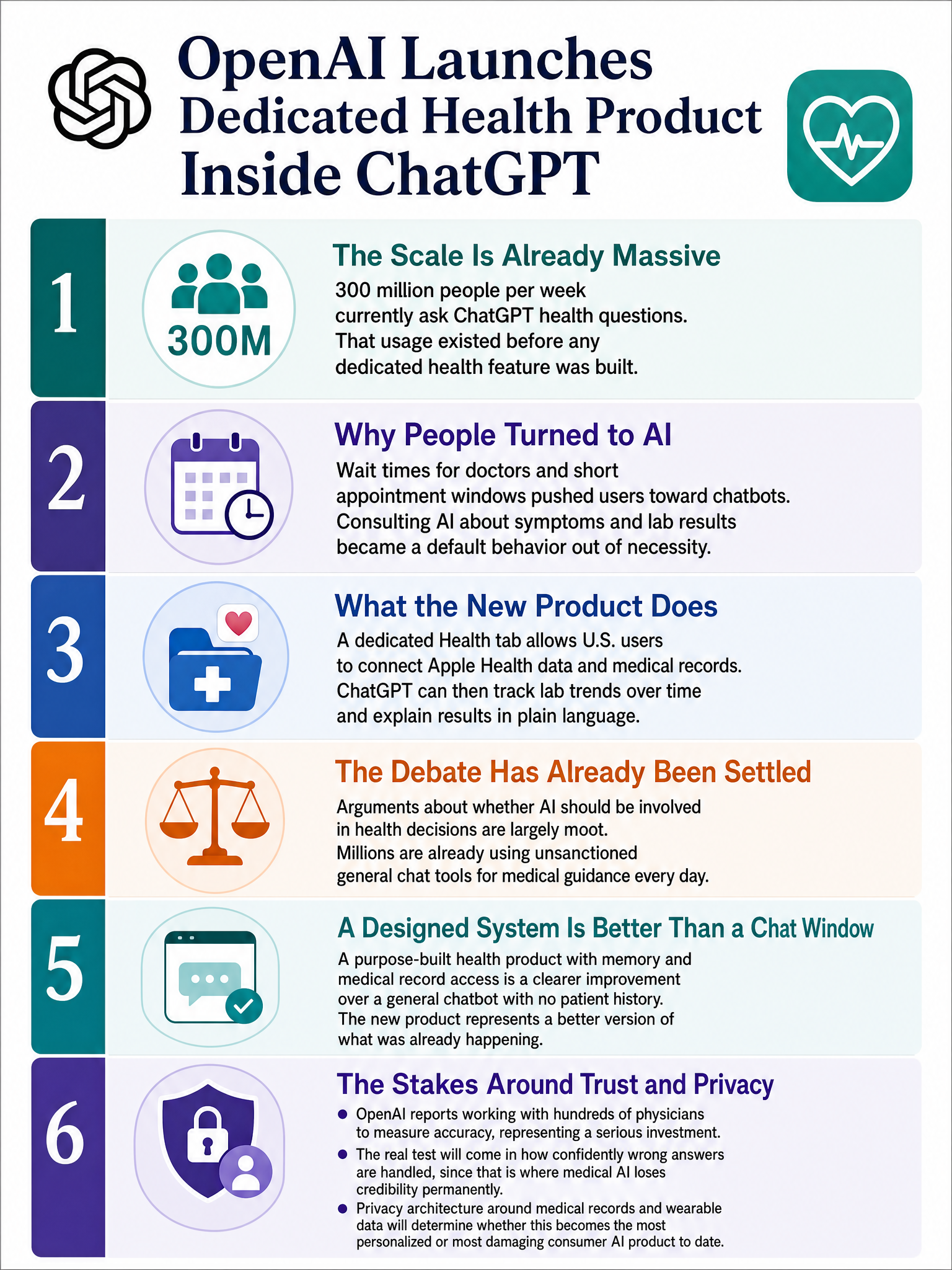
That number stopped me when I read it. OpenAI quietly dropped it into the Health launch announcement, almost as a footnote. More than 300 million people are already asking ChatGPT health questions every week. Before any dedicated health feature existed. Before Apple Health integration. Before medical records could be connected. People were already doing this with a general-purpose chatbot because the existing system, a two-week wait for an eight-minute appointment, was worse.
That context matters enormously when you think about what OpenAI just launched.
What the Product Actually Does
The new Health tab inside ChatGPT is now rolling out to U.S. users. With permission, it connects to Apple Health and supported medical records, then lets ChatGPT compare your new lab results against historical ones, track trends, and explain what changed since your last checkup. In plain English. Without you needing to understand what a slightly elevated creatinine level means at 11pm on a Tuesday when no doctor is available.
OpenAI says they built this based on feedback from early testers and physicians, and that they work with hundreds of physicians worldwide to measure and improve accuracy, safety, and communication. That word “hundreds” is doing a lot of work in that sentence. Hundreds, against 300 million weekly users, is a very small number. But it is a start.
Why the 300M Number Changes the Regulatory Conversation
Here is the uncomfortable truth for medical regulators and health systems. The adoption curve did not wait for approval. It did not wait for clinical validation studies or FDA guidance on AI-generated health information. People voted with their anxiety at 2am, and the verdict is not close.
This creates a genuinely different situation than previous medical AI deployments. When a hospital system rolls out a diagnostic algorithm, regulators engage before patients do. Here, patients arrived first. Hundreds of millions of them. The feature OpenAI just launched is, in a meaningful sense, catch-up infrastructure for usage that already exists.
The question is not whether people will use AI for health questions. They already do. The question is whether the experience gets better or stays dangerously informal.
The Integration Angle Is Where This Gets Interesting
Connecting actual medical records and biometric data from Apple Health changes the epistemic quality of the interaction entirely. Right now, a person typing “my hemoglobin was 11.2, is that bad” gets a generic response without context. With Health integration, ChatGPT can know that six months ago it was 13.1, that this person is a 52-year-old woman, and that the trend is worth a conversation with a doctor. That is a qualitatively different kind of help.
I think this is the right direction. Not because I trust OpenAI to get every edge case right, but because context-free health information has always been the problem with Dr. Google, not AI specifically. Search engines have been answering health questions for 25 years with zero continuity and zero context. At least the Health integration is trying to solve that.
What I Am Still Watching
Privacy is the obvious concern, and I will not pretend it is trivial. Connecting your Apple Health data and medical records to OpenAI’s servers is a real decision with real implications. OpenAI says the connection is with permission and data is used to help you across conversations. The details of data retention and training use matter here, and the launch announcement is lighter on those specifics than I would like.
The other thing I am watching is accuracy under pressure. A model that works well for common lab result interpretations may fail in ways that are hard to detect for rarer conditions. The physicians helping calibrate this product presumably know that. Whether the error modes are visible to users before they cause harm is the real test.
This is not a solved problem. But 300 million people per week were already living with the unsolved version of it. OpenAI Health is at least an honest attempt to make that reality safer than it currently is.
The medical establishment will resist this, and some of that resistance will be legitimate. But some of it will be institutions protecting a bottleneck that was never serving patients particularly well. The difference between those two categories of objection is worth paying attention to as this rolls out.
Sources & Further Reading
#AIHealth #OpenAI #ChatGPT #HealthTech #AIinMedicine #MedicalAI #DigitalHealth