Prediction on what an OpenAI/Anthropic/Google shared AI standards body means for builders relying on frontier model access windows
If You Build on Frontier Models, Pay Attention to This
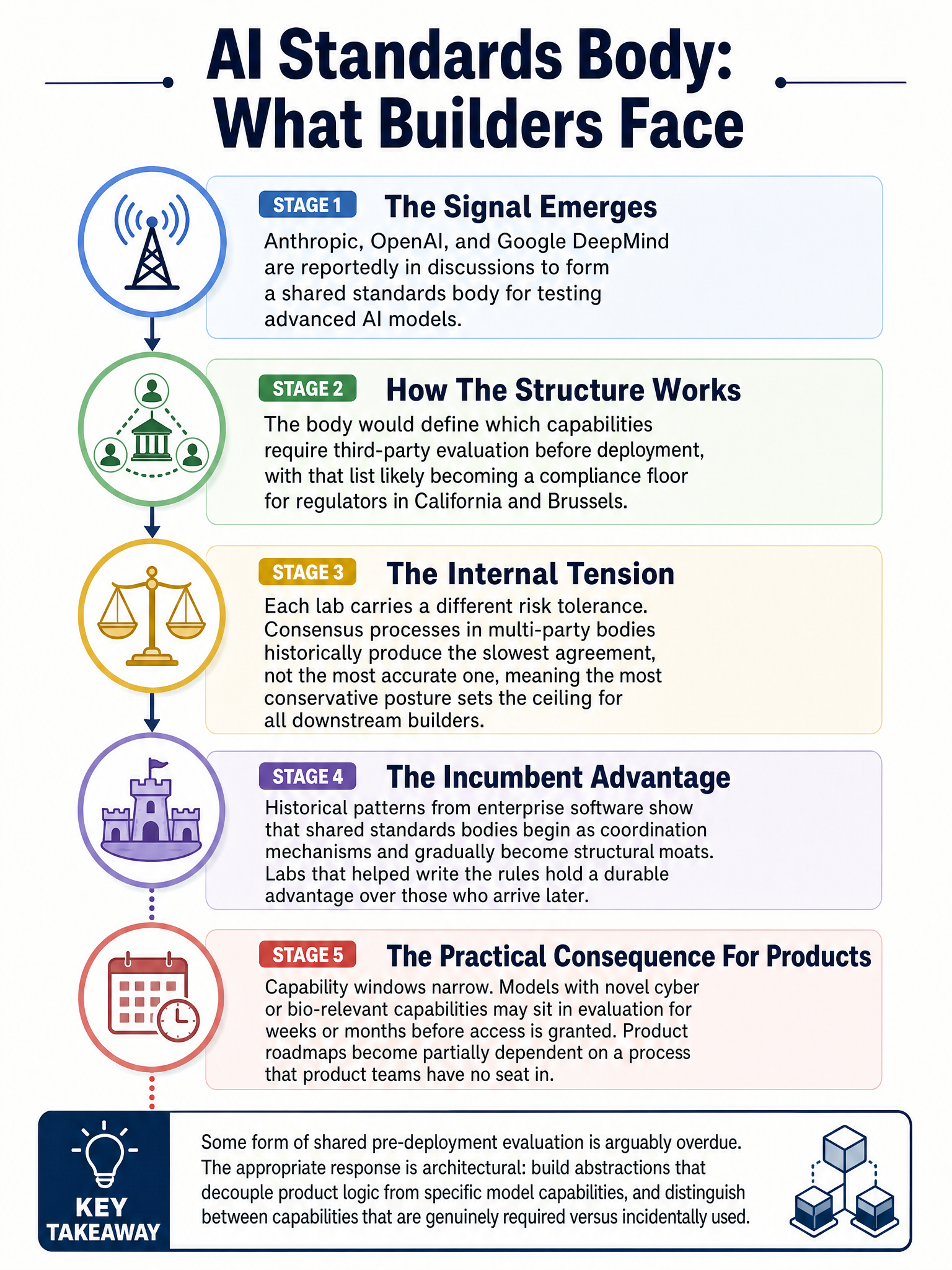
The three biggest AI labs in the world are apparently sitting at the same table. Anthropic, OpenAI, and Google DeepMind are reportedly in discussions to form a shared standards body for testing advanced AI models. No official announcement yet. No press release. Just signals, leaks, and the kind of quiet institutional maneuvering that tends to reshape entire industries before most people notice it is happening.
I think this is the most consequential governance signal of 2026. And almost none of the commentary I have seen focuses on what it actually means for builders.
What This Body Probably Looks Like in Practice
Standards bodies are not abstract. They produce lists. Threshold definitions. Testing requirements that eventually get picked up by regulators looking for something concrete to cite.
Here is my read on how this plays out. The labs agree on which capability categories require a third-party evaluation before deployment. Bio, cyber offense, autonomous agent behavior, that kind of thing. They publish the list. California and Brussels use it as a compliance floor. You ship a product built on GPT-6 Astra or Fable 5.1, and now your product sits downstream of a testing regime you had no input into and cannot change.
That is not a crisis. That is just the operating environment hardening around you.
The California Signal Is Already Here
Governor Newsom signed two AI safeguard bills on September 9, 2026, establishing what his office called first-in-the-nation standards for independent assessments of AI systems. He also called on the federal government to match that standard nationally. https://www.gov.ca.gov/2026/09/09/governor-newsom-signs-first-in-the-nation-ai-safeguards-to-protect-californians-calls-on-the-federal-government-to-do-its-part
That is not a coincidence in timing. California moves when it has something to point to. A shared labs framework gives Sacramento exactly the technical vocabulary it needs to write enforceable rules.
The Access Window Question Nobody Is Asking
Here is what I actually care about as someone who builds with these models.
When a shared testing body flags a capability as requiring a third-party eval, what happens to the API access window for that capability? Does it get gated? Rate-limited? Pulled from public tiers entirely while evaluation is pending?
Paul Christiano, formerly head of safety at the Commerce Department’s Center for AI Standards and Innovation, said in September that he believes rapid capability acceleration carries a “meaningful risk” of catastrophic outcomes. https://www.cnbc.com/2026/09/10/openai-anthropic-ai-safety-slowdown-extinction.html
When people with that view are also shaping the testing frameworks, the answer to my question above is probably yes, some capabilities will get gated. That is a real operational consideration for teams building agentic workflows, autonomous coding pipelines, or anything touching sensitive domains.
The Competitive Angle Labs Will Not Say Out Loud
There is something else worth naming. Google DeepMind still has not shipped Gemini 3.5 Pro, despite Sundar Pichai announcing it at Google I/O in May. OpenAI has GPT-6 Astra out. Anthropic has Fable 5.1 out. https://mashable.com/tech/google-gemini-3-5-pro-delay-updates
A shared standards body benefits labs that are ahead on safety infrastructure. If you have already built internal evals for bio risk and autonomous agent behavior, you can absorb the compliance cost. If you are behind on those evals, a shared framework accelerates your disadvantage. I am not saying that is the motive here. I am saying the timing is worth noting.
What Builders Should Actually Do
Stop treating model selection as a purely technical decision. If your product depends on a specific capability, find out which testing category that capability falls under and how the labs are likely to gate it.
Read the Anthropic threat intelligence report from September 2026. https://www.anthropic.com/threat-intelligence-report-september-2026 They documented blocking a threat actor who used Claude to build an automated identity-profiling tool targeting hundreds of individuals. That is the exact use-case category that will anchor early capability restrictions. If your legitimate workflow pattern looks anything like that operationally, you need to know that now, not when your API calls start failing.
The labs are building the fence. You still get to decide where you stand relative to it.
Sources & Further Reading
#AIGovernance #MachineLearning #AIPolicy #BuildingWithAI #FrontierModels