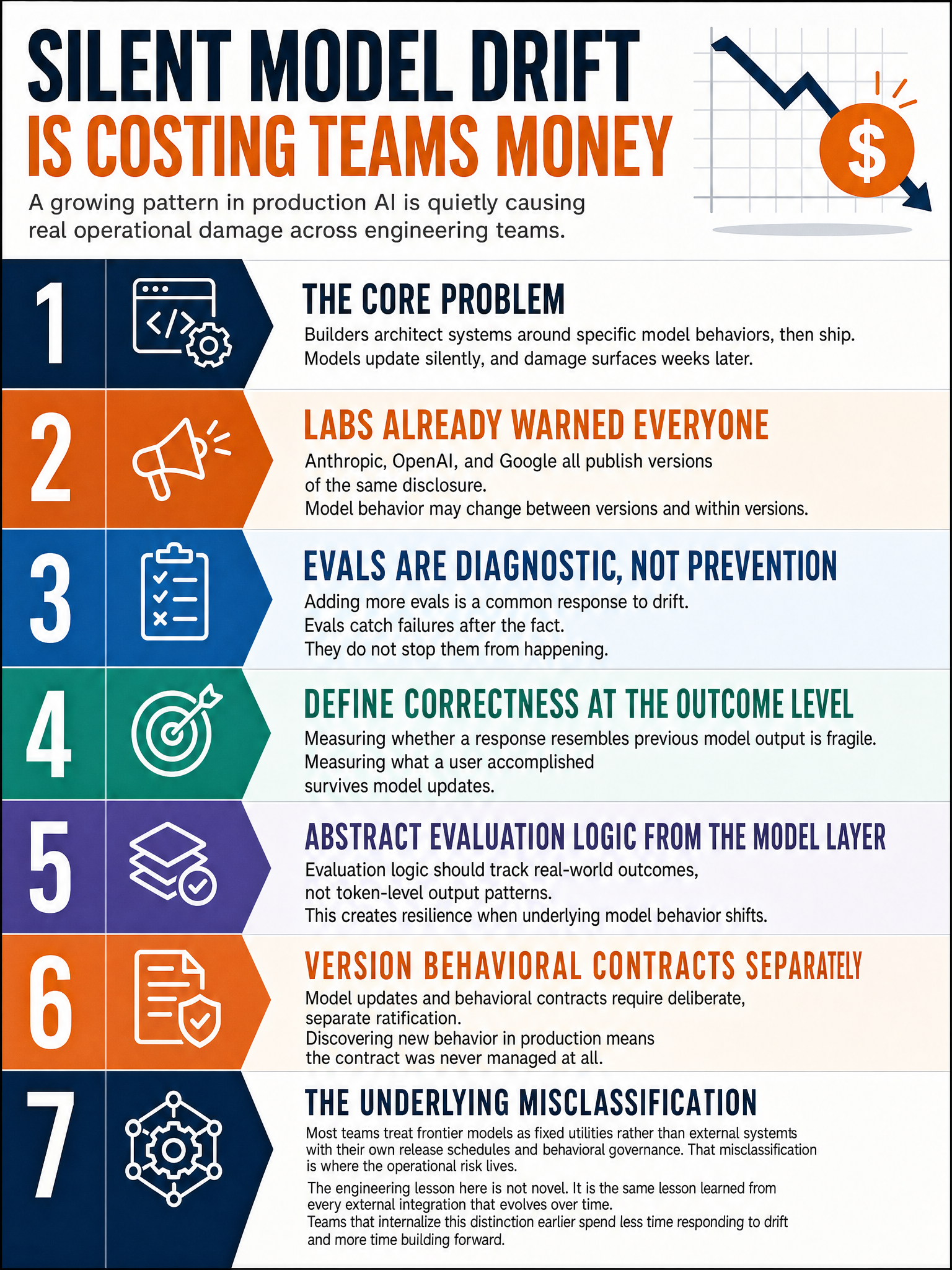
Insight on silent model behavioral drift as an operational production risk, and how to architect evaluation logic that survives model updates
Silent Drift: The Production AI Risk Nobody Puts in the Postmortem
Here is a failure mode I keep watching teams walk into, and it almost never shows up in the incident review. You build a system on a specific model behavior. You tune prompts around it, write evals that confirm it, set thresholds that depend on it. You ship. Then three weeks later, your monitoring catches something weird. Outputs are slightly different. Edge cases that used to resolve cleanly are now failing. A behavior you depended on is just… gone. No announcement. No changelog. No alert from the lab. The model drifted under you, and the damage was already done before you knew to look.
This is not a hypothetical. It is Tuesday in production AI.
The Sentence That Does the Most Quiet Work in AI Today
Anthropic, OpenAI, Google DeepMind. They all carry some version of the same disclosure buried in their model cards and usage policies: model behavior may change between versions and within versions. That sentence is doing enormous work right now, and most teams are not taking it seriously enough.
The cadence of releases is not slowing down. Anthropic shipped Claude Fable 5.1 on September 1. OpenAI followed almost immediately with GPT-6 Astra. Meta dropped Muse Spark 1.5 in the same window. These labs are in a full sprint, and when you are releasing at that pace, behavioral consistency across versions is simply not the priority. Capability is the priority. You are building on a foundation that the people who poured it are actively jackhammering.
Why More Evals Are Not Enough
The standard response from engineering teams is to add more evals. That is the right instinct and also an incomplete one.
The problem with evals is that they are written to confirm the behavior you expect today. They test for known failure modes. Silent drift, by definition, introduces failure modes you did not anticipate when you wrote the suite. Your evals pass. Your thresholds hold. Your dashboards look clean. And somewhere in the long tail of real user inputs, the model is doing something different than it was doing last month.
What you actually need is evaluation logic that treats the model itself as an untrusted input. That means behavioral fingerprinting at deploy time, not just at launch. It means regression tests that run against a frozen reference output set on every model update, even minor ones. It means alert logic that fires on output distribution shifts, not just hard failures.
Architecting for Drift
The architecture changes I have seen work in practice are not complicated, but they require accepting an uncomfortable premise: the model will change, and you will not always know when.
First, version-lock aggressively where the API lets you, and log when you cannot. If the provider forces a version bump, that event should trigger an automatic eval run, not a human decision to maybe run evals later.
Second, build a behavioral baseline at every deploy. Run a fixed prompt battery, store the outputs, and compare distributions on subsequent deploys. You are looking for semantic drift, not just string matching.
Third, separate your eval logic from your prompt logic. Teams that couple these together end up rewriting evals every time they tune prompts, which means the evals are validating the new behavior rather than catching regression from old behavior.
Fourth, treat latency and token-count changes as behavioral signals. A model that starts producing significantly longer outputs on the same prompts has changed something about its instruction-following defaults, even if the content looks similar on a quick read.
The Operational Reality Right Now
With Dario Amodei publicly calling for a development slowdown in September 2026 (https://www.politico.com/news/2026/09/12/anthropic-ceo-dario-amodei-seeks-immediate-slowdown-artificial-intelligence-01073519), and multiple researchers at both Anthropic and OpenAI echoing that concern publicly, there is at least an acknowledgment from the labs that the pace is a problem. But acknowledgment does not freeze your production environment. The tech-insider.org breakdown of the proposed “AI development brake” made clear that pacing does not mean halting model releases. The API cadence is not stopping.
That means the operational burden lands on you.
The teams that are handling this well are the ones who stopped thinking of the model as a stable dependency and started treating it the way you treat a third-party data feed: assume it will change, build detection around change, and have a rollback story before you need one. That mindset shift is the actual work. The tooling is secondary.
If your current system would not catch a 15% semantic shift in model output within 48 hours, you do not have a monitoring problem. You have an architecture problem, and the next model release is coming whether you are ready or not.
Sources
#ProductionAI #MLOps #AIEngineering #ModelDrift #LLMOps #AIArchitecture