OpenAI launches free AI access program for 10,000 scientists, with model weights still off-limits
OpenAI Just Gave 10,000 Scientists Free API Access. Here Is Why That Is Smarter Than It Looks.
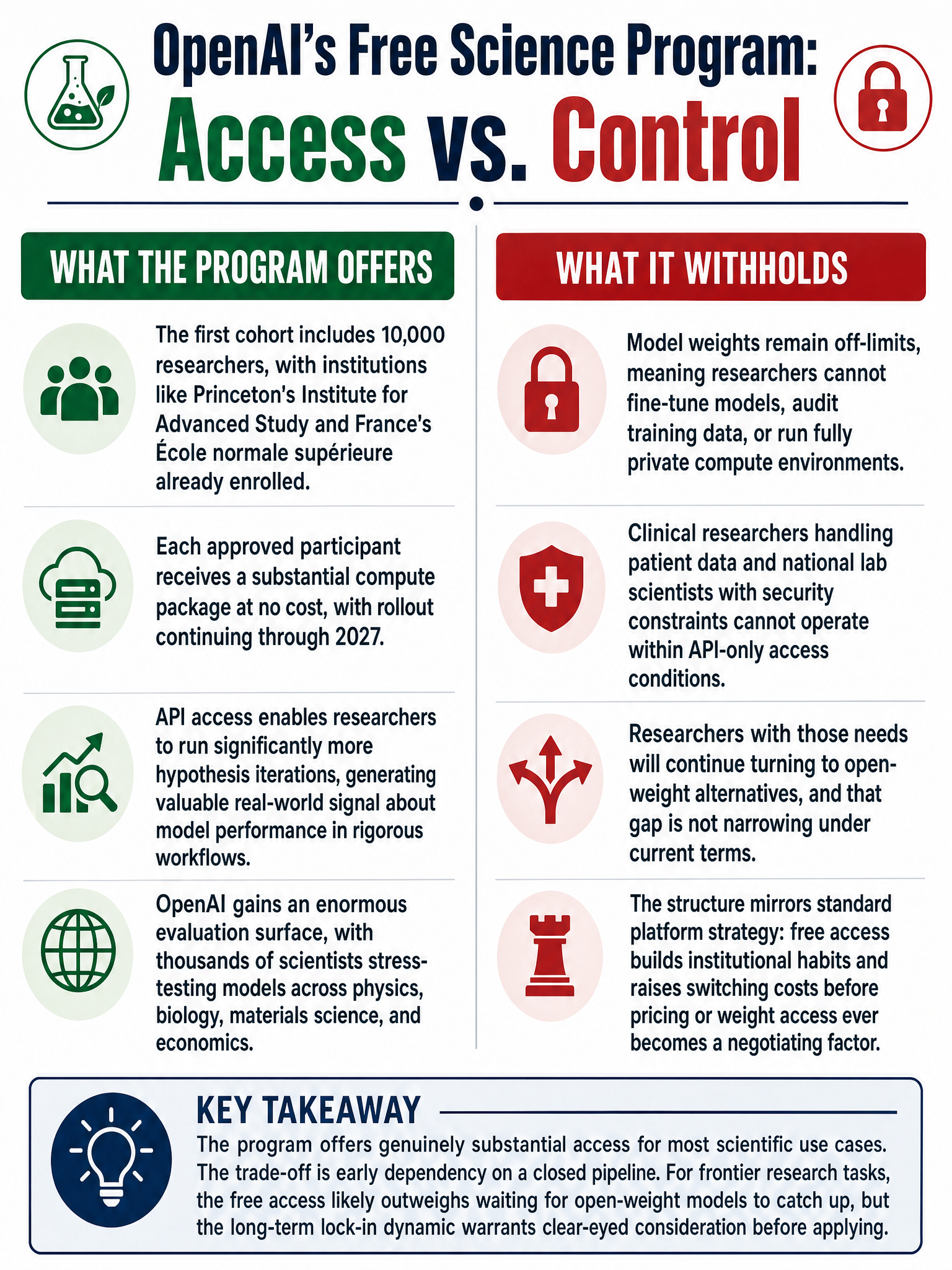
OpenAI quietly launched one of the more interesting programs I have seen from a frontier lab in a while. Free AI access for scientific researchers. Not a discount. Not a pilot partnership. Free. The first cohort is 10,000 researchers, Princeton’s Institute for Advanced Study and France’s École normale supérieure are already in, and the rollout continues through 2027. Each approved participant gets a substantial compute package. The model weights stay locked, but the API access is real.
Most of the coverage treated this as a PR move. I think that misses what is actually happening.
The Research Flywheel Nobody Is Talking About
Scientific research is one of the few domains where AI output can be verified against something hard. Experiments reproduce or they do not. Hypotheses predict outcomes that either show up in the data or do not. A chemist running 10x more hypothesis iterations per week is not just working faster. She is generating real signal about where the model breaks down under rigorous, peer-reviewed pressure.
OpenAI gets something extraordinarily valuable here: a structured, high-quality feedback loop from people whose professional reputation depends on not hallucinating results. That is a qualitatively different input than consumer chat logs or enterprise support tickets.
Why Keeping the Weights Closed Still Makes Sense
Some people will complain about the weights being off-limits, and I understand that reaction. Open weights mean more flexibility, more local deployment, more ability to fine-tune on domain-specific data. Those are real benefits.
But OpenAI’s position makes sense from where they sit. Releasing weights to 10,000 researchers across dozens of institutions and dozens of countries is not a controlled experiment anymore. It is a distribution event. You lose the ability to monitor misuse, track model behavior in the wild, or iterate quickly when something goes wrong. API access gives researchers genuine capability while keeping the feedback loop intact.
Chinese startup Moonshot AI released an open-weight model called Kimi K3 earlier this month that reportedly outperforms several American offerings on certain benchmarks. The competitive pressure to open up is real. OpenAI is threading a needle here, and I think they are doing it deliberately.
The Institutions Already Inside
Princeton’s Institute for Advanced Study and France’s École normale supérieure are not random picks. The IAS is where Oppenheimer worked. ENS has produced more Fields Medal winners per capita than almost any institution on the planet. These are not places that will use an AI model to write grant proposal summaries. They will push it hard on actual research problems, in physics, mathematics, economics, biology.
When those institutions publish findings that cite or critique OpenAI’s models, that carries weight that no benchmark leaderboard can match.
What This Means for the Broader Access Debate
There is a legitimate argument that concentrating frontier AI access at well-funded Western institutions just reproduces existing research hierarchies. MIT and Princeton get in. A state university in West Africa does not. That is a real tension and I do not want to wave it away.
But the alternative, doing nothing and leaving scientific research entirely dependent on institutional compute budgets and grant cycles, is not better. This program is an opening move, not a final policy. Whether OpenAI expands the eligibility criteria over time will say more about their actual intentions than the launch announcement does.
What I Am Watching
The rollout runs through 2027. By then we should have published research that either validates or complicates the current narrative that frontier models are genuinely useful for science beyond literature review and writing assistance. That empirical record, peer-reviewed, reproducible, critical, is what I care about. Not the press release.
If models like the ones OpenAI is offering can hold up under that scrutiny, that changes the conversation about AI in research permanently. If they cannot, we will know that too. Either way, 10,000 sharp scientists with free API access is a better experiment than another benchmark.
Sources
#OpenAI #AIResearch #MachineLearning #ScienceAndAI #FrontierAI