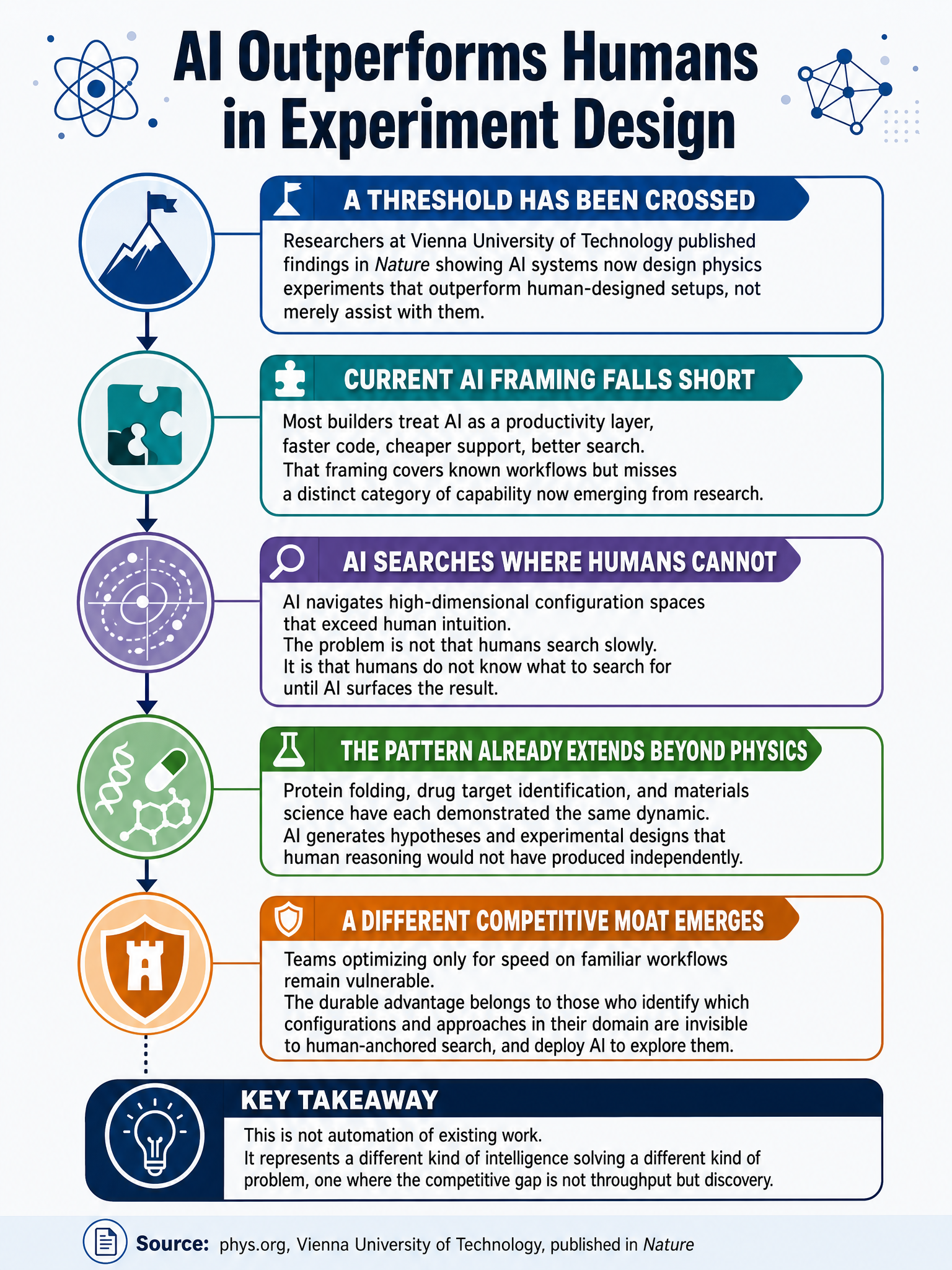
AI-designed physics experiments outperforming human-designed setups, published in Nature by Vienna University of Technology, and what it means for builders thinking about AI as hypothesis generation vs. workflow automation
AI Designed Better Physics Experiments Than Humans. Now What?
There is a result buried in a September 2026 Nature paper from Vienna University of Technology that deserves more attention than it is getting. Researchers there built an AI system that designs physics experiments, and those experiments outperformed human-designed setups. Not “assisted with.” Not “accelerated.” Outperformed. The paper, authored by Jonathan Klimesch and colleagues, is titled “Designing physics experiments with artificial intelligence” and the DOI is 10.1038/s41586-026-10898-6. Read that title slowly. The AI is not running experiments. It is designing them.
That is a different category of thing.
Why Hypothesis Generation Is the Harder Problem
Most builders, myself included, have been thinking about AI as a productivity layer. Faster code review, cheaper support queues, better search over internal docs. That framing is correct for a lot of the work happening right now. But it quietly assumes that humans are still generating the questions worth asking.
The Vienna result breaks that assumption. Physics experiments live in enormous configuration spaces. Angles, materials, timing, geometry, all interacting in ways that human intuition navigates through a combination of training and heuristic shortcuts. The AI found configurations that human researchers did not find. Not because it worked faster, but because it searched differently.
That is hypothesis generation. And it is not a workflow problem.
What High-Dimensional Search Actually Means
Here is the part that should make any ML engineer sit up. Human experts are good at searching near known solutions. We explore neighborhoods. We have priors built from years of reading the same papers and running the same categories of experiments. That is a strength most of the time and a ceiling all of the time.
AI systems, when designed well, do not share our priors. They will try configurations that look wrong to a trained physicist because nothing in their objective function penalizes looking wrong. Some of those configurations are garbage. Some of them are the paper that gets published in Nature.
The Vienna team essentially demonstrated that the ceiling imposed by human intuition in experimental design is real and measurable. That is a significant empirical result, not a philosophical claim.
🔬 What This Means for Builders
If you are building AI-powered products, this paper is a prompt to ask a harder question than “how do I make my users faster?”
The more interesting question is: what decisions in your domain are being constrained by human priors that nobody is questioning? Experiment design in drug discovery. Portfolio construction. Infrastructure architecture choices made the same way for a decade because everyone who works there trained under people who made the same choices.
These are not workflow problems. Wrapping them in a chatbot or a copilot does not address them. They require AI systems that can generate and evaluate candidate hypotheses at scale, in high-dimensional spaces, without inheriting the same blind spots as the domain experts who define the objective functions.
That is genuinely hard to build. It also means the leverage is enormous if you do it right.
The Uncomfortable Implication
I want to be direct about something. A result like this is easy to read as “AI is coming for scientists.” I do not think that is the right frame. The Vienna paper does not describe an AI that understands physics. It describes an AI that searches experimental configuration spaces in ways humans cannot. The physicists still designed the search problem, defined what “better” means, and interpreted the results.
But the scope of what AI can productively contribute to that chain is wider than most teams are building for. Most AI product roadmaps I see stop at “help the human do the thing faster.” The Vienna result is evidence that there is a class of contributions where AI finds things the human would not have thought to look for. Those are different products. They require different architectures, different evaluation frameworks, and a different conversation with stakeholders about what the system is actually for.
We are not all building physics experiment designers. But we are all building in domains where human priors have ceilings. This paper is a useful reminder that those ceilings are real, measurable, and not permanent.
Sources
#AIResearch #MachineLearning #AIStrategy #ScientificAI #BuildingWithAI