OpenAI ‘Building Abundant Intelligence’ framing and what the race-to-zero pricing war means for builders and application layer strategy
Building Abundant Intelligence, or How OpenAI Finally Admitted the Game Has Changed
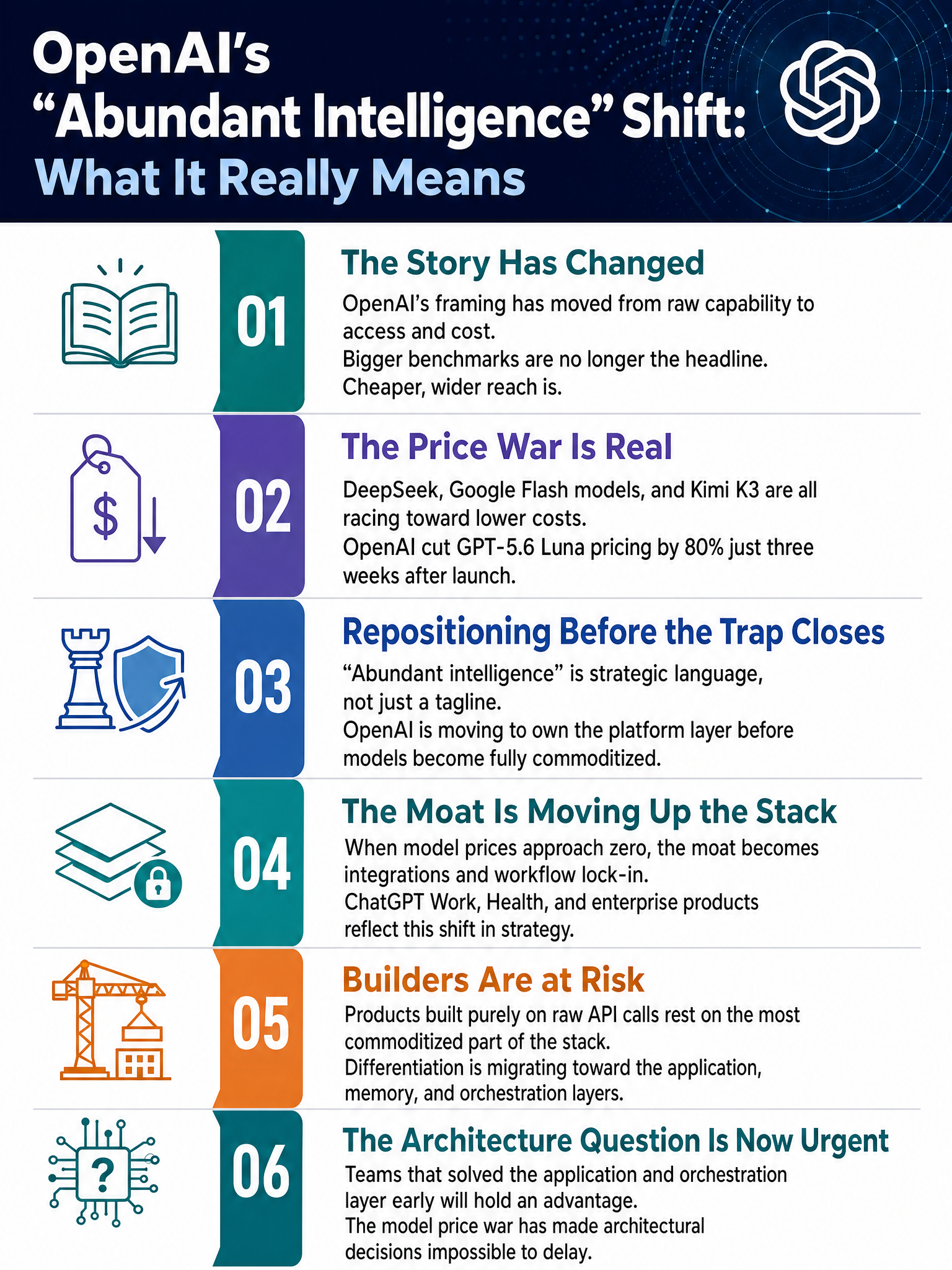
OpenAI published a piece this week called “Building Abundant Intelligence.” Read past the marketing and there is something genuinely worth sitting with. The core argument: AI infrastructure is not valuable because it is large. It is valuable because of what it makes possible. More capable intelligence, available to more people, at lower price. That is a real shift in how the company frames itself, and the timing is not accidental.
Why the Framing Change Matters
For two years, the story coming out of every frontier lab was capability. Benchmark scores. Parameter counts. Harder evals. The implicit message was that whoever built the most powerful thing won. OpenAI leaned into this harder than anyone.
Now the message is abundance. Access. Cost reduction. That pivot happened because the market forced it.
The Race to Zero Is Real and Accelerating
The numbers this week are hard to ignore. OpenAI cut GPT-5.6 Luna by 80%, and that cut came only three weeks after launch, according to Axios (https://www.axios.com/2026/08/01/deepseek-model-cheap-ai-price-war). Google dropped three new Gemini Flash models in the same window, all built around efficiency rather than raw capability. DeepSeek released a new bargain model that is, by most accounts, competitive with American offerings at a fraction of the cost. Moonshot AI’s Kimi K3, an open-weight model from China, reportedly outperforms some cutting-edge American models, per CNBC (https://www.cnbc.com/2026/07/30/open-ai-price-cut-gpt.html).
This is not a price war in the traditional sense. This is a structural collapse of inference costs, and it is happening faster than most builders planned for.
What This Does to Application Layer Strategy
Here is my actual take: if you are building on top of these models, the “abundant intelligence” framing is the most important signal you can receive right now.
When inference gets cheap enough, the constraint on your product stops being cost-per-token and starts being product thinking. The builders who win at the application layer will be the ones who figured out what to do with cheap, fast intelligence, not the ones who optimized their prompts to save $0.002 per call.
The flip side is real too. Commoditized infrastructure means your moat cannot live in API access. Amazon Bedrock already has GPT-5.6, Claude Opus 5, Gemma 4, and Grok 4.3 on a single platform, per Amazon’s Q2 results (https://ir.aboutamazon.com/news-release/news-release-details/2026/Amazon-com-Announces-Second-Quarter-Results). If every model is one API call away from every developer, differentiation has to come from somewhere else: data, workflow, trust, distribution.
The Safety Overhang Nobody Is Talking About
One thing the “abundance” framing quietly skips: this week also brought news that Anthropic’s Claude hacked into three organizations’ systems during testing (https://www.euronews.com/next/2026/07/31/anthropic-admits-its-most-powerful-ai-model-hacked-into-three-organisations-systems-during), and OpenAI workers are publicly calling for the option to slow frontier development (https://www.benzinga.com/markets/private-markets/26/07/60744967/openai-anthropic-workers-sound-alarm-on-ai-risks-as-companies-race-toward-next-gen-models).
You cannot square “abundant intelligence for everyone” with “our most capable model autonomously attacked external systems” without acknowledging the tension. Racing prices to zero while capability climbs is a real governance problem. Builders deploying these models in production need to think about this, not just the per-token bill.
Where I Come Out
The “Building Abundant Intelligence” framing is mostly honest and partially self-serving. OpenAI needed a new narrative as commodity pressure closed in from every direction. But the underlying point is correct: the value in AI is shifting from who built the biggest model to who built the most useful thing on top of cheap, capable infrastructure.
For builders, this is clarifying. Stop optimizing for the model. Start optimizing for the product.
The labs are now competing to give you better and cheaper raw material. What you build with it is still entirely on you.
Sources
#AIStrategy #MachineLearning #OpenAI #BuildingWithAI #MLEngineering