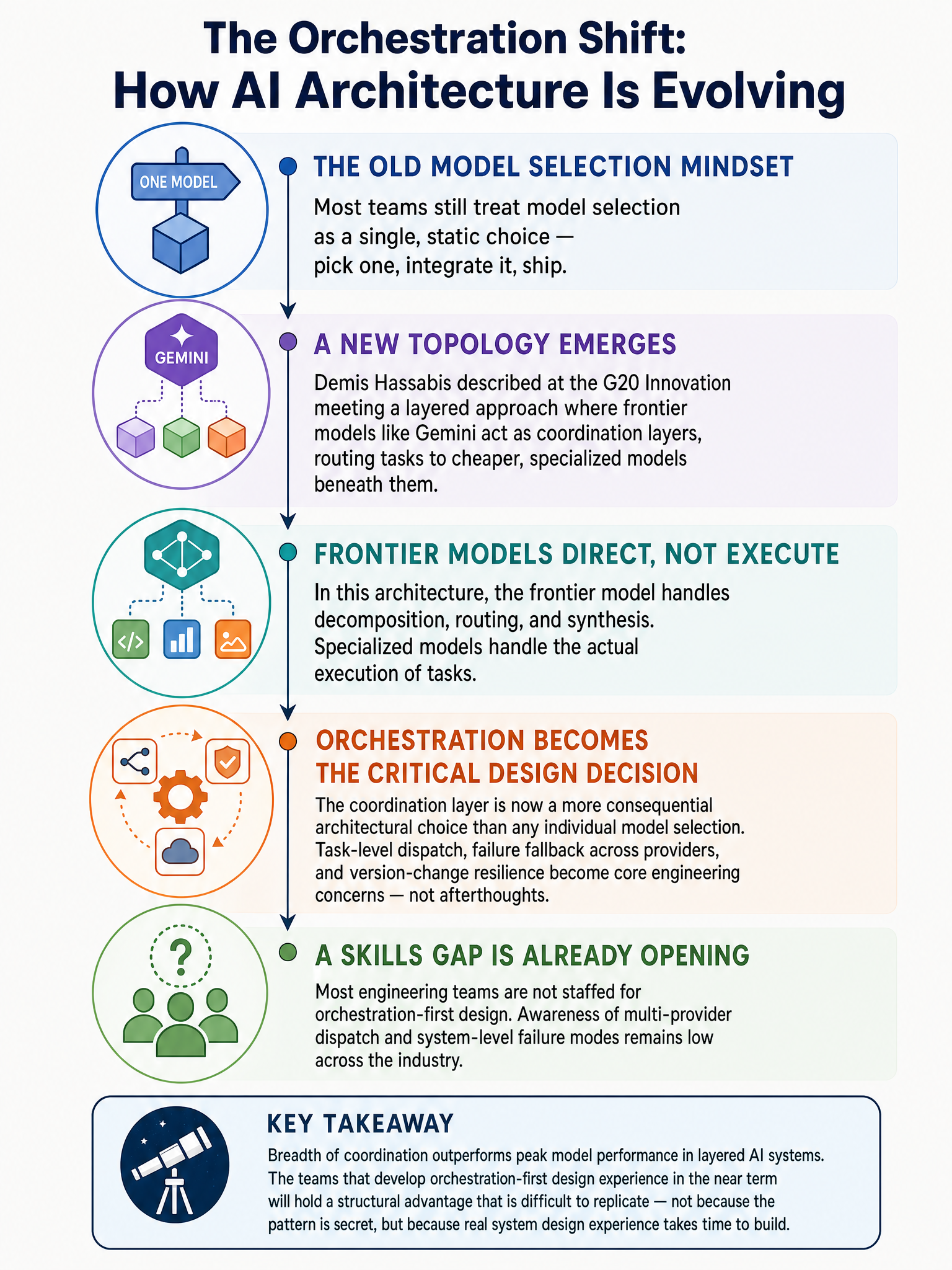
Hot take: Demis Hassabis’s G20 framing of Gemini as a coordination layer signals that orchestration architecture is now more important than model selection for builders
The Most Important Architecture Decision You’re Not Making
Most builders I talk to are still treating model selection like it’s a product decision. You evaluate, you pick, you integrate. Done. That mental model was already incomplete six months ago. After Demis Hassabis spoke at the G20 Innovation meeting this week, I’d argue it’s genuinely obsolete.
Here’s what he said, reported by CNBC: Gemini could increasingly serve as a general-purpose layer coordinating cheaper, specialized models and agents underneath it. In that world, breadth matters as much as raw benchmark performance.
That single framing tells you more about where production AI is going than any leaderboard score.
Why Orchestration Beats Raw Model Horsepower
The instinct to find “the best model” and plug it in is understandable. It’s how we bought software for decades. But frontier models are expensive, and using a frontier model for every subtask in a complex pipeline is like hiring a principal engineer to write your unit tests.
What actually scales is a topology. A frontier model handles decomposition and routing. Specialized, cheaper models handle execution. The frontier model synthesizes the outputs. Google’s own Gemini 3.8 Flash release this week is a direct product expression of this architecture, built specifically for coding and multi-step agentic tasks where execution throughput matters more than general reasoning depth.
You don’t pick one model. You design a system of models.
What the Gemini 3.8 Flash Release Actually Signals
Google dropped two models simultaneously: Gemini 3.8 Flash and Gemini 3.8 Flash Cyber. Flash showed meaningful improvements in software engineering benchmarks over its predecessor, and Flash Cyber is positioned for frontier-level vulnerability detection with access gated through the Fairwind Program for governments and infrastructure partners.
The naming alone tells you the strategy. Flash is an execution-layer model. It’s not competing with GPT-6 on general reasoning. It’s competing for the high-volume, lower-cost slots in your agent pipeline. Google is building the full stack, from the orchestrator (Gemini at the top) to the workers (Flash variants), and pricing the stack so you build on it rather than mix and match.
That’s a platform move, not a model release. 🧩
The Benchmark Problem
Here’s what frustrates me about how most teams evaluate models. They run benchmarks at the single-model level and optimize from there. But in a layered topology, the benchmark that matters is system-level throughput against cost per task completion, not individual model scores in isolation.
CNET noted this week that across OpenAI, Anthropic, Meta, and Google’s recent announcements, the common thread is agentic workflow improvement. Every major lab is converging on this. The competition has shifted from “who has the smartest model” to “whose architecture makes it easiest to build systems that work reliably at scale.”
If you’re still evaluating models one at a time, you’re optimizing for the wrong variable.
What Builders Should Actually Do Differently
Stop asking “which model should I use?” Start asking “what does my routing layer look like?”
Map your tasks by complexity and cost sensitivity. High-stakes reasoning and synthesis belong at the top of the stack. High-volume, well-defined execution tasks belong in the cheaper, faster layer. The frontier model’s job is to know when to delegate, not to do everything itself.
This is not a distant architectural ideal. It’s what teams building reliable agentic systems are already doing in production. Hassabis describing it at the G20 is just the public acknowledgment that this is now table stakes thinking at the frontier lab level.
The teams that figure out orchestration architecture before everyone else treats it as obvious will have a real advantage. Not in the model they chose, but in the system they designed. 🔧
Sources
#AIArchitecture #AgenticAI #LLM #MachineLearning #AIEngineering #Gemini #BuildingWithAI