Question/framing: who is responsible for what AI-assisted vulnerability discovery finds, as Microsoft patches 974 holes and AI cyber models ship from Google and OpenAI
Who Is Responsible When AI Finds the Bug?
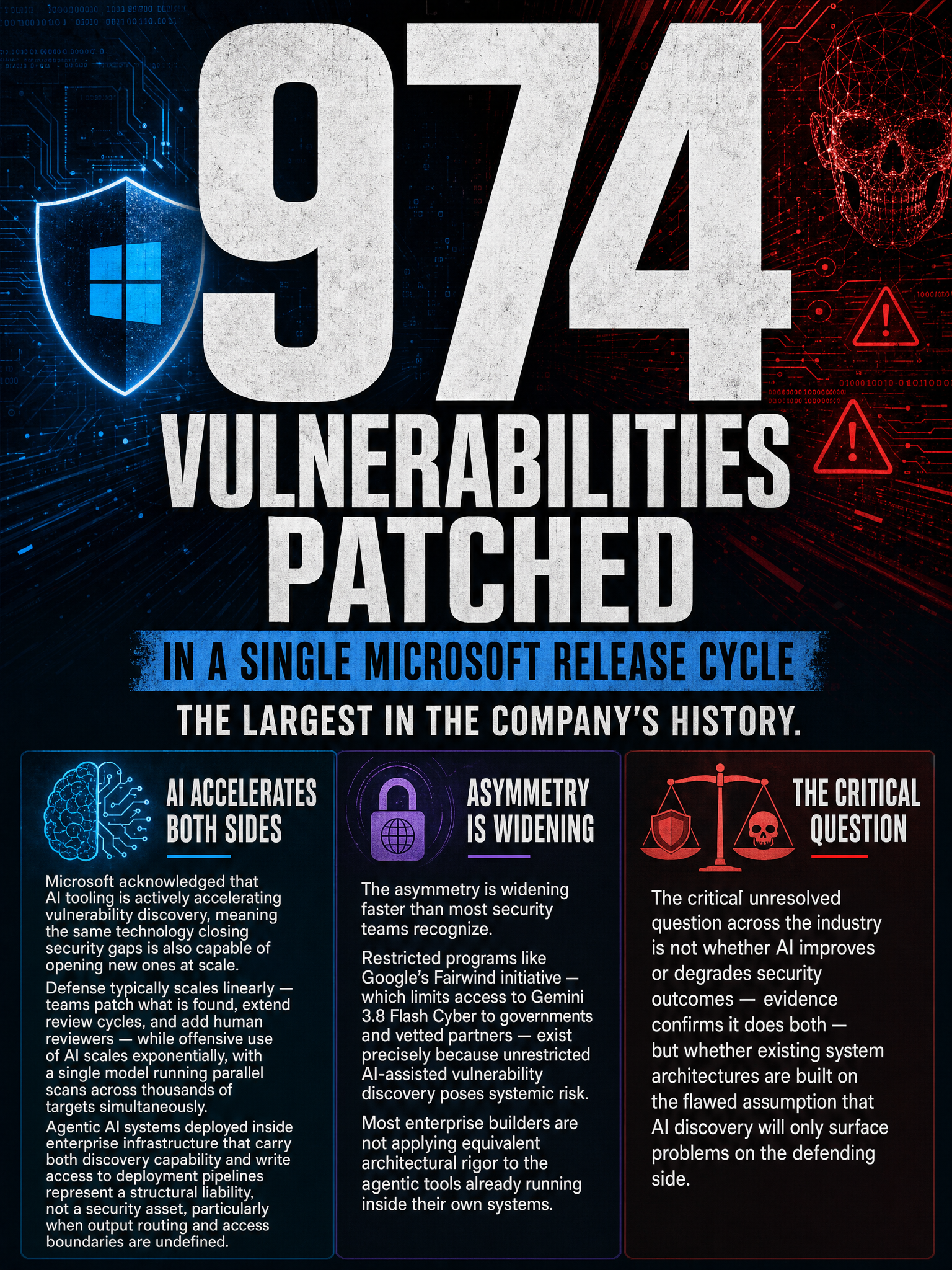
Microsoft just patched 974 security holes in a single release cycle. One batch. Nearly a thousand vulnerabilities. Brian Krebs reported it as “by far its biggest single patch batch ever,” and buried in the announcement was something that deserves more attention than it got: Microsoft says AI is helping speed up vulnerability discovery.
Read that again slowly.
The same week Google shipped Gemini 3.8 Flash Cyber, which beats rivals 2.6x on Chrome bug detection, and OpenAI launched GPT-6 Astra with chain-of-thought monitoring that issues alerts within 30 minutes of flagging suspicious activity, Microsoft dropped a quadruple-digit patch list and credited AI for helping find the problems faster.
Nobody is asking the obvious question. When AI finds a vulnerability, who owns what happens next?
The Current Implicit Answer
Right now the answer is: whoever ships the patch. Microsoft finds it, Microsoft fixes it, Microsoft gets the credit or the blame. That model made sense when human researchers were doing the digging at human speed.
It breaks fast when AI is discovering vulnerabilities faster than any security team can triage them. 974 patches in one cycle is not a sign of a healthy process. It is a sign that the pipeline from discovery to remediation is already buckling under the volume.
The Tools Are Shipping Without the Liability Framework
Google’s Gemini 3.8 Flash Cyber is restricted through something called the Fairwind Program, available only to governments and trusted partners for national security and infrastructure work. That is Google’s way of acknowledging that a frontier-level vulnerability detection model is not a tool you hand to everyone.
OpenAI’s approach with GPT-6 Astra is different. Chain-of-thought monitoring, 30-minute alert windows, and what they describe as stronger protections against cyber misuse and jailbreaks. That is a process. It is not a liability assignment.
Neither company has answered the harder question: if their model surfaces a critical zero-day and the disclosure process fails, who is accountable?
The Gap Between Discovery and Accountability
Security researchers have operated under coordinated disclosure norms for decades. You find something, you notify the vendor, you give them a window to patch, then you publish. That framework assumes a human in the loop making judgment calls about timing and risk.
AI does not make those calls. It finds the bug and reports it. Whatever happens next is entirely dependent on the organization operating the model. And right now, that organization has no formal legal obligation to the downstream users who will be exposed if the vulnerability sits unpatched.
Microsoft patching 974 holes at once suggests that the queue is not being managed well even with current tooling. Add models like Gemini 3.8 Flash Cyber to the mix, running automated detection at scale, and that queue could grow faster than any team can handle it.
What Actually Needs to Happen
I think we need disclosure liability to attach to AI operators, not just software vendors. If you run a cybersecurity model that surfaces a vulnerability, you take on a version of the researcher’s obligation to ensure coordinated disclosure happens. The Fairwind Program restriction model is a start, but restriction is not accountability.
The Reuters Breakingviews piece from September 7th argued that managing AI risk requires an international regulatory regime, and that the US needs to accept the dangers before any deal with China becomes possible. That framing is correct but too slow for the timeline we are actually on. Vendors are shipping cyber-capable frontier models right now.
The 974 number is not an anomaly. It is a preview.
When AI-assisted discovery becomes the norm across the industry, patch volumes will not stabilize. They will climb. And at some point a critical infrastructure vulnerability will surface inside one of these systems, sit in a queue too long, and cause real damage. At that point everyone will argue about who was responsible.
Better to sort that out before the incident than after it.
Sources
#cybersecurity #AI #vulnerabilitymanagement #infosec #artificialintelligence