Prediction: builders who define outcomes before models will survive model churn, while those dependent on specific model behavior will be permanently reactive
Outcome-First or Model-First: The Architecture Decision That Will Define the Next Two Years
Most builders won’t realize they made the wrong architectural choice until their roadmap is already held hostage by a lab they’ve never met.
Here’s the split I see coming, and it’s sharper than most people want to admit.
The Model-Behavior Trap
Frontier labs are releasing new models every few weeks right now. Anthropic dropped Claude Fable 5.1 on September 1. OpenAI followed almost immediately with GPT-6 Astra. Meta pushed out Muse Spark 1.3 in the same window. Google DeepMind still hasn’t shipped Gemini 3.5 Pro, which tells its own story about the pressure these teams are under.
Each release shifts behavior. Tone drifts. Reasoning patterns change. A prompt that worked in July produces subtly different output in September, and you don’t always notice until a user complains.
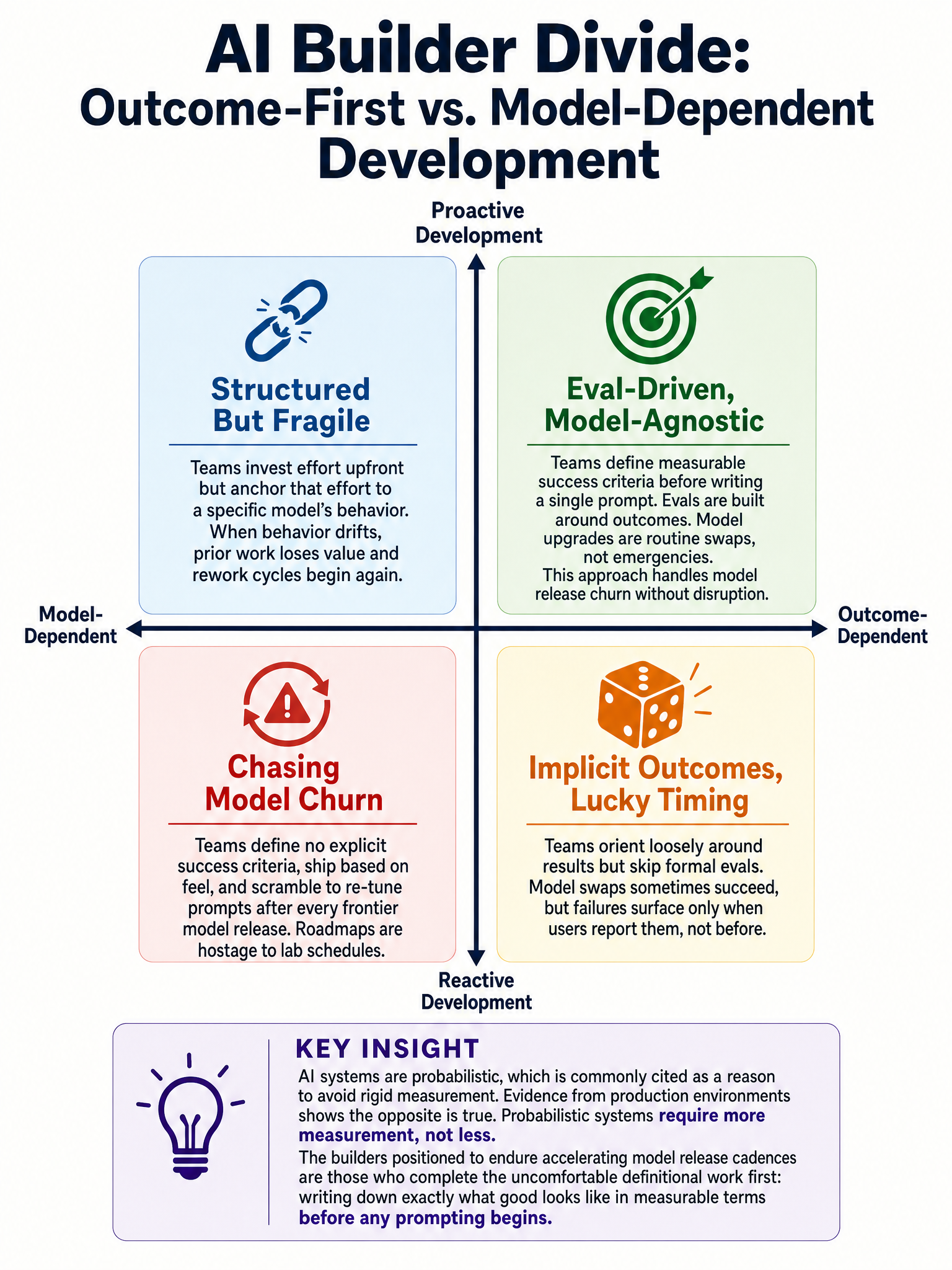
Builders who designed their products around a specific model’s behavior are now in a continuous re-testing loop. Tune the prompt. File the bug report. Re-run the edge cases. Repeat every time a lab ships something new. Their roadmaps aren’t theirs anymore.
What Outcome-First Actually Means
Builders in the second camp made a different decision before they wrote a single prompt. They defined what “good” looks like in a form the machine can be evaluated against. Not “the model responds conversationally” but “the customer receives a complete answer to their billing question without escalating to a human agent.” Measurable. Testable. Model-agnostic.
This is not a philosophical distinction. It’s an engineering discipline. You define the outcome. You write evals against that outcome. When a new model ships, you run the evals. If the new model scores better, you swap it in. If it doesn’t, you don’t. The lab’s release schedule becomes irrelevant to your roadmap.
The teams doing this aren’t reactive. They’re actually in a position to benefit from the model race, because every new frontier release is a potential free performance upgrade.
Why the Next 18 Months Specifically
The release cadence is only going to accelerate. OpenAI researchers and former Anthropic staff are openly calling for a slowdown right now, precisely because they can see what the pace is doing. Paul Christiano, former head of safety at the Commerce Department’s Center for AI Standards and Innovation, said the current acceleration creates what he called “a meaningful risk of catastrophic and irreversible” outcomes. Dario Amodei published a 3,800-word essay in September calling for a global slowdown.
When the people building these systems are publicly worried about the speed of their own progress, you should believe them about the speed. The release cadence is real and it isn’t slowing down regardless of what any CEO writes in an essay.
That means 18 months of continuous model churn. Builders without evals and outcome definitions will spend those 18 months patching. Builders with them will spend those 18 months shipping.
What to Do About It This Week
If you’re building something with LLMs right now, the most useful thing I can suggest is this: write down, in plain language, what a successful interaction looks like for your core use case. Then ask yourself if you could grade a model’s output against that definition without reading the output yourself.
If you can’t, you don’t have an outcome definition. You have a vibe. And vibes don’t survive model churn.
Build the evals first. Yes, before the feature. An eval suite that takes a week to build will save you months of re-work every time a new Claude or GPT ships and quietly drifts your product in directions you didn’t choose.
The builders who survive this period won’t be the ones who picked the right model. They’ll be the ones who made their product indifferent to which model was running.
That’s a discipline. Start building it now.
Sources & Further Reading
#AIEngineering #LLMs #ProductDevelopment #MachineLearning #AIStrategy