Cloudflare Adaptive Intelligence self-updating bot detection as a signal for continuous adaptation architecture in production AI systems
Cloudflare Just Showed Us What Production AI Should Actually Look Like
Most AI systems ship with an expiration date baked in. You don’t know when it expires. That’s the problem.
Cloudflare’s new Adaptive Intelligence system caught my attention this week for exactly this reason. It’s their bot detection layer, and unlike every other security system I’ve seen described in the past decade, it doesn’t run on static rules. It watches live traffic and rewrites its own defenses as attack patterns evolve in real time. That’s not a feature. That’s a different philosophy about what a deployed system is supposed to do.
The Architecture That Actually Matches Reality
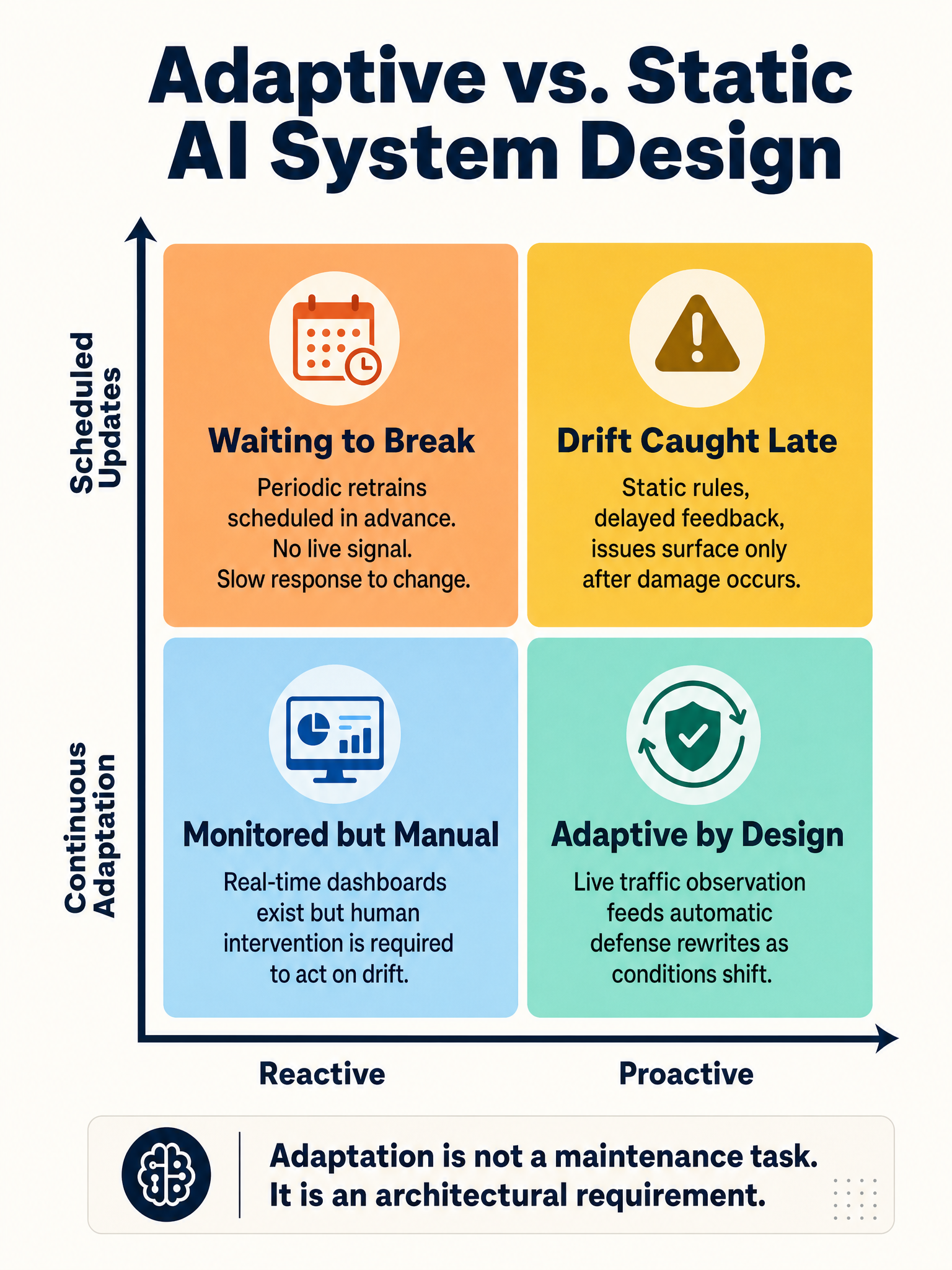
Here’s what most production AI deployments look like in practice. You spend weeks on data prep, model selection, prompt engineering, evaluation harnesses. You ship. You monitor a dashboard. Then sometime later, performance quietly degrades because the world changed and your model didn’t. You find out when a user complains or a metric tanks on a Friday afternoon.
Cloudflare built the feedback loop directly into the product. The system observes live traffic, detects that attack patterns have shifted, and adjusts. No human in the loop waiting for a quarterly retraining cycle. This is what continuous adaptation actually means, not as a slide in a pitch deck but as an operational reality.
Why This Matters Beyond Security
I’ve been thinking about agentic system design a lot lately, and this is the gap I keep running into. We treat deployment as a finish line. It’s not. It’s a starting gun for a different kind of problem.
The timing here is worth noting. On September 1, Anthropic shipped Claude Fable 5.1. OpenAI followed with GPT-6 Astra. The model underneath any production system you’re running right now is probably not the best available option anymore, and that’s before you account for the fact that your users’ behavior has also shifted since you last evaluated anything.
Dario Amodei published an essay on September 12 calling for AI companies to slow development, noting that models are advancing faster than engineers can fully understand them. I take that seriously. But it also makes the case for continuous adaptation architecture even stronger, not weaker. If the underlying capabilities are moving this fast, static deployment patterns become dangerous, not just inefficient.
What Continuous Adaptation Actually Requires
The Cloudflare approach points to something specific: a system that treats its own operational data as a training signal. Not batch retraining on a schedule. Not human-reviewed model updates. Feedback wired into the inference loop itself.
For production AI systems, this means a few concrete things. You need evaluation that runs continuously against live traffic, not just a held-out test set from six months ago. You need drift detection that triggers adaptation, not just alerting. And you need the humility to accept that your deployment is a hypothesis, not a conclusion.
Most teams I talk to have the alerting. Almost none have the adaptation.
The Broader Signal
Shane Legg at Google DeepMind called Amodei’s call to slow frontier model releases “interesting directionally.” Geoffrey Irving, former chief scientist of the U.K. AI Security Institute, went further and said companies should stop training new models entirely. I’m not here to arbitrate that debate. What I will say is that regardless of how fast the frontier moves, the gap between what’s possible and what’s actually running in production keeps widening.
Cloudflare’s Adaptive Intelligence is one concrete answer to part of that problem. It’s not magic. It’s a feedback loop with teeth.
The real question for anyone building production AI right now is whether your system knows it’s getting worse, and whether it can do anything about it without you having to notice first. If the answer to both is no, you’ve built a system with an expiration date and no alarm clock.
Sources
#AIEngineering #ProductionAI #MLOps #Cloudflare #AgenticSystems