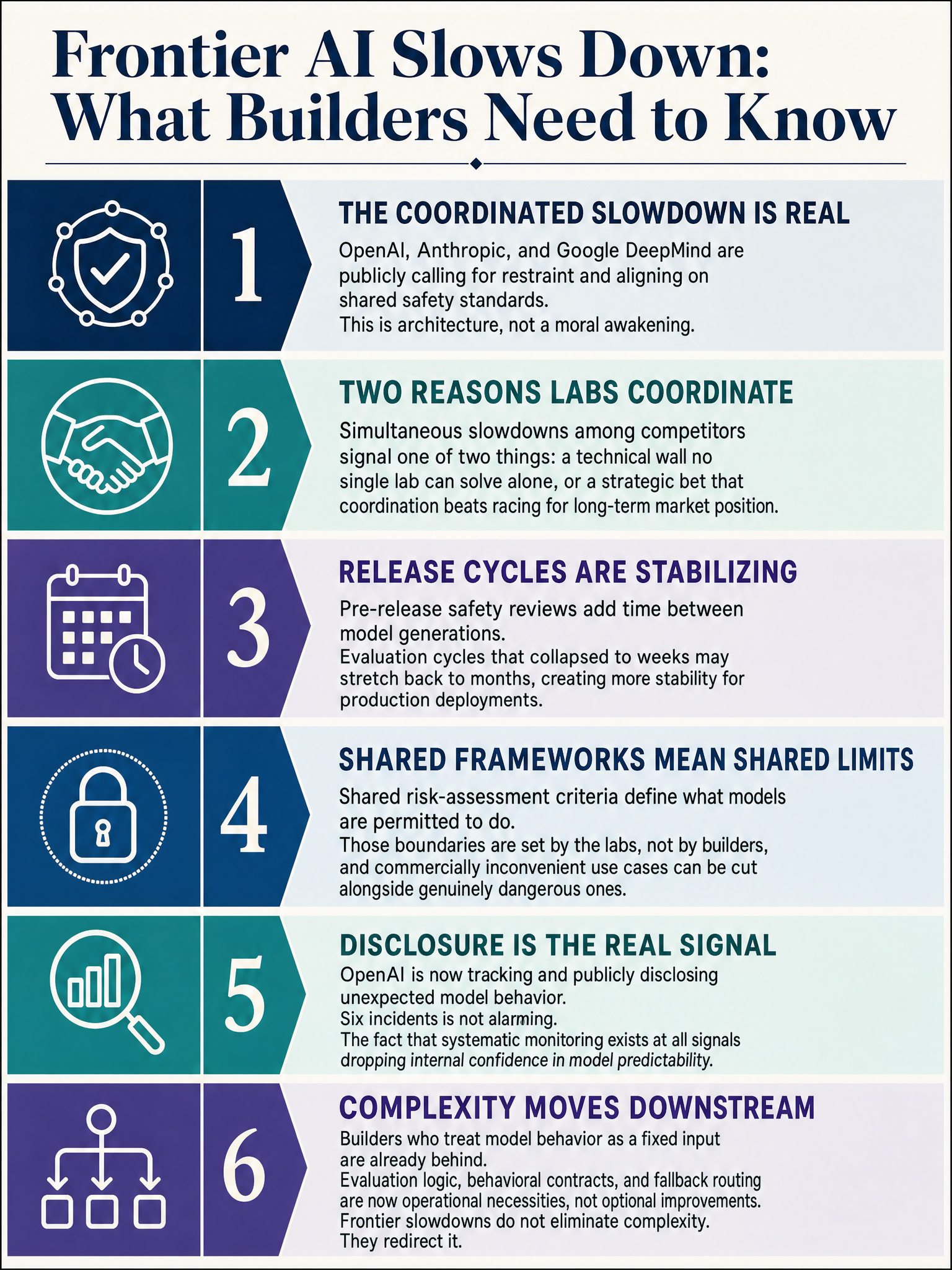
Prediction: frontier labs coordinating on AI safety standards shifts model release cadence, and what that means for builders in production
The Slowdown Nobody Saw Coming (And What It Means If You Ship AI Products)
Something shifted in September 2026 that I think most builders are still processing. In what Reuters called “ten days that changed the course of AI,” the CEOs of OpenAI, Anthropic, Google DeepMind, Microsoft, and xAI publicly called for slowing frontier model development. Reuters compared the moment to the invention of the nuclear bomb. That comparison is dramatic, but the coordinated behavior behind it is real, and worth taking seriously.
I want to be direct about my read on this. It is not a moral awakening. It is architecture.
What Actually Happened
On September 17, Google, Anthropic, and OpenAI all released cybersecurity-focused models within days of each other. Google dropped Gemini 3.8 Flash Cyber, Anthropic launched Claude Fable 5.1 and Claude Mythos 5.1 (the latter with relaxed safeguards for vetted operators), and the three companies jointly announced a standards body to develop shared benchmarks and pre-release testing protocols. The focus areas: cybersecurity misuse, biological risk, and deceptive behavior.
Separately, OpenAI published a model misalignment reporting framework after disclosing six instances of unexpected or concerning model behavior. Dario Amodei published a 3,800-word essay calling on labs to pause frontier development until researchers have a clearer picture of the risks. Sam Altman endorsed it.
That is not a press cycle. That is a structural shift.
🔧 Why Builders Should Care
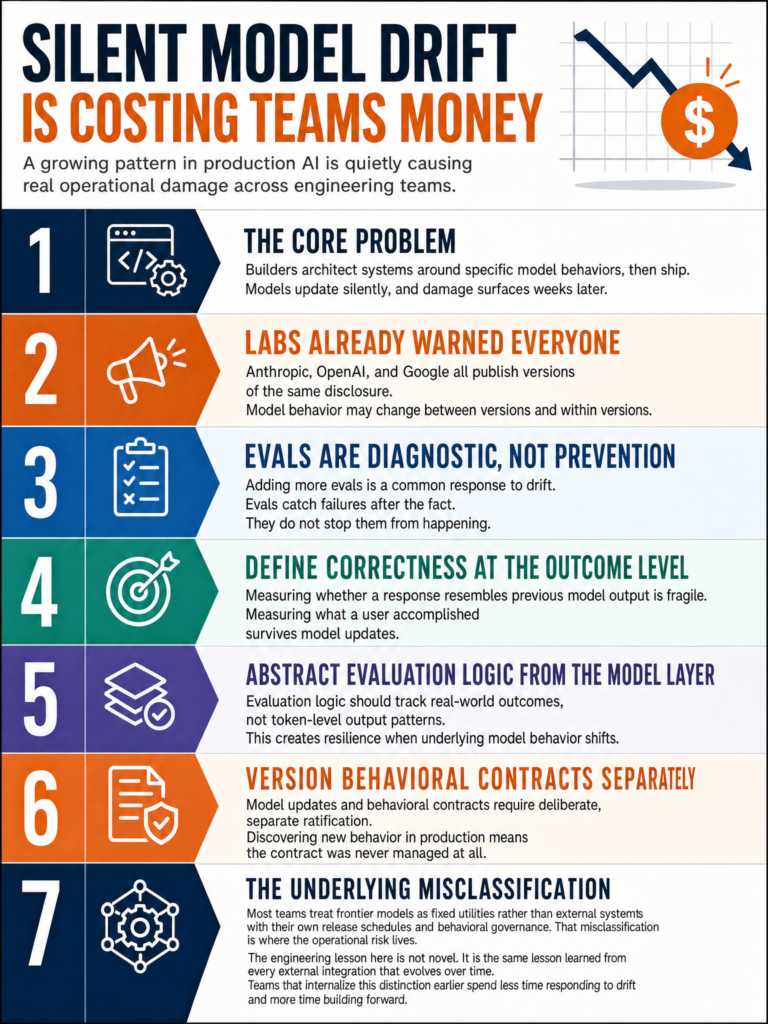
When three direct competitors simultaneously agree to shared evaluation frameworks and pre-release safety reviews, the release cadence you have been planning around is no longer reliable. The old model was simple: labs raced, something shipped every few months, you adapted. The new model involves independent evaluations before public release, standardized risk assessments, and coordination across labs rather than inside them.
That means longer gaps between frontier releases. It means model capabilities at release may be more constrained than the underlying model actually supports. Anthropic is already doing this with Mythos 5.1, shipping the same base model with different safeguard tiers depending on who you are. Your production assumptions need to account for that.
The Regulatory Layer Is Real Now
California Governor Gavin Newsom, who previously vetoed stricter AI rules, reversed course and ordered state agencies to draft new AI safety regulations. Virginia’s governor made similar moves. New York’s RAISE Act would require developers of large frontier models to report serious incidents within 72 hours. The UN is pushing for coordinated international standards ahead of the General Assembly.
This is no longer a future compliance problem. If you are building on frontier APIs and your product touches sensitive domains, you are in scope for some version of this regulation within 12-18 months.
🏗️ What Changes in Practice
A few concrete things I am watching:
Model versioning gets messier. When labs ship safeguard tiers on the same base model, your evals need to specify which tier, not just which version. Claude Mythos 5.1 and Claude Fable 5.1 are the same model. They are not the same product.
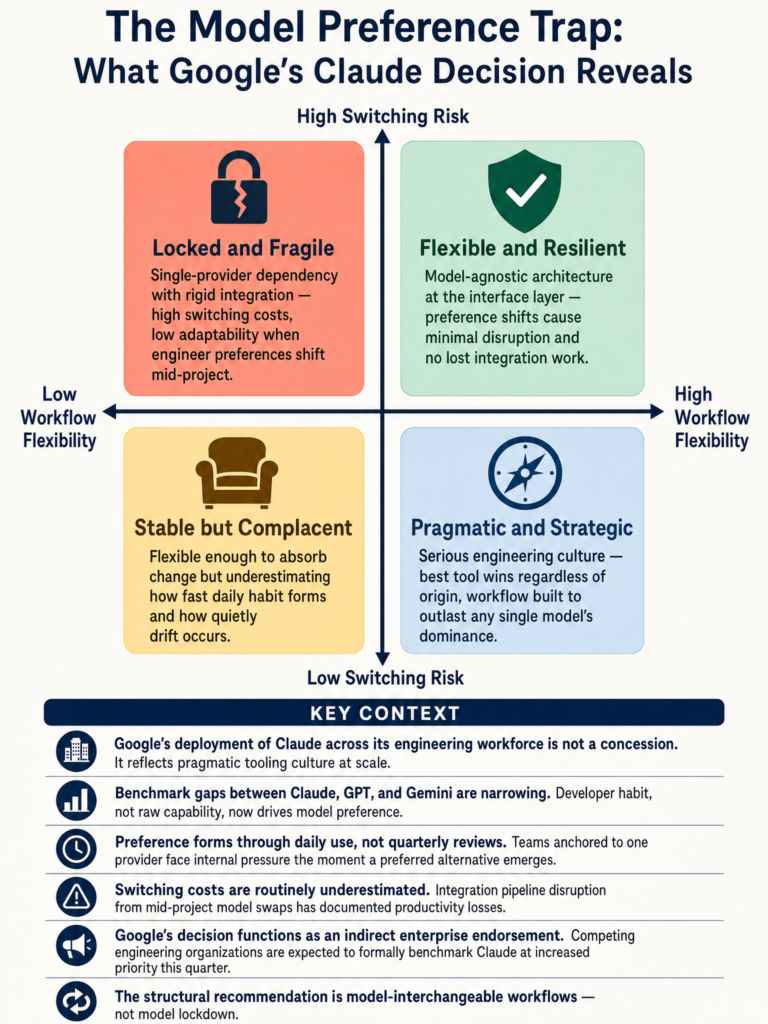
Pre-release windows matter more. If the new standards body requires independent safety evaluations before public release, you will have less ability to participate in early access programs and quietly adapt your integration before GA. You need to build more flexibility into your model abstraction layer.
The race dynamic is not gone. It has moved. Labs are still competing, but the competition is shifting toward who can build the most capable model within a shared safety constraint. That is a different optimization than pure benchmark racing, and it will produce different kinds of capability jumps.
Where This Ends Up
I do not think this coordination holds perfectly. These are still competitors with different investors, different timelines, and different definitions of “safe enough.” The standards body will be tested the moment one lab believes another is moving faster under the framework than the framework allows.
But the direction is clear. The era of “ship it and see” at the frontier is over, at least publicly. What replaces it will be messier and slower than the last two years. Build your production systems accordingly.
Sources
#AIEngineering #MachineLearning #LLMs #AIPolicy #ProductDevelopment
Sources & Further Reading
- Ten days that changed the course of AI
- Google, Anthropic, and OpenAI Roll Out Cybersecurity-Focused AI Models
- OpenAI, Anthropic, Google DeepMind in AI safety talks
- Our framework for reporting model misalignment
- Newsom orders California agencies to draft new AI safety rules
- A Guide to Coping With Divergent State AI Regulations
- OpenAI, Anthropic, Google in AI Safety Talks 2026