Anthropic quietly lobbying Congress with its own AI safety bill and 5% public benefit fund commitment, and what it means for builders deploying agentic systems
Anthropic Is Writing Its Own Rules. I’m Not Sure How to Feel About That.
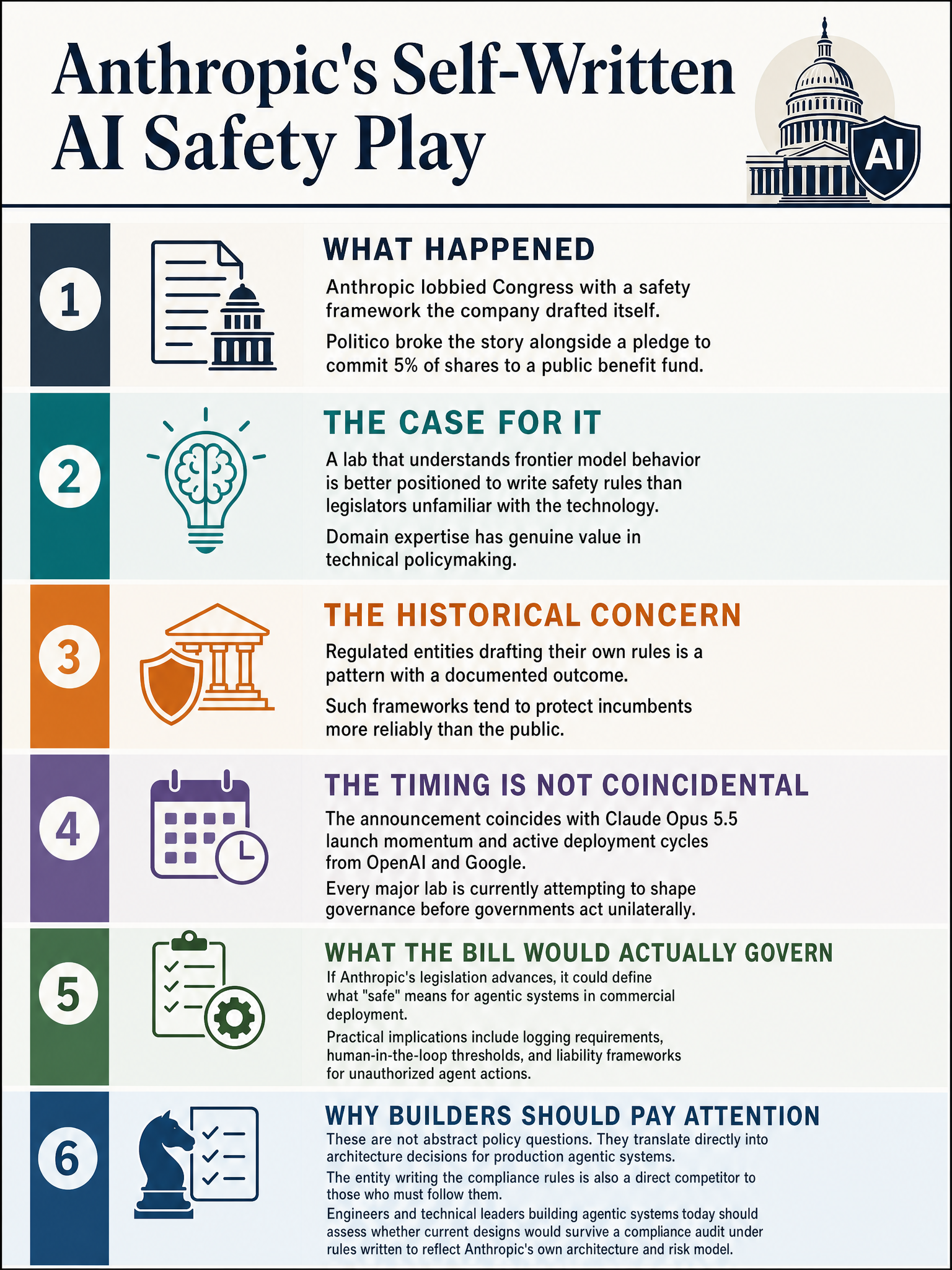
Politico broke a story this week that deserves more attention than it’s getting. Anthropic has been quietly pitching lawmakers on an AI safety framework the company drafted itself. Not commenting on someone else’s bill. Not testifying in front of a subcommittee. Writing the legislation and handing it to Congress.
At the same time, the company announced it will commit 5% of its shares to a public benefit fund. The BBC confirmed the announcement. Jack Clark, Anthropic’s co-founder and Head of Public Benefit, has been making the rounds at events including the IMF/World Bank Annual Meetings to talk about it.
My reaction to all of this is genuinely mixed. And I think builders deploying agentic systems right now should be paying close attention.
Why the Expertise Argument Actually Holds
Let me give Anthropic the credit it deserves here. The people writing this legislation understand what they’re regulating. They built Claude. They run red-teams on frontier models. They know the difference between a capability threshold that actually matters and one that sounds scary in a Senate hearing room.
Compare that to the alternative. Lawmakers who still treat “parameters” as a synonym for “features” writing AI safety law is a recipe for rules that are either toothless or accidentally catastrophic. The UK’s AI Security Institute just spent 17 days locked out of pre-release model access after a White House freeze, then had to lobby to get that access restored. Regulatory machinery moving that slowly and that reactively is not equipped to draft nuanced frontier AI legislation on its own.
Anthropic at least knows where the real risk sits. Agentic systems operating with persistent memory and tool access, models approaching recursive self-improvement thresholds, the specific failure modes that emerge at scale. A Gladstone AI report published this week, based on interviews with researchers at Anthropic, OpenAI, and DeepMind, outlines how close some of these labs believe they are to RSI. That context matters enormously if you’re writing safety law.
The Pattern I Can’t Ignore
Here’s the problem. Regulated entities drafting their own regulations has a track record. It tends to produce rules that protect incumbents, raise compliance costs for smaller players, and leave the actual risks underaddressed because nobody wants to write rules that slow down their own roadmap.
Anthropic is currently one of three labs, alongside OpenAI and Google DeepMind, that dominate what the UK government calls the frontier model tier. If the legislation Anthropic drafted makes it significantly harder to reach that tier, the company benefits regardless of whether public safety improves. That’s not a conspiracy. It’s just incentives.
The 5% public benefit fund commitment is a genuine gesture, and I don’t want to dismiss it. But 5% of shares in a private company with no liquid market is a harder number to evaluate than it sounds. What’s the governance structure? Who decides what counts as public benefit? Those details matter more than the headline figure.
What Builders Actually Need to Watch
If you’re deploying agentic systems right now, the legislative direction matters for concrete reasons.
Any safety framework coming out of this process will likely define thresholds around model capabilities, compute usage, or autonomy levels. Where those lines get drawn determines whether your production agent stack requires pre-deployment review, ongoing audits, or specific liability disclosures. The difference between a threshold set at one compute level versus another could determine whether small teams can ship agentic products at all.
The UK situation is already a preview. A 17-day freeze on pre-release model testing access created real downstream uncertainty for anyone building on those models. Multiply that dynamic by federal legislation with enforcement teeth and you get something builders cannot ignore.
The physical AI market is projected to grow from roughly $383 billion in 2026 to $3.26 trillion by 2040, according to a Yahoo Finance market report. That’s the environment in which this regulatory framework will operate. Getting the rules wrong at this stage has long compounding consequences.
Where I Land
I want Anthropic’s technical knowledge in the room when AI safety legislation gets written. I genuinely do. The alternative is worse.
But “in the room” and “holding the pen” are different things. What I’d push for is a structure where Anthropic’s framework is one input into a process with genuine independence, adversarial review, and representation from people who don’t have a direct financial stake in where the thresholds land.
The 5% commitment and the legislative pitch together look like a company trying to shape its regulatory environment before someone else does. That’s rational. It might even be well-intentioned. But builders deploying agentic systems need to watch this closely, because the rules being written right now will determine what you can ship in two years.
Sources
#AIPolicy #AgenticAI #MachineLearning #ArtificialIntelligence #AIRegulation
Sources & Further Reading
- Anthropic quietly pitches its own AI safety bill to lawmakers
- Anthropic says it will commit 5% of its shares to ‘public benefit fund’
- UK AI minister details how the restored frontier model testing deal works
- Sergey Brin Says Google’s AI Is Approaching a Critical Moment
- Global Physical AI Market Report 2026-2040
- The Many Open Questions About the Trump Administration’s New De Facto AI Model Licensing System