Gartner warns $3.5 trillion in AI infrastructure spending faces impairment risk by 2030, and what stranded capacity pressure means for builders
Gartner Just Put a Number on the AI Infrastructure Bubble. It’s $3.5 Trillion.
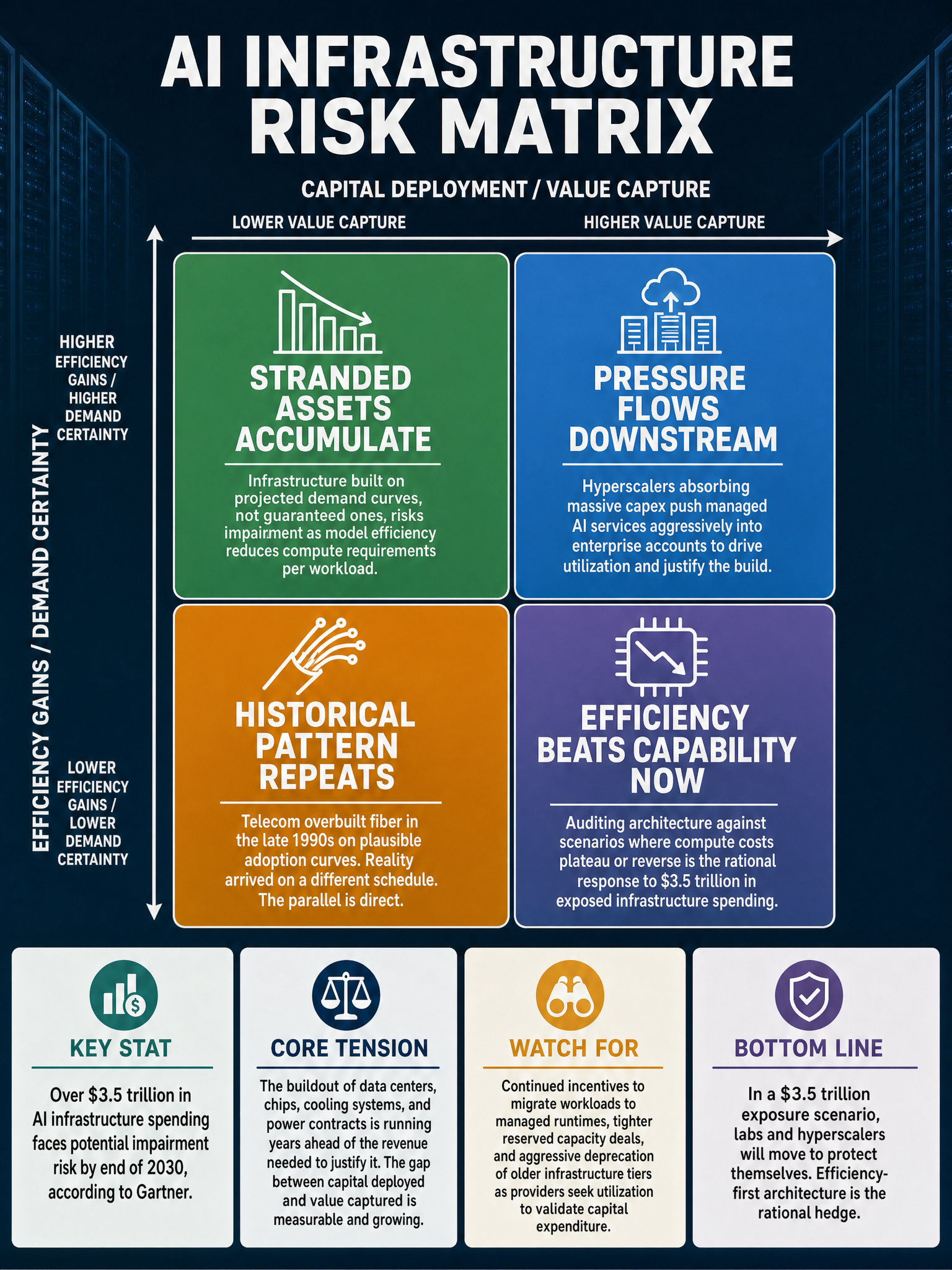
If you’re building anything that depends on AI compute right now, you need to sit with this number for a minute. Gartner is warning that over $3.5 trillion in AI infrastructure spending could be exposed to impairment by the end of 2030. Not some of it. Over three and a half trillion dollars. That’s not a hedge. That’s a structural warning about where the industry is heading if the assumptions underneath all this spending don’t hold.
I want to break down what “impairment risk” actually means for builders, because the phrase is easy to skim past.
What Impairment Risk Actually Means
When an asset gets impaired on a balance sheet, it means the future economic value of that asset dropped below what you paid for it. For AI infrastructure, we’re talking about data centers, GPU clusters, cooling systems, long-term power contracts. All of it was purchased based on demand projections. Projections, not guarantees.
If those demand curves shift, because model efficiency improves faster than expected, because enterprise adoption plateaus, because a cheaper inference paradigm displaces the current one, then hardware bought at 2025 prices against 2025 assumptions becomes stranded capacity. You own it. You’re paying for the power. Nobody needs it at the rate you planned.
That’s the pressure Gartner is flagging.
We’ve Watched This Movie Before
The telecom fiber overbuild of the late 1990s is the obvious comparison. Companies laid hundreds of thousands of miles of fiber on the assumption that internet traffic would keep doubling at the rate it was growing in 1998 and 1999. It did, eventually. But not on the timeline the capital markets demanded. What followed was one of the most brutal asset write-down cycles in tech history.
AI infrastructure in 2025 and 2026 rhymes uncomfortably with that period. The difference is the speed. Chips depreciate faster than buried fiber. A GPU cluster that costs a fortune today may be economically obsolete in three years because a more efficient architecture made the same workload 10x cheaper to run. That’s not speculation. That’s roughly what happened with inference costs over the 18 months leading into this warning.
The Efficiency Curve Is the Real Variable
This is the part most financial analysts covering AI infrastructure get wrong. They model demand growth but they don’t adequately model efficiency improvement on the supply side. If the compute required per workload keeps dropping, then the installed base of hardware serves more demand than anticipated. Which sounds good until you realize that means less new hardware gets purchased, and the stuff already deployed gets used at lower-than-projected utilization rates.
Stranded capacity doesn’t have to mean zero demand. It can mean 60% utilization when you underwrote the asset at 90%.
The builders I worry about most are the mid-tier cloud providers and the enterprises who signed long-term power and colocation contracts in 2024 and 2025 betting that their internal AI workloads would scale linearly. Some of those bets are going to look very bad by 2028.
What This Means If You’re Building Right Now
I’m not saying stop building. I’m saying build with assumptions that can fail gracefully.
A few things I’d be thinking hard about right now. Avoid long lock-in on fixed infrastructure wherever possible. The hyperscalers have more flexibility than anyone to absorb stranded capacity because they can repurpose it across thousands of customers. An enterprise that built its own GPU cluster for one use case does not have that option.
Pay attention to model efficiency trends, not just model capability announcements. When Meta launches models like Muse Wonder and Muse Wonder Full designed to compete at the frontier level, and when Google is shipping Gemini 4 Argon as a reasoning model, the competitive pressure on inference cost is relentless. Each of those releases puts downward pressure on the cost of running a given workload, which affects how much infrastructure you need to own.
And if you’re a CTO approving a nine-figure infrastructure commitment right now, you need Gartner’s $3.5 trillion number in your board presentation. Not as a reason to stop, but as a reason to show you’ve thought through the downside.
The Honest Conclusion
The AI infrastructure cycle will not stop. The demand for compute is real and the use cases are real. But “real demand” and “correctly sized capital commitment” are two different things, and right now a lot of organizations are conflating them.
The companies that come out of this decade in the best position will be the ones who treated infrastructure spending as a bet with defined risk parameters, not as a guaranteed return on a trend line.
$3.5 trillion is a civilization-scale number. The question isn’t whether some of it gets impaired. The question is who’s holding the assets when it happens.
Sources
#AIInfrastructure #MachineLearning #AIStrategy #TechLeadership #CloudComputing