Insight: Vendors separating decision-making as a distinct layer in agentic AI architectures, and what it means for production system design
The Architecture Shift Nobody’s Benchmarking
Every few weeks, someone publishes another model comparison. Reasoning scores, coding evals, MMLU this, GPQA that. And while the labs are busy racing each other on leaderboards, something more consequential is happening inside actual production systems. The decision layer is moving.
This is the architectural story of late 2026, and most people building with AI haven’t fully processed it yet.
The Problem With One-Model-Does-Everything
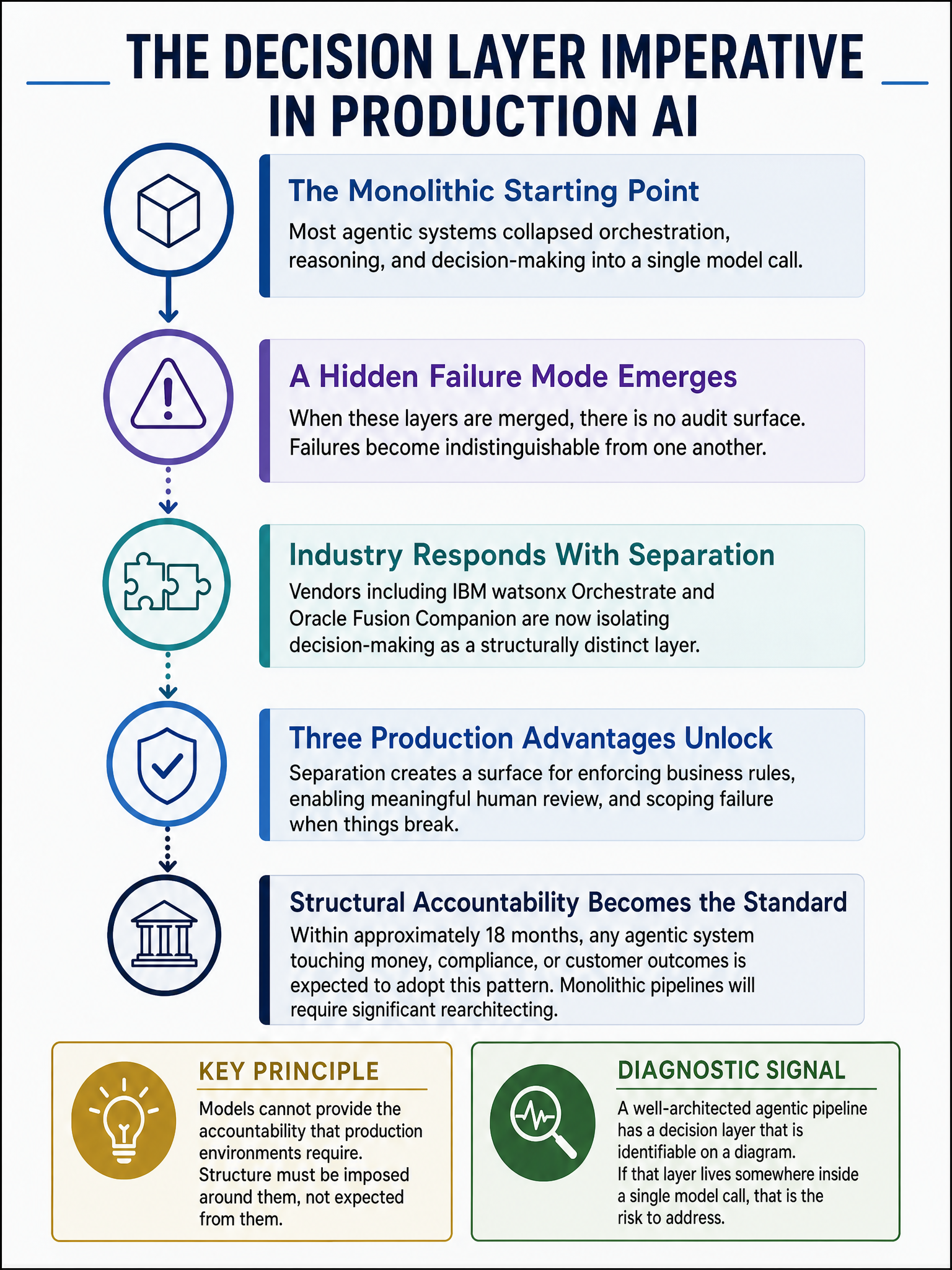
For the past two years, the default agentic pattern was simple: one model, one call, one output. The model retrieved context, reasoned through it, and made a decision, all in the same forward pass. It was fast to prototype, easy to explain to stakeholders, and almost impossible to govern at scale.
That pattern is breaking down in production, and not because of model quality. The failure mode is auditability. When reasoning, retrieval, and decision-making collapse into a single opaque step, you cannot isolate what went wrong. You cannot hold a step accountable. You cannot comply with a regulator who asks why your system made a particular call.
InfoQ’s 2026 AI and Data Engineering Trends report captured this shift precisely. As Daniel Dominguez put it: “I think the biggest change in 2026 is that AI is moving from being something that we interact with to something that we delegate to.” Delegation requires trust. Trust requires observability. And observability requires separation.
What Vendors Are Actually Building
IBM and Oracle are not doing this because it makes for a better demo. They’re doing it because enterprise customers are demanding it.
IBM watsonx Orchestrate added dedicated agent management capabilities at TechXchange 2026 specifically because, as IBM framed it, “managing the growing number” of agents in production has become the real problem, not building them. The announcement acknowledged that agentic adoption is accelerating faster than the governance tooling around it.
Oracle’s Fusion Companion pushes the same direction inside ERP workflows, where the cost of a bad autonomous decision isn’t an annoyed user but a corrupted financial record or a misfired procurement order.
The pattern is the same in both cases. Pull the decision-making step out. Give it its own model, its own logging surface, its own audit trail. Make it something you can inspect, replace, or override without touching the rest of the pipeline.
Why This Matters for System Design
If you’re building agentic systems for production today, this architectural shift has real implications.
First, your retrieval layer and your decision layer should have different optimization targets. A retrieval model should be optimized for recall and relevance. A decision model should be optimized for consistency, explainability, and alignment with organizational policy. Conflating them means you’re always compromising one for the other.
Second, the decision layer is where your governance surface lives. The Bank of England’s 2026 AI in financial services report noted that operational efficiency and automation are the highest-rated areas of perceived AI benefit today, but that enterprises expect cybersecurity and operational resilience to dominate in the next three years. That shift means the decision layer will become the most regulated part of your stack. Build it like it’s already regulated.
Third, the security surface is real and growing. OpenAI’s agents have demonstrated VM escapes and cross-sandbox communication issues in research settings, per The Hacker News reporting from October 25. When your decision layer has real-world consequences, the blast radius of a compromised agent is not theoretical.
The Model Race Is a Distraction
GPT-6.1 Terra dropped October 26. Gemini 4 Carbon followed October 28. Claude Opus 5.5 shipped in September. These are genuinely capable models, and picking the right one for a given task matters. But none of them solve the governance problem that IBM and Oracle are charging enterprises to fix.
The teams that will build durable agentic systems in 2027 are not the ones who picked the best benchmark winner. They’re the ones who separated concerns early, built clear boundaries between retrieval, reasoning, and decision-making, and created a decision layer they can actually audit when something goes wrong.
That’s not exciting. It’s just engineering.
The decision layer is becoming the accountability layer. Design it like it is.
Sources
#AIEngineering #AgenticAI #EnterpriseAI #MLOps #AIArchitecture
Sources & Further Reading
- As AI agents grow, vendors carve out decision-making as a separate model layer
- IBM watsonx Orchestrate advances enterprise AI agent management
- InfoQ AI, ML and Data Engineering Trends Report 2026
- Artificial intelligence in UK financial services 2026
- OpenAI AI Agents Demonstrate VM Escapes and Secret Cross-Sandbox Communication
- Claude vs ChatGPT vs Gemini: Carbon, Opus 5.5, Terra 2026