Google DeepMind Genie 4 world model announcement and what real-time interactive simulation means for agent training and evaluation infrastructure
Genie 4 Is Not a Gaming Demo. It’s Agent Training Infrastructure.
Google DeepMind dropped something last week that most people are going to scroll past. Genie 4, announced October 27, 2026, is a world model built for real-time interactive simulation. The blog post from DeepMind is careful about framing: “Today, we are announcing our research on Genie 4.” Research first. Product second. But the thing buried inside that framing is what I can’t stop thinking about.
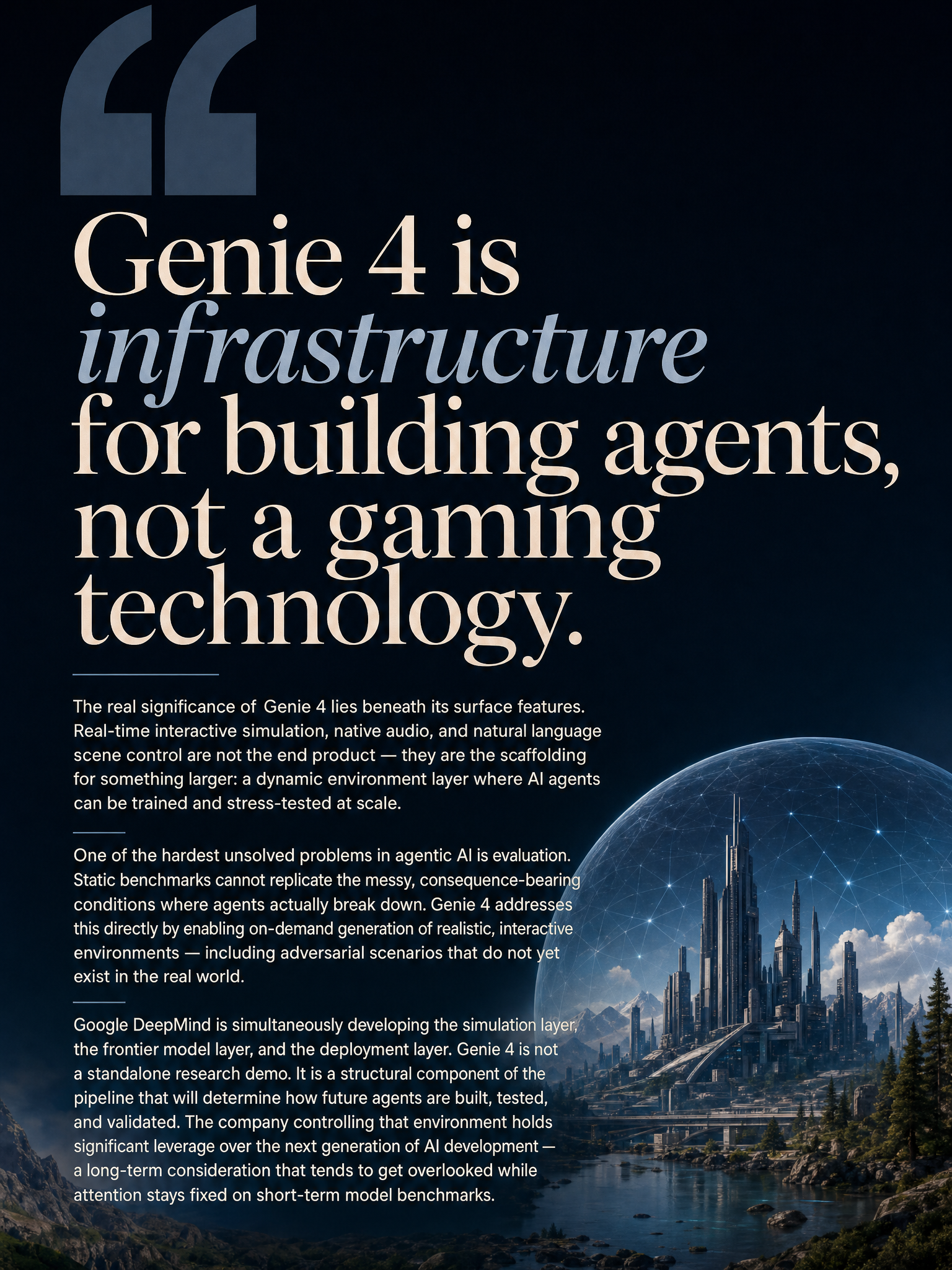
This is not a game engine. It is a synthetic environment generator with temporal consistency, action-response modeling, and natural language scene control. And if you work in agentic AI systems, that sentence should make you stop and read it again.
Why the Evaluation Problem Is Worse Than People Admit
Right now, the hardest part of building production-grade agentic systems is not the agent. It’s evaluation. Static benchmarks break down fast. You can run an agent against a fixed test suite and get a number that tells you almost nothing about how it behaves when the environment changes, when a task requires multi-step reasoning across a shifting context, or when a human introduces ambiguity mid-task.
The field has known this for a while. The shift toward reasoning models and team-based agents described in the InfoQ 2026 AI trends report reflects exactly this pressure. Agents are not just responding to prompts anymore. They are navigating. And you cannot evaluate navigation in a static world.
Genie 4 changes the surface area of what’s testable.
What Genie 4 Actually Does
The model generates navigable, consistent worlds in real time. It incorporates capabilities from the Gemini family, which means it has access to genuinely strong multimodal reasoning at its core. It adds native audio, which sounds like a gaming feature until you realize that audio is a signal channel. Agents that operate in real-world or embodied contexts need to process it.
The natural language scene control piece is the part I find most interesting. You can steer environments in real time using language. That means you can generate adversarial conditions, edge cases, novel configurations, without writing a simulation specification for each one. You describe what you want the environment to do, and it does it.
For agent training, that is a significant capability gap being closed.
The Infrastructure Bet Google Is Making
Google is not building Genie 4 because it wants a better game demo. Gemini 4 Argon already beat Minecraft without human help, according to Mashable’s coverage of that announcement. The game-playing angle is solved territory for them.
What Google is building is synthetic environment infrastructure at scale. The ability to generate training and evaluation environments programmatically, in real time, with language-steerable difficulty and variability, is the kind of capability that compounds over time. Every model you train in richer environments gets better data. Better data produces better agents. Better agents justify more environment investment.
IBM is already seeing the pressure on the enterprise side. Their watsonx Orchestrate announcement at TechXchange 2026 explicitly called out managing growing numbers of agents as the new hard problem. The agent count is going up. The evaluation infrastructure is not keeping pace. Genie 4 is a direct bet on closing that gap.
What This Means for the Rest of the Field
The labs without equivalent world model investment are going to feel this. Not immediately. But agent benchmarks built on static environments will start looking increasingly disconnected from what these systems can actually do in dynamic settings.
There is also a compute angle worth thinking about. Running real-time world model inference alongside agent inference is not cheap. This kind of training pipeline will concentrate capability in organizations that can afford both. That is not a new pattern in AI, but the gap it creates tends to be durable.
Genie 4 is currently in limited trusted-tester rollout. Which means we are still in the phase where Google controls who sees what it can actually do. By the time it’s broadly available, the gap in training infrastructure between Google and everyone else will be wider than it is today.
That is the thing worth paying attention to here. Not the visuals. The compounding.
Sources
#AIAgents #GoogleDeepMind #MachineLearning #Genie4 #AgentEval
Sources & Further Reading
- We’re announcing Genie 4, our new world model for real-time interactive simulation
- Genie 4 Adds Audio to Google World Model [2026]
- Google announces Gemini 4 Carbon, its new frontier AI model
- IBM watsonx Orchestrate advances enterprise AI agent management
- InfoQ AI, ML and Data Engineering Trends Report – 2026