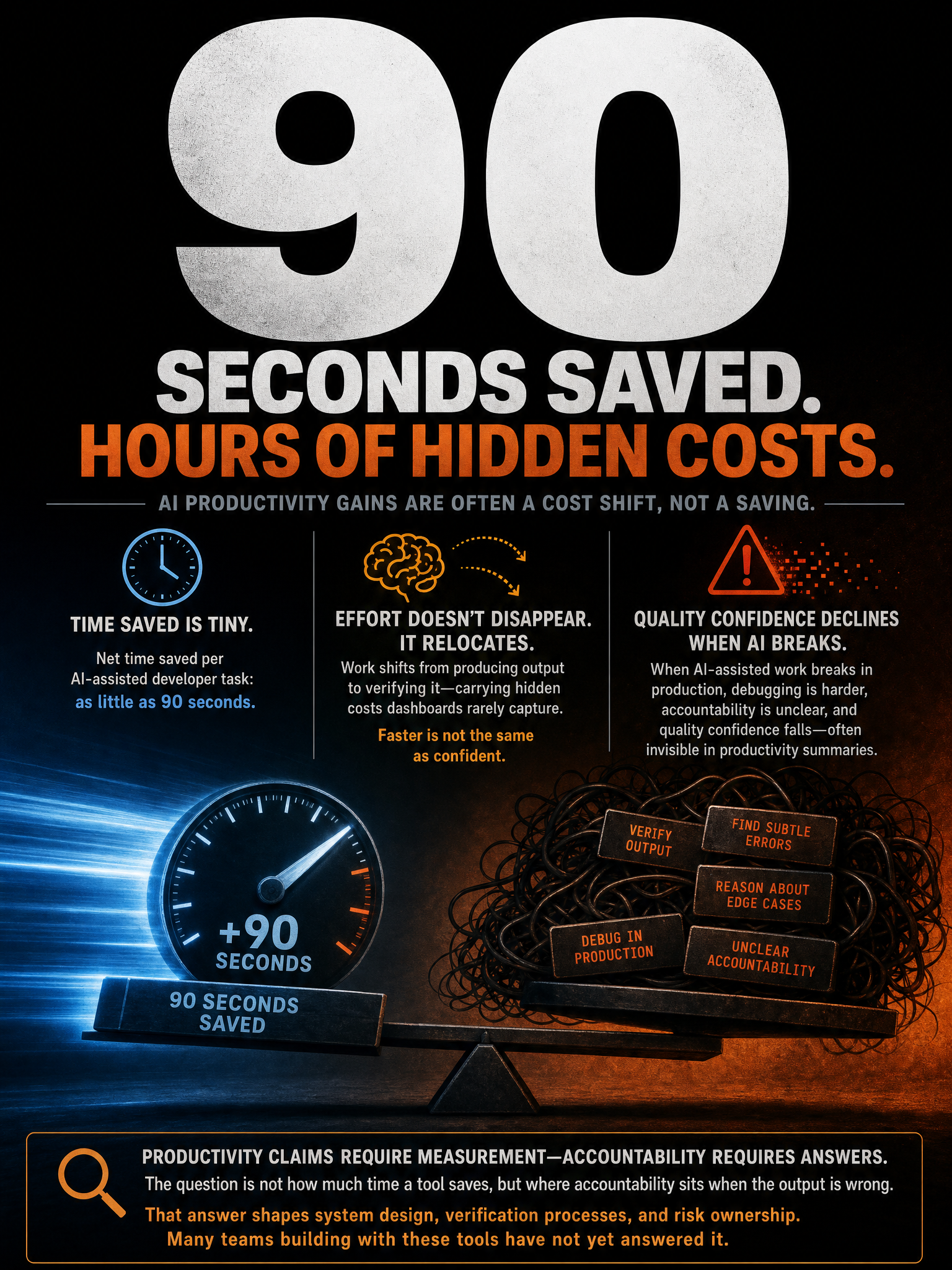
Critique of contradictory AI productivity time-savings data and the hidden cost shift from doing to verifying in AI-assisted workflows
The Productivity Illusion: What AI Time-Savings Data Actually Tells Us
Everyone in enterprise tech right now is pointing at AI productivity numbers like they’re a winning lottery ticket. The problem is nobody can agree on what the numbers say. CIO ran a piece in early November pulling together the actual research on AI time savings, and the headline was about as damning as it gets: the data is contradictory. Some teams report meaningful gains. Others report spending more time reviewing, correcting, and re-prompting than the original task ever took. I’ve been watching this play out in production systems for two years, and I’ll tell you what I think is happening.
The Wrong Metric
“Time saved” is a seductive metric because it’s simple to measure and easy to sell upward. But it doesn’t account for where the time goes after you wire an LLM into a workflow. The work doesn’t disappear. It shifts. The cognitive load moves from doing to verifying, and verification is a fundamentally different kind of work.
Consider a developer who used to write a SQL query in 10 minutes. With an AI assistant, they get a draft in 30 seconds. Great story. Except they spend 8 minutes checking whether the joins are correct, whether the edge cases are handled, whether the query will perform at scale. Net savings: 90 seconds. But here’s the part that doesn’t show up in productivity dashboards: the checking is harder than the writing, because the output looks authoritative whether it’s right or wrong.
That’s the hidden cost. And it doesn’t scale the way people assume it does.
The Verification Tax
There’s a name for what happens when a system produces output that looks correct but requires expert review to validate: it transfers the cognitive burden to the most expensive person in the room. Junior developers don’t catch the subtle bugs in AI-generated code. Junior analysts don’t catch the plausible-but-wrong SQL aggregations. The people who can verify are the people whose time you were supposedly freeing up.
This is not theoretical. The CIO piece from Taryn Plumb cited research showing that productivity gains are inconsistent across teams and roles, with some workers reporting net time losses after accounting for review cycles. The variance is high, which means the averages being reported in vendor case studies are likely pulling from the best-case scenarios.
The Model Arms Race Doesn’t Fix This
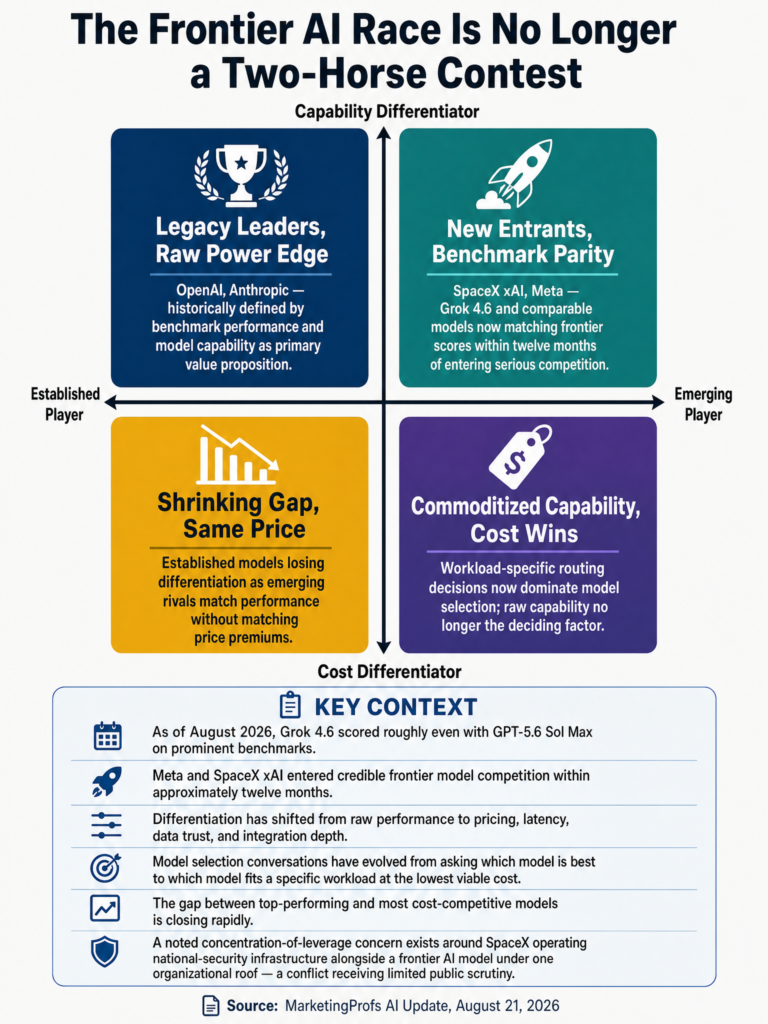
Every week brings another model announcement promising better accuracy and fewer hallucinations. DeepMind launched Gemini 4 Carbon this month, which tops Artificial Analysis’s Intelligence Index with a score of 59 and leads on vulnerability-finding benchmarks. OpenAI released GPT-6.1 Terra. The pace is real. But better models don’t eliminate the verification problem. They make it harder, because the outputs get more convincingly wrong in ways that are more expensive to catch.
METR’s independent assessment of Anthropic published November 5th found that as of October 2026, Anthropic is likely improving model capabilities on well-specified tasks at roughly twice the rate of the previous 18 months, though they put wide error bars on that estimate, anywhere from 1.3x to 3x. Faster capability improvement sounds like good news. But if the benchmark for “capable” is performance on well-specified tasks, and real-world workflows involve poorly-specified, context-heavy work, the gap between benchmark and reality stays wide.
What the Honest Accounting Looks Like
If you want to measure AI productivity honestly in your organization, you need to track three things the standard metrics ignore. First, time spent on re-prompting and correction cycles, not just time to first output. Second, error rates in AI-assisted work versus unassisted work, controlled for task complexity. Third, which roles are absorbing the verification load, because that’s where the real cost is hiding.
My bet is that most organizations running this analysis will find the gains concentrated in a narrow band of well-structured, repetitive tasks, writing boilerplate code, drafting routine documents, summarizing meeting transcripts. For anything that requires judgment, context, or accountability, the verification tax eats the savings.
The industry will figure this out eventually. The question is whether it happens before another wave of premature automation decisions gets made on the basis of cherry-picked productivity numbers. I’d rather it happens before.
Sources
#AIProductivity #EnterpriseAI #MachineLearning #SoftwareEngineering #AIStrategy