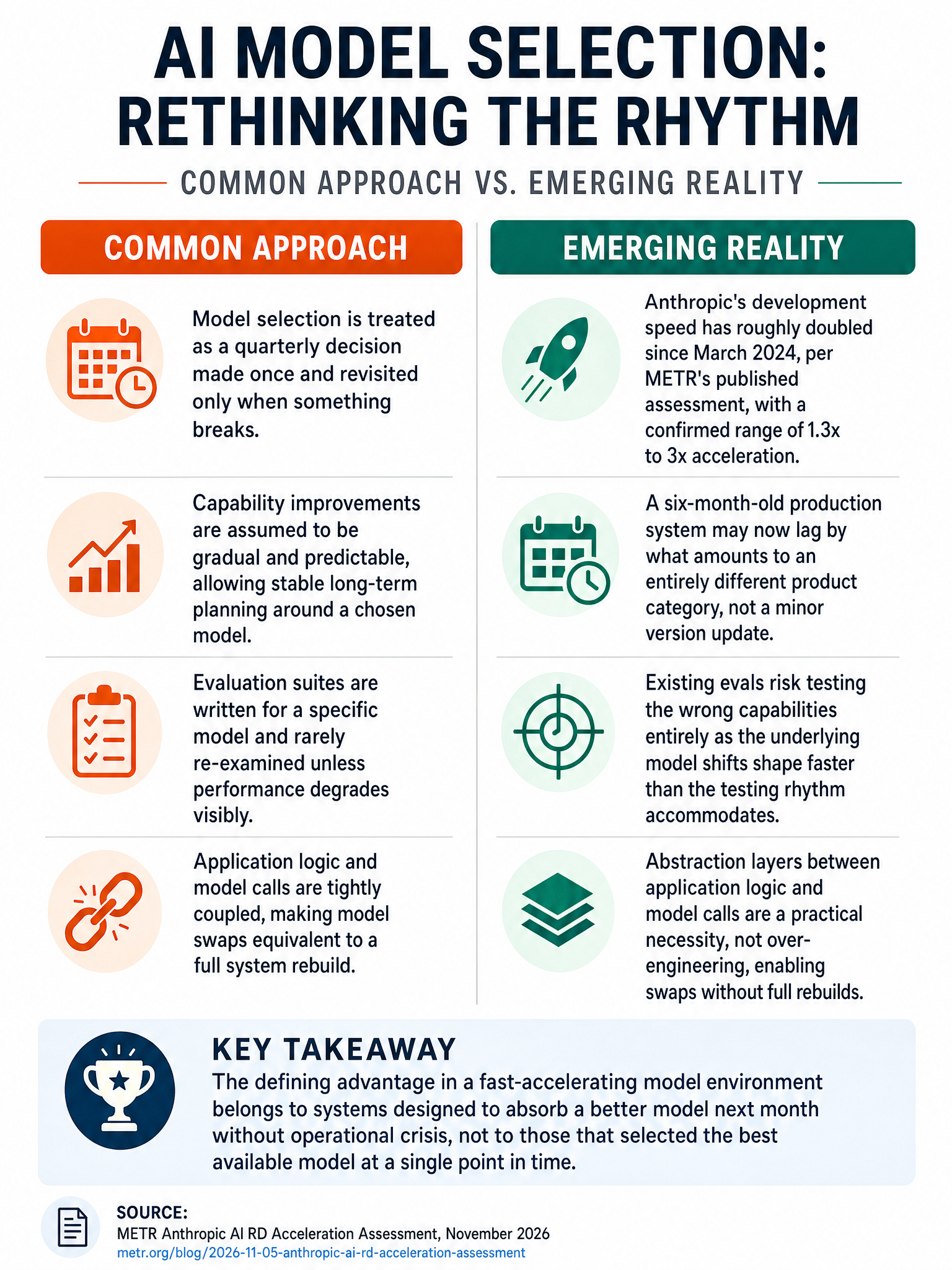
METR assessment that Anthropic is doubling model capability improvement rate, and what accelerating model velocity means for production system architecture
The Floor Keeps Rising: What METR’s Anthropic Assessment Means for Production Architecture
METR published something last week that deserves more attention than it’s getting. Their independent assessment, released November 5th, found that Anthropic is improving model capabilities on well-specified tasks at roughly twice the rate it was achieving between March 2024 and October 2025. METR is honest about the uncertainty, putting the real figure somewhere between 1.3x and 3x. But here’s the thing: even 1.3x sustained over 18 months is a seismic architectural problem if you’re building production systems on top of these models.
Most of the conversation I’ve seen focuses on the speed of AI progress itself, treating it as an abstract geopolitical or safety story. That’s not the right lens for builders. The real question is what this velocity does to the systems you’re shipping today.
🔧 The Quarterly Evaluation Rhythm Is Broken
Most engineering teams I’ve worked with treat model selection like any other vendor decision. You run evaluations, pick something, build your abstractions around it, and revisit the question maybe once a quarter. That rhythm made sense in 2023 and early 2024, when capability jumps were gradual and predictable enough to plan around.
It doesn’t hold anymore.
When capability is compounding at 2x the previous rate, a model that was best-in-class when you started your project may be two meaningful generations behind by the time you ship. And right now we’re seeing exactly this in the data. DeepMind just launched Gemini 4 Carbon, which currently ranks first on Artificial Analysis’s Intelligence Index with a score of 59. OpenAI released GPT-6.1 Terra, which completes agent tasks over three times faster than their flagship models at half the predecessor’s API price, and cut its hallucination error rate from 53.6% to 16.7%. Anthropic dropped Claude Opus 4.8. These aren’t minor patch releases.
🏗️ What Your Architecture Needs to Assume Now
If I were designing a production AI system today, I would treat model swappability as a first-class requirement, not a nice-to-have. This means a few specific things.
Your evaluation suite needs to run continuously, not quarterly. If capability is accelerating, the gap between your current production model and what’s available can open up within weeks. You need automated regression and capability benchmarks running against new releases as they drop, not on a human-driven schedule.
Your prompt layer needs to be model-agnostic. Prompts that are tightly coupled to one model’s quirks, context window, or instruction-following behavior are technical debt the moment a better model ships. I’ve seen teams spend weeks re-engineering prompts when they swap providers. That cost is about to become more frequent.
Your latency and cost assumptions need error bars. GPT-6.1 Terra completing agent tasks three times faster than flagship models at half the price is the kind of shift that breaks budget projections and changes which architecture patterns are even viable. If you’ve designed a workflow around synchronous user-facing calls, a faster model might open up approaches that were previously too slow to be practical.
The Capability Floor Problem
Here’s the part that isn’t getting enough discussion. The problem isn’t just that better models exist. It’s that user expectations track the frontier, not your deployment.
When models in the wild can do something, users expect your product to do it too. The floor of acceptable performance rises continuously. This means that even if your 18-month-old model is technically doing what you shipped it to do, it may feel broken to users who’ve spent time with more capable systems. You’re not just competing with other products. You’re competing with the baseline expectation that fast-moving frontier models are establishing.
Building for Velocity, Not Stability
The traditional software engineering instinct is to stabilize dependencies. Pin versions, test thoroughly, ship infrequently, and treat the external API as something that changes on your schedule. That instinct is correct in most contexts and completely wrong here.
The teams that are going to build durable products on top of these models are the ones treating their AI layer more like a live data feed than a versioned library. The model is the most dynamic part of your stack. Architect accordingly.
METR’s assessment is worth reading in full. The uncertainty bounds they acknowledge are themselves informative. We don’t have a precise number for how fast capability is accelerating, and that uncertainty is itself a design constraint. You can’t plan precisely for a future you can’t measure precisely. What you can do is build systems that don’t require precise plans to stay competitive.
The acceleration isn’t slowing down. The architecture decisions you make this quarter will be tested against a capability environment that looks meaningfully different by the time those systems are in production. That’s the actual engineering problem in front of us.
Sources
#AIEngineering #ProductionAI #MachineLearning #SoftwareArchitecture #Anthropic #LLMs
Sources & Further Reading
- Independent Assessment of AI R&D Acceleration at Anthropic in October 2026 – METR
- Anthropic’s AI development has doubled in speed despite slowdown calls – Fast Company
- This Week in AI #95: Anthropic Opens Its Books, Gemini 4 Carbon Debuts – LinkedIn
- OpenAI debuts new cybersecurity-focused AI model – Fortune