GPT-6.2 Astra release after OpenAI scrapped prior version for safety reasons, and what that means for builders in production
GPT-6.2 Astra Is Out. The More Interesting Story Is What Got Pulled Before It.
OpenAI dropped GPT-6.2 Astra today, their most advanced model for professional use. The benchmarks will circulate, the demos will trend, and the usual cycle of hot takes will run its course. I want to talk about something most of that coverage will skip entirely.
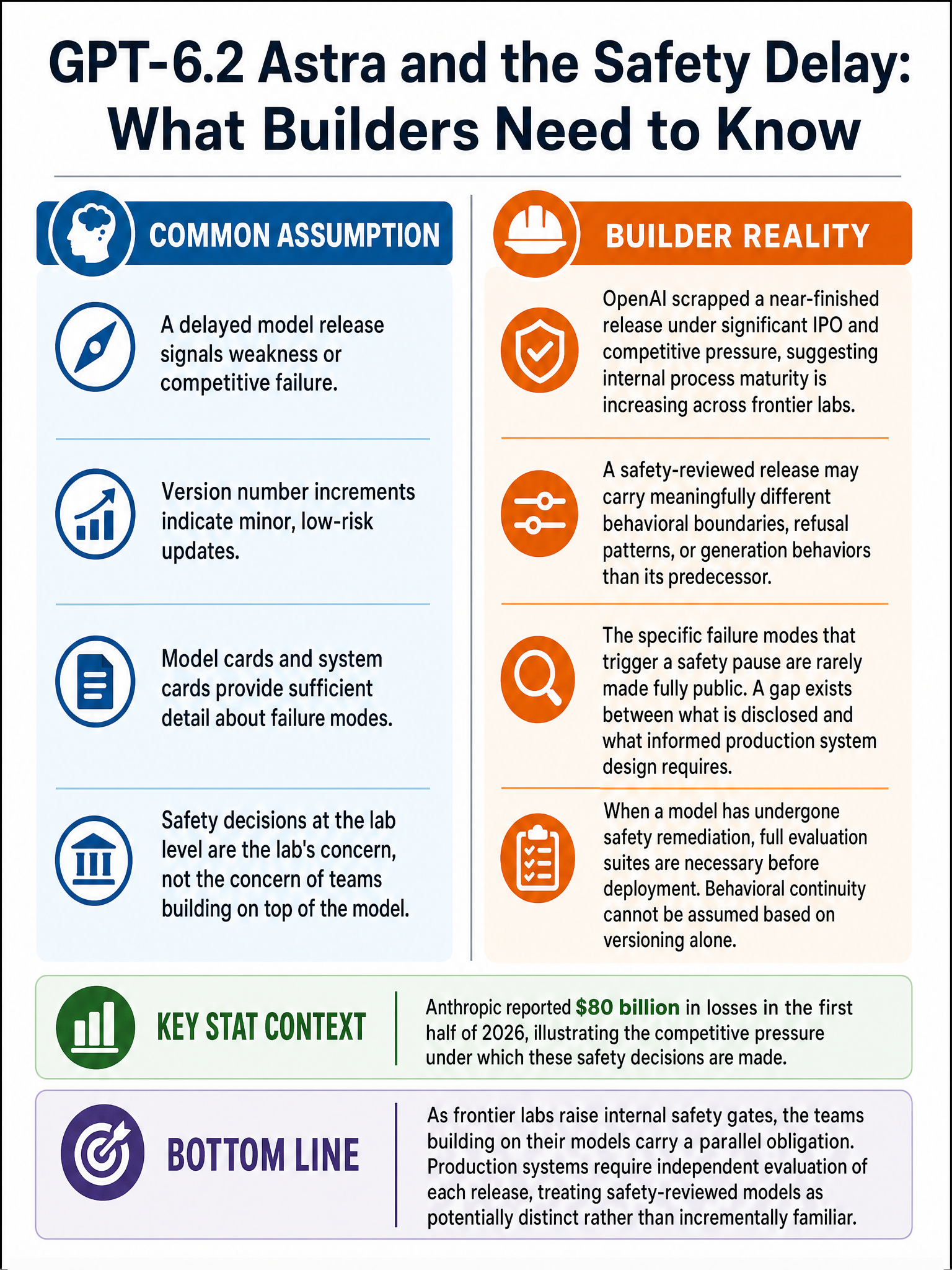
Nearly two months ago, OpenAI had a release ready. They pulled it. Not because it was broken. Not because a competitor forced their hand. Because internal review flagged safety concerns significant enough to stop a near-complete release and rework it from scratch.
That is worth sitting with for a moment.
Why The Pull Matters More Than The Release
The competitive pressure OpenAI is operating under right now is not abstract. Anthropic reportedly lost $80 billion in the first half of 2026 alone. OpenAI is marching toward an IPO. Every week without a new flagship release is a week a competitor can close ground, a week analysts ask uncomfortable questions, a week the narrative shifts.
And they still stopped.
I want to be careful here. One decision is not a pattern. It is not proof that OpenAI has permanently turned a corner on safety culture. Organizations can do the right thing once under pressure and still have broken processes underneath. I am not handing out trust based on a single data point.
But I do think builders should pay attention to what that decision signals about process maturity. Because most of us are not building AI. We are building on top of AI. And that distinction matters enormously.
🔧 My Actual Concern as a Builder
Here is what keeps me up at night when I think about production systems sitting on top of frontier models.
The capabilities of Astra are real and probably impressive. But when a provider modifies a model, even for good reasons, the behavior your production system depended on may shift underneath you. Prompt responses change. Edge cases that worked before no longer work. Classification thresholds move. You find out in prod, not in staging.
The two-month gap between the pulled release and today’s Astra launch is a window into how much internal iteration happened on this model before it reached us. That is a lot of change accumulated before any external developer gets to test it.
The right response is not to distrust the model. The right response is to build as if the model beneath you can change, because it can and will. Regression suites for model behavior. Canary deployments against new versions. Explicit documentation of what your system actually depends on behaviorally, not just what the API spec says.
The Broader Safety Signal
The pulled release lands in a broader moment. Nonprofit groups are actively suing to halt AI development, citing systems that are “already autonomously breaking the law and causing harm,” according to a November 14 filing covered by Jurist. The U.S. Commerce Department just closed a loophole allowing remote access to advanced AI chips through overseas data centers. The APA published new workplace AI guidance this week.
The pressure on these companies is coming from every direction. Regulatory, legal, competitive, financial. Against that backdrop, a unilateral decision to pull a model for safety reasons is a meaningful signal. Not a guarantee. A signal.
What Builders Should Do With This
Stop treating the foundation model layer as stable infrastructure. It is not a database. It is not a cloud compute primitive. It is an evolving system maintained by a company with its own pressures and priorities, and those will occasionally produce changes you did not ask for.
Build accordingly. Test model behavior explicitly and repeatedly. Maintain version pinning where the API allows it. Have a rollback plan that does not require a rewrite. And when a provider does something like pulling a release for safety reasons, notice it. It is data about how that organization makes decisions under pressure.
The release of Astra is good news for builders who need more capable models. The pull before it is the more interesting news for builders who care about what kind of infrastructure layer they are trusting.
Both things can be true.
#OpenAI #AIEngineering #MachineLearning #LLMsInProduction #AIStrategy
Sources
Sources & Further Reading
- OpenAI Unveils Astra, Its Most Advanced AI Model for Professional Use
- OpenAI Unveils Latest Astra AI Model After Canceling Prior Release
- Nonprofit advocacy groups cite dangers, sue to stop development of artificial intelligence
- APA offers new guidance as artificial intelligence use at work expands
- U.S. closes loophole allowing remote access to AI chips