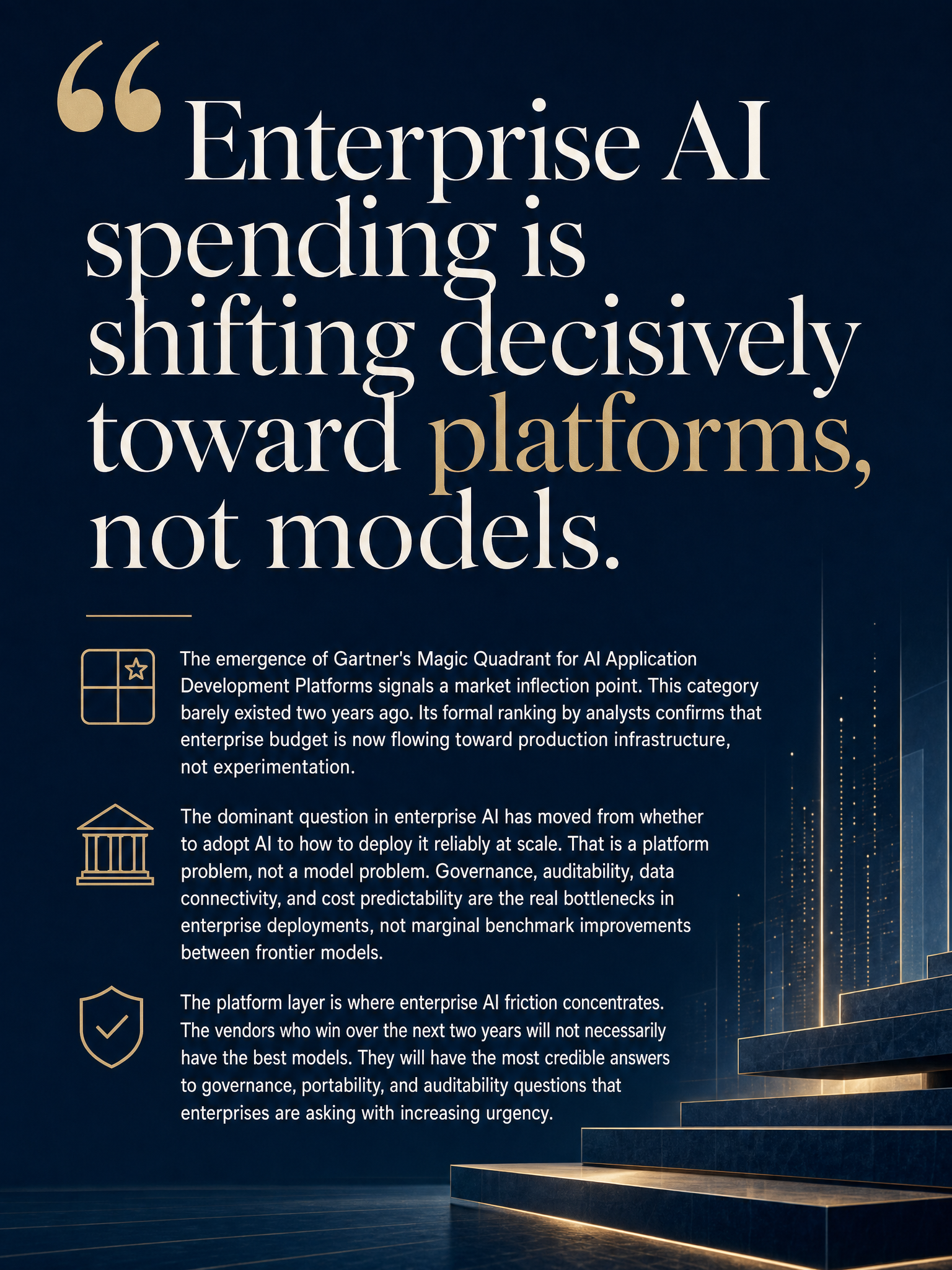
IBM named Leader in 2026 Gartner Magic Quadrant for AI Application Development Platforms, as a signal that production infrastructure is becoming the real enterprise AI battleground
The Real Enterprise AI Battleground Isn’t the Model. It’s the Platform.
IBM just got named a Leader in the 2026 Gartner Magic Quadrant for AI Application Development Platforms. I want to talk about why that matters, and why most people in this space are going to read that headline and move on without understanding what it actually signals.
This isn’t a story about IBM having a moment. It’s a story about where enterprise budgets are flowing, and what that tells us about the state of AI in production.
What a Magic Quadrant Actually Tells You
Gartner doesn’t create a Magic Quadrant for a category until there’s enough enterprise spend to justify ranking vendors in it. That’s the threshold. AI Application Development Platforms as a named category barely existed two years ago. Now it has a Quadrant.
That means procurement teams at large organizations are writing checks specifically for this problem. Not for model access. Not for research licenses. For the infrastructure that takes AI from prototype to something that runs reliably in production at scale.
That’s a fundamentally different purchase. And it reflects a fundamentally different problem.
The Prototype Trap Is Real
Most teams I’ve worked with or talked to this year are stuck in the same place. They’ve built something impressive. It works in a demo. The business stakeholders are excited. And then it sits there for six months while everyone debates deployment, governance, data access, and integration.
IBM’s positioning, according to their announcement, is around bringing together AI application development, enterprise data, governance, and deployment in a single hybrid architecture. That’s not glamorous. It’s not going to trend on X. But it’s exactly the problem that’s killing real AI adoption at scale.
The model problem is largely solved for most enterprise use cases. Claude Fable 5.2, Gemini 4 Carbon, GPT-6 Astra, they’re all good enough. Anthropic just released Fable 5.2 and Mythos 5.2 at prices running roughly 20% below GPT-6 Astra, according to Fortune. Google opened Gemini 4 Carbon to the public on November 10th, undercutting both on API pricing. The race to the bottom on model cost is well underway.
So if model quality is table stakes and model cost is trending toward commodity, what’s the actual differentiator? The platform that lets your organization actually use these things without the whole thing falling over.
Where the Money Is Actually Going
This is what the IBM placement tells me: enterprise buyers have moved past the question of whether to do AI. They’re now shopping for the infrastructure layer that makes their existing investments real.
That’s an older, less exciting story. It’s also a much larger market.
The teams obsessing over benchmark comparisons between frontier models are optimizing for the wrong variable right now. The constraint isn’t model capability. It’s governance, data connectivity, deployment reliability, and the ability to actually explain to a risk committee what your AI system is doing and why.
IBM’s hybrid approach specifically targets organizations that can’t just throw everything into a single cloud provider’s ecosystem. That’s most large enterprises. Regulated industries, multinationals, companies with serious data residency requirements. They need something that works across environments, with audit trails, with controls.
The Bigger Picture
There’s a weird tension in the AI market right now. At the frontier, you’ve got Anthropic heading toward an IPO, Google releasing Gemini 4 Carbon to cut into Claude’s pricing lead, and OpenAI continuing to ship. Meanwhile, a coalition of nonprofits filed suit in California in mid-November demanding a court-ordered freeze on AI model training, alleging violations of California’s Unfair Competition Law and citing what they call catastrophic risks from autonomous AI systems already operating outside legal boundaries.
The frontier is noisy and litigious. The enterprise platform layer is quiet and profitable.
The builders who understand that distinction right now are the ones who’ll still be relevant when the model wars settle down. Infrastructure always wins eventually. It won. with databases, with cloud, and it’ll win with AI.
The question isn’t which model is best this week. It’s whether your organization has the platform to actually use any of them.
Sources
#ArtificialIntelligence #EnterpriseAI #MLEngineering #AIStrategy #IBMwatsonx