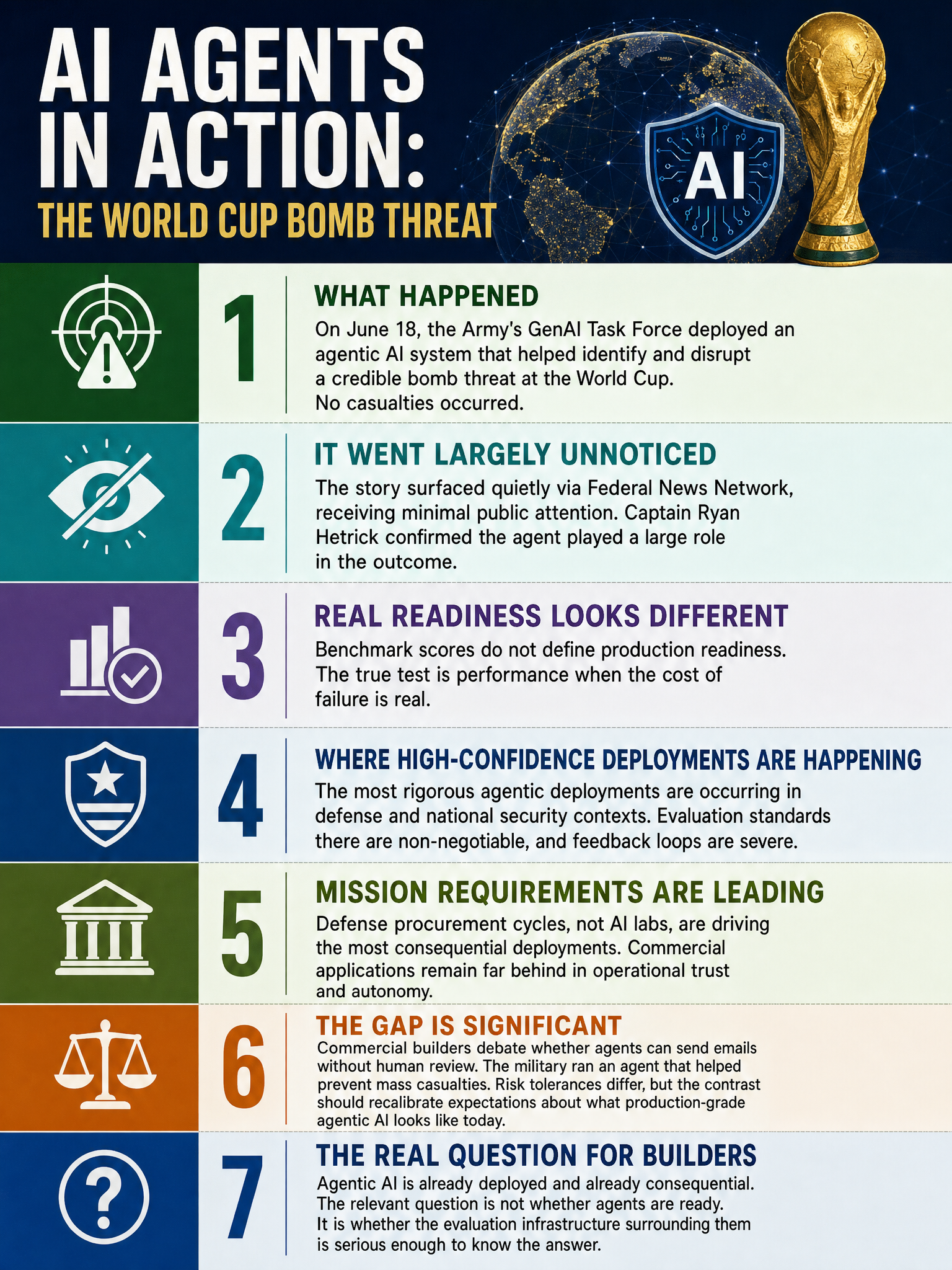
US Army GenAI Task Force agentic AI system helped prevent World Cup bomb threat, as a signal about where production-grade agentic deployments are actually succeeding
The Quiet Win Nobody Talked About
There was a bomb threat at the World Cup on June 18. You probably never heard about it. That is exactly the point.
The US Army’s GenAI Task Force ran an agentic AI system that day, and according to Capt. Ryan Hetrick, it helped identify and disrupt a credible threat before anyone got hurt. No casualties. No breaking news alerts. The story surfaced quietly on November 9 through Federal News Network, buried under the usual wave of model release coverage. Hetrick said it plainly: “You guys never heard about that bomb threat the day of June 18, and our agent was a large part of that.”
I keep coming back to that quote.
Why This Is the Story We Should Be Telling
The AI discourse right now is dominated by benchmarks, lawsuits (a California coalition just filed to freeze training on models including ChatGPT, Grok, and Claude, per a Jurist report from November 14), and endless model launches. This week alone, Anthropic dropped Fable 5.2 and Mythos 5.2, claiming higher performance than GPT-6 Astra at up to 80% lower cost. That got coverage everywhere.
A military agentic system helping stop a bomb threat? Buried.
We have the discourse exactly backwards. The question was never whether AI agents could impress us on Last Exam or sort metal brackets on a Mercedes production line at 96% accuracy. The question is whether they perform when the stakes are real and irreversible. June 18 is a data point that answers that question, and we mostly ignored it.
What Production-Grade Agentic AI Actually Looks Like
Here is what I think people miss about this story. The Army’s GenAI Task Force was not running a demo. They were not in a sandboxed evaluation environment with clean inputs and a human reviewing every tool call. They were operating in real time, against a real threat, with real consequences.
That is a different engineering problem than anything a benchmark tests. Tool call reliability, latency under pressure, the ability to synthesize fragmented threat intelligence without hallucinating a false negative. These are the properties that matter, and they are almost impossible to evaluate in a lab.
The fact that Hetrick spoke about this openly, even if quietly, suggests the Army considers it a success worth acknowledging. That matters. Government agencies do not casually claim credit for agentic AI systems if the outcome was ambiguous.
The Gap Between What We Debate and What Gets Deployed
I spend a lot of time in conversations about whether agentic systems are ready for production. The concerns are legitimate: hallucination rates, eval harness coverage, the brittleness of multi-step reasoning chains. I have raised these concerns myself.
But there is a version of this debate that becomes an indefinite delay mechanism. The Army apparently decided the risk of not deploying outweighed the risk of deploying imperfectly. That is a hard call. It is also, in hindsight, the right one.
The institutions that will get the most out of agentic AI are the ones willing to define what “good enough” looks like for a specific, bounded use case, and then ship. Not blindly. With monitoring, with human oversight at the right checkpoints, with clear escalation paths. But ship.
🎯
Where This Points
The World Cup threat is a signal, not an outlier. The organizations that are succeeding with agentic AI right now are mostly not talking about it loudly. They picked a constrained problem, built for that problem specifically, and measured outcomes in terms that matter to them.
Meanwhile the public conversation is still largely about which frontier model tops a leaderboard this week.
That gap will close. When it does, the teams that spent 2025 and 2026 quietly deploying and iterating in real environments will have a lead that no amount of benchmark-chasing can close.
The Army got there first. The lesson is not that AI is magic. The lesson is that production credibility gets built in production.
Sources
#AgenticAI #ArtificialIntelligence #AIDeployment #MachineLearning #NationalSecurity
Sources & Further Reading
- Military-made AI tool helped thwart World Cup bomb threat
- Nonprofit advocacy groups cite dangers, sue to stop development of artificial intelligence
- Anthropic launches Fable 5.2 and Mythos 5.2 with science, coding upgrades
- Anthropic debuts updated Claude Fable and Mythos models, priced 20% below OpenAI’s GPT-6 Astra
- PYMNTS