12 major proprietary AI models released in 6 weeks (Oct 7–Nov 18, 2026) including Gemini 4 Neon, and what the accelerating release cadence means for production builders
Twelve Models in Six Weeks
I’ve been building on top of these APIs long enough to remember when a major model release was a once-a-quarter event. The whole field would stop, benchmark everything, and argue about it for weeks. Now a new frontier model drops and you’ve got maybe 72 hours before another one lands on top of it.
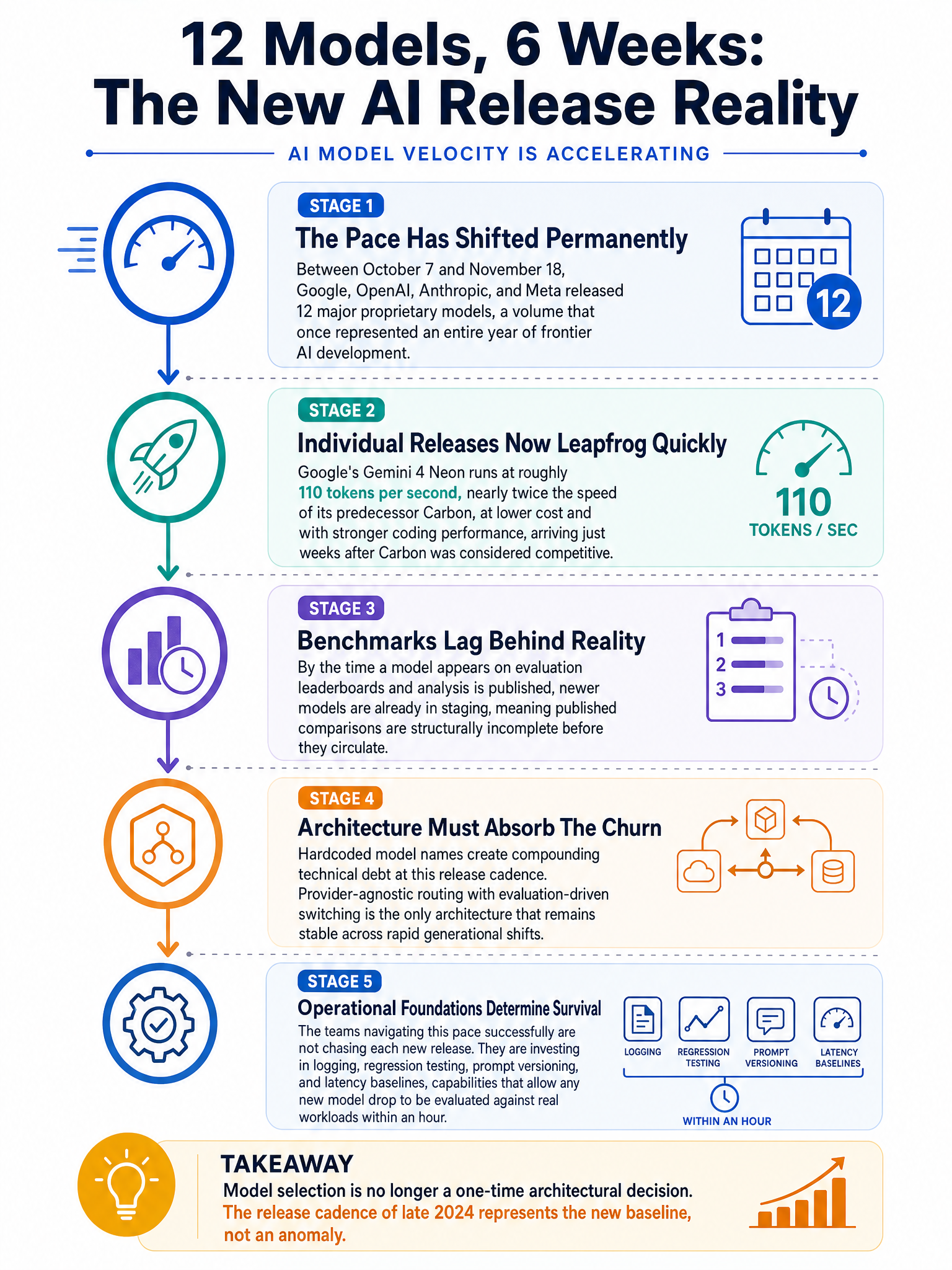
Between October 7 and November 18, 2026, Google, OpenAI, Anthropic, and Meta collectively released 12 major proprietary AI models. Google alone shipped four Gemini 4 variants. That’s not a release cadence anymore. That’s a firehose.
The latest one, Gemini 4 Neon, is worth pausing on.
What Neon Actually Does
According to The Decoder’s coverage, Neon runs at roughly 110 tokens per second, nearly twice the throughput of Gemini 4 Carbon, which came out just weeks earlier. It costs less per token. It beats Anthropic’s comparable model on coding tasks at a fraction of the price. It also ranks third overall on the Artificial Analysis benchmark, behind OpenAI and Anthropic’s current top models.
That’s a lot of ground to cover for a model Google is not even positioning as its flagship. The comparison benchmarks don’t include the strongest current offerings from OpenAI or Anthropic, which matters if you’re trying to make real procurement decisions. But the trajectory is real: faster, cheaper, stronger on the tasks most production builders actually care about, shipping in rapid succession.
🔧 What This Means If You’re Building
The model you chose four weeks ago might not be the right one today. That’s not hypothetical anymore.
If you built a coding pipeline optimized around Gemini 4 Carbon’s latency profile, Neon just changed your assumptions. If you priced a product around Anthropic’s current tier for coding workloads, a competitor using Neon at lower cost per token has an edge you need to account for.
I’m not saying you should chase every release. I am saying that model selection is now an ongoing operational decision, not a one-time architecture choice. The abstractions you build matter more than ever because the underlying models are moving too fast to hard-code against.
The Competitive Dynamics Nobody Talks About
Here’s what’s actually interesting to me about the Neon release specifically. Google is shipping fast enough that its own models are becoming each other’s competition. Four Gemini 4 variants in six weeks means Google is iterating on itself in production time. That’s a different kind of pressure than competing with OpenAI.
The Federal Reserve noted in a November 2026 speech that on-balance-sheet debt at the seven largest AI firms is on track to exceed $800 billion before year’s end. That is a staggering number. These companies are spending at a scale where shipping slower is not an option. The release cadence is partly a product decision and partly a financial one.
Meanwhile, per Stanford’s 2026 AI Index, the best American models no longer hold a clear lead over the best Chinese ones. That context matters. Twelve models in six weeks isn’t just competition between labs, it’s labs under pressure from multiple directions at once.
⚡ What I’d Tell Any Team Right Now
Stop treating model selection like infrastructure selection. Infrastructure changes slowly. Models don’t.
Build evaluation pipelines you can run in hours, not days. Keep your model abstraction layer thin enough that swapping providers is a configuration change, not a refactor. And actually run your benchmarks on your own data, because Neon beating Anthropic’s model on a standard coding benchmark says nothing about whether it beats it on your specific workload.
The 110 tokens-per-second number is real and relevant. But only if your use case is latency-sensitive. Know what you’re optimizing for before the next model drops, because one will.
The teams that will navigate this well are not the ones picking the best model. They’re the ones who built for the assumption that the best model today will be the second-best model next month.
That assumption is now just accurate.
Sources
#AIEngineering #MachineLearning #GenerativeAI #ProductionAI #LLMs #GoogleGemini #AIStrategy