Gemini 4 Neon launch and what the 44-model 2026 release cadence means for production builders
Gemini 4 Neon Just Dropped. Your Architecture Is Already Stale.
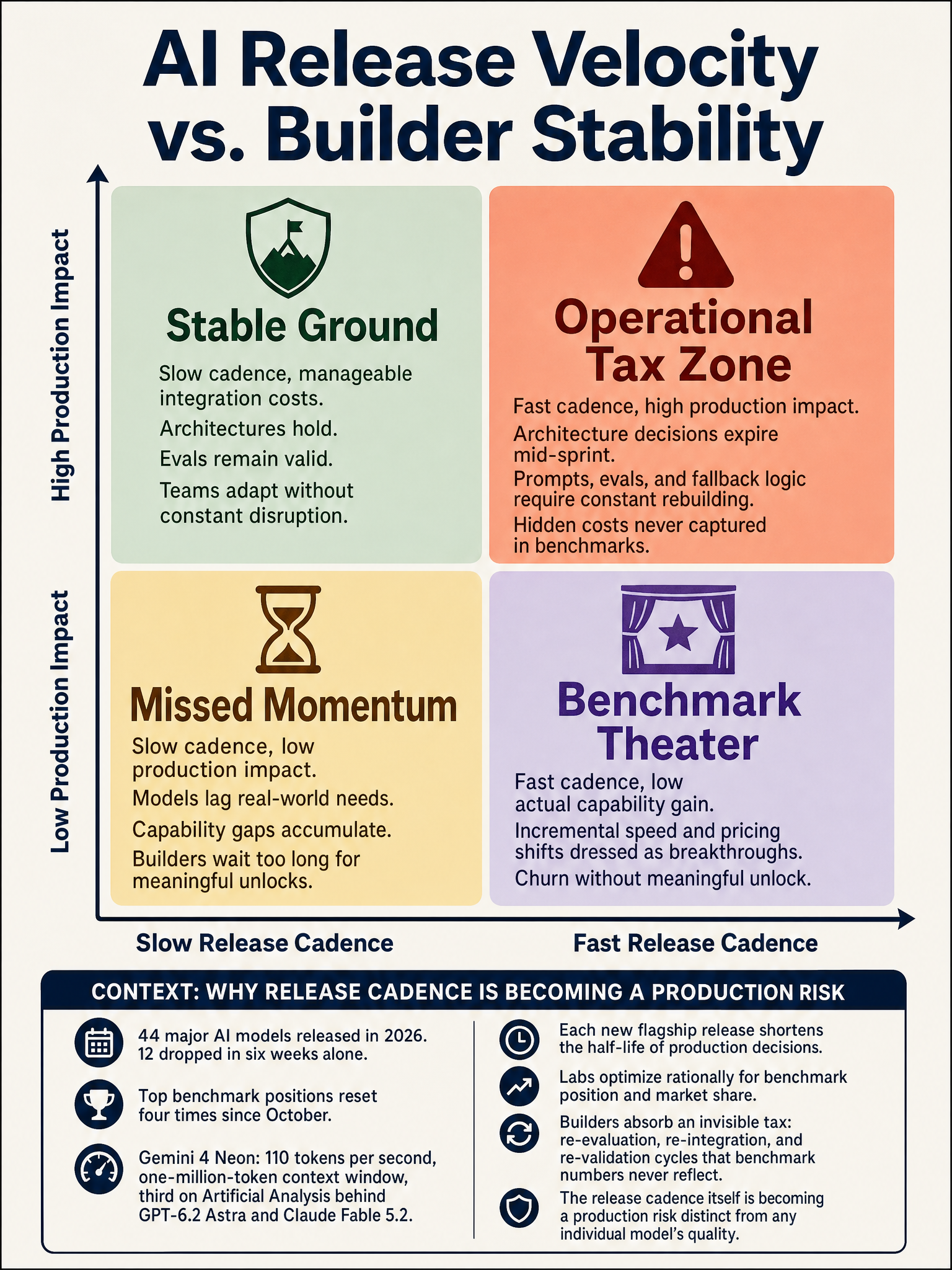
44 major AI models in 2026. Twelve of them in the last six weeks. If that number doesn’t make you pause before your next production deployment decision, it should.
Google DeepMind released Gemini 4 Neon this week. It’s faster and cheaper than Gemini 4 Carbon, which came out just weeks ago. It runs at roughly 110 tokens per second, offers a one-million-token context window, and posts strong numbers in coding, image analysis, and safety evals. It currently sits third on the Artificial Analysis benchmark, behind OpenAI’s GPT-6.2 Astra and Anthropic’s Claude Fable 5.2.
Third place. In a race that has reset four times since October.
That’s the story I want to talk about. Not the model itself. The cadence.
🔁 What 44 Models Actually Means for Builders
Between October 7 and November 18 alone, Google, OpenAI, Anthropic, and Meta dropped 12 major proprietary models, per PTI’s tracking of the autumn rollout. That’s roughly two per week. Some were flagship reasoning systems. Some were lightweight variants. All of them arrived with new pricing, new benchmarks, and new context windows that immediately aged whatever you shipped the sprint before.
The half-life of an architecture decision is now shorter than a sprint cycle. You pick a model for production. You tune your prompts, wire up your evals, build your fallback logic, and document your latency assumptions. Then Neon lands and the benchmark picture shifts. The pricing changes. Something that worked last month is now two generations behind.
This isn’t a complaint about progress. It’s a structural observation about what building on top of these APIs actually requires right now.
The Abstraction Tax
There’s a tension every production builder is navigating. On one side, you want to abstract your model calls behind a clean interface so you can swap providers without rewriting your application. On the other side, every model has real behavioral differences that bleed through any abstraction layer you build.
Neon’s one-million-token context window isn’t just a bigger number. It changes how you chunk documents, whether you cache intermediate results, and what your cost model looks like at scale. Carbon’s window was different. Astra’s behavior on structured output is different from Fable 5.2’s. These aren’t rounding errors you can hide behind a wrapper function.
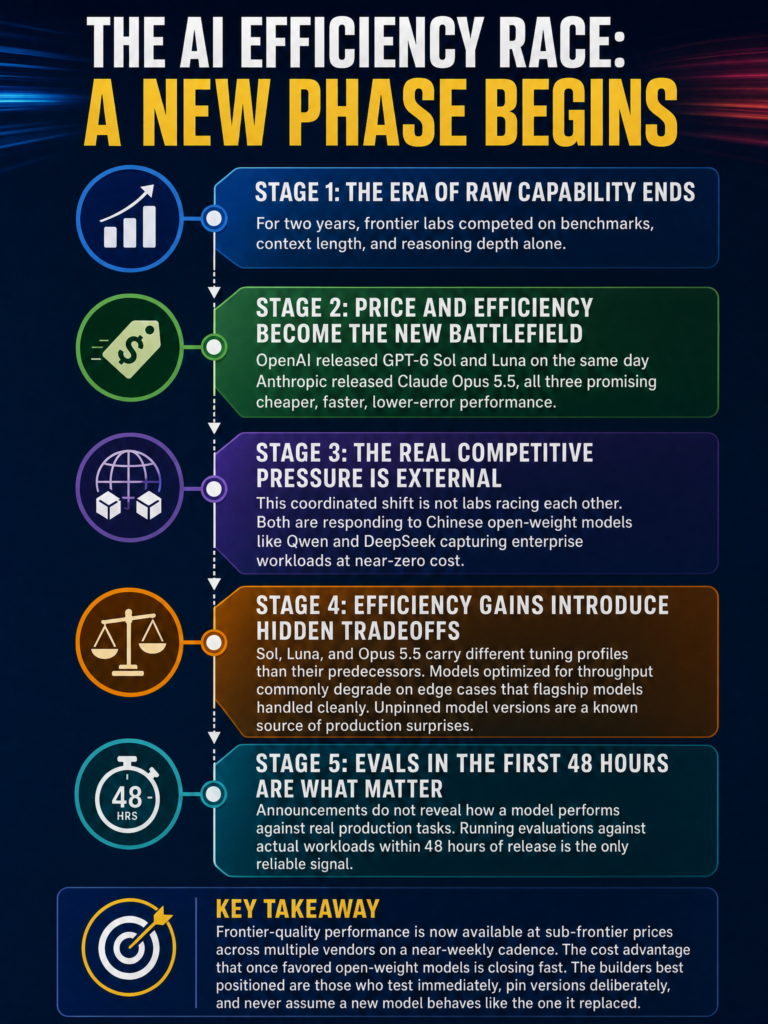
The builders who are surviving this cadence aren’t the ones with the cleanest abstractions. They’re the ones who’ve built serious eval harnesses, run them against every new model on day one, and have clear decision criteria for when to migrate versus when to hold.
🧪 The Benchmark Problem
Neon sits third on Artificial Analysis. That’s a real data point. But GPT-6.2 Astra launched to what VentureBeat described as “essentially unusable” reception from power users, despite leading the benchmark at release. The gap between benchmark performance and production behavior remains wide enough to swallow a roadmap.
I’ve said this before and I’ll keep saying it: aggregate benchmarks tell you roughly which tier a model is in. They don’t tell you whether it handles your edge cases, your domain vocabulary, or your failure modes. The only benchmark that matters for your use case is the one you built for your use case.
If you’re making model selection decisions based on Artificial Analysis alone, you’re optimizing for someone else’s workload.
What Sustainable Looks Like
The labs aren’t slowing down. Stanford HAI’s AI100 report, released earlier this month, put it plainly: the technology has outrun both expectations and governance. That’s true inside companies too. The models are outrunning internal processes for evaluating and adopting them.
The teams I see handling this well share a few habits. They version their prompts with the same discipline they apply to code. They maintain a production model and a shadow model in parallel, so they can run real traffic comparisons before cutting over. They treat a new model release as a trigger for running evals, not for immediately rewriting their stack.
The teams struggling are the ones chasing the benchmark table every time it updates. That is a full-time job now, and it’s not a productive one.
Neon is fast. It’s cheap. It may well deserve a spot in your stack. But the decision to adopt it should be driven by your eval results, not by the press release. Carbon was the right call six weeks ago for the same reason.
Pick your model. Build your evals. Trust your data. The race doesn’t stop when you do.
Sources