OpenAI GPT-6 Sol and Luna plus Anthropic Claude Opus 5.5 same-day releases, both promising cheaper frontier performance as labs shift competitive focus from capability to cost
The Price War Nobody Saw Coming (But Everyone Should Have)
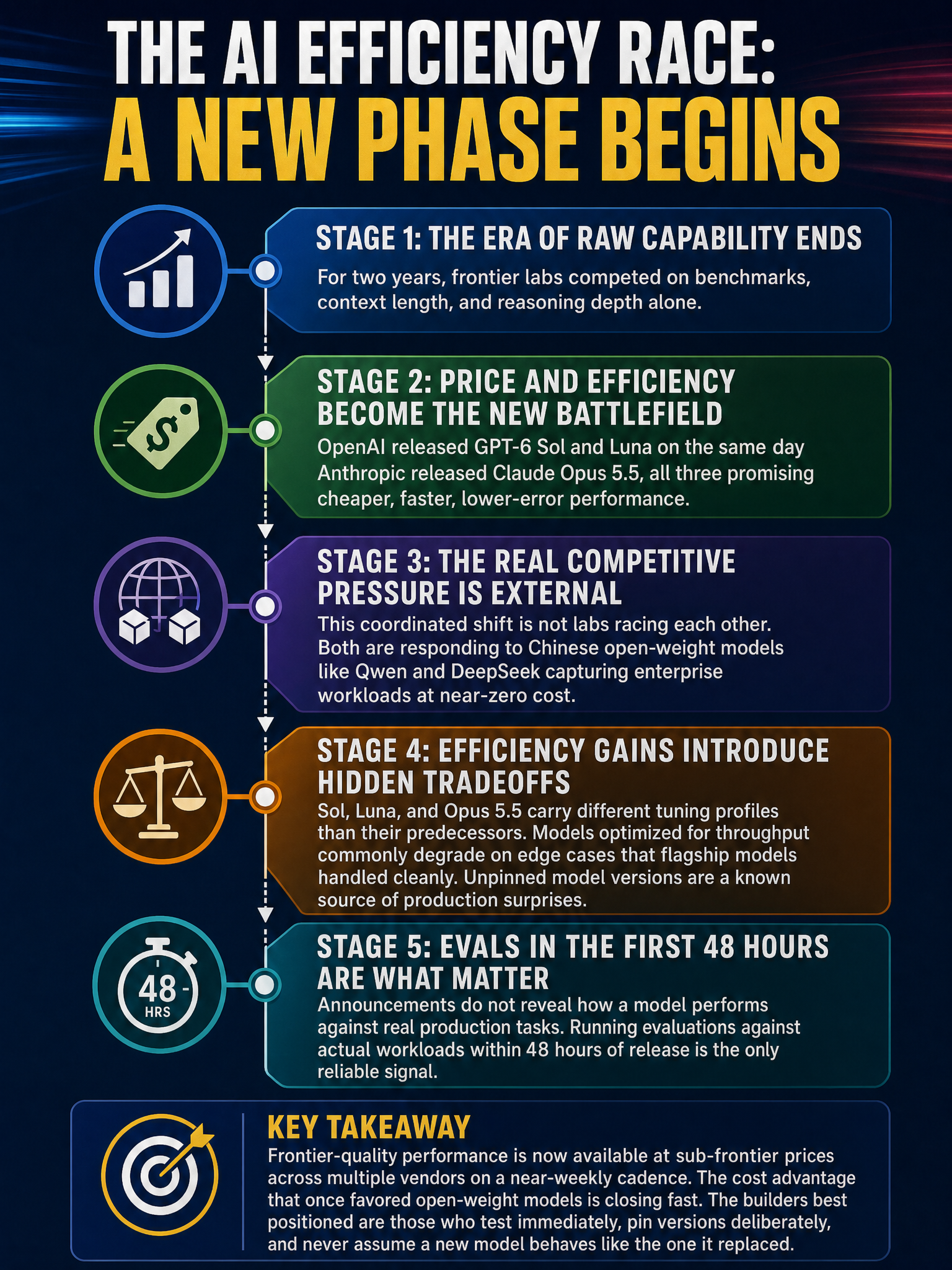
Something shifted last Tuesday that I think a lot of people are going to look back on as a turning point. OpenAI dropped GPT-6 Sol and GPT-6 Luna. Anthropic dropped Claude Opus 5.5. Same day. And every headline wrote it off as a coincidence of competitive timing. It wasn’t. This is the frontier AI race entering a completely different gear, and if you’re building anything with these models right now, you need to understand what actually changed.
The Capability Arms Race Is Over (For Now)
For the past two years, the game was raw benchmark performance. Longer context windows. Better reasoning on hard math problems. Higher scores on whatever evaluation the labs decided mattered that week. Labs competed to be the smartest model in the room.
That era isn’t dead, but it’s no longer the primary battlefield. The new competition is cost per useful output. And that shift changes everything for anyone building production systems.
What These Models Actually Are
Sol is OpenAI’s answer for coding workloads. Luna targets high-volume extraction and summarization. Both are positioned as bringing GPT-6 Astra-level advances to everyday work at lower price points. On the Anthropic side, Opus 5.5 is the interesting one. It reportedly matches the performance of Claude Fable 5.1 at roughly 40% lower cost to run. Think about that number. Not 5%, not 10%. Forty percent.
OpenAI also claims Sol and Luna have a lower error rate on factual accuracy. Their internal evaluation is based on de-identified real-world conversations where users flagged mistakes, which is actually a more honest signal than most synthetic benchmarks. Whether the improvement holds in your specific workload is a different question, but the direction is right.
Why This Happened Now
Reuters reported that Anthropic was already considering a new release specifically to counter OpenAI’s momentum since GPT-6 Astra launched. That’s the honest version of what’s happening here. Both labs are also facing real pressure from open-weight competitors who have been closing the capability gap while charging nothing for inference. When the competition is free, your only lever is value per dollar at the hosted tier.
There’s also the IPO angle. Anthropic’s financials eventually need to work as a business, not just as a research org. Cheaper, more efficient models that can run profitably at scale matter a lot more to that story than another benchmark record.
What I Actually Think
I’ve been saying for a while that the capability ceiling for most real enterprise workloads was already hit. The limiting factor was never whether the model could reason better. It was whether the cost structure made economic sense to deploy at scale, and whether the model was reliable enough to trust in production.
Forty percent cost reduction on a frontier model is genuinely meaningful. That’s the kind of number that turns a use case from a proof of concept into a real product. Sol being optimized specifically for coding workloads tells me OpenAI has been paying attention to where actual token spend is going inside developer organizations.
The labs framing this as “a little more for a lot less money” (Ars Technica’s phrase, and a good one) is exactly right. This isn’t about democratizing AI in some abstract sense. It’s about making the unit economics work for builders who have been sitting on promising prototypes that didn’t pencil out at full inference costs.
Where This Goes
The next phase of this competition is going to be brutal for anyone who can’t compete on both dimensions at once: raw capability when it matters, plus cost efficiency at volume. Google DeepMind hasn’t made its move in this cycle yet. When it does, I expect the price pressure to accelerate further.
For now, if you’re building and you haven’t re-evaluated your model routing strategy in the last month, do it this week. The math has changed.
Sources
#AIEngineering #MachineLearning #LLMs #OpenAI #Anthropic #BuildingWithAI