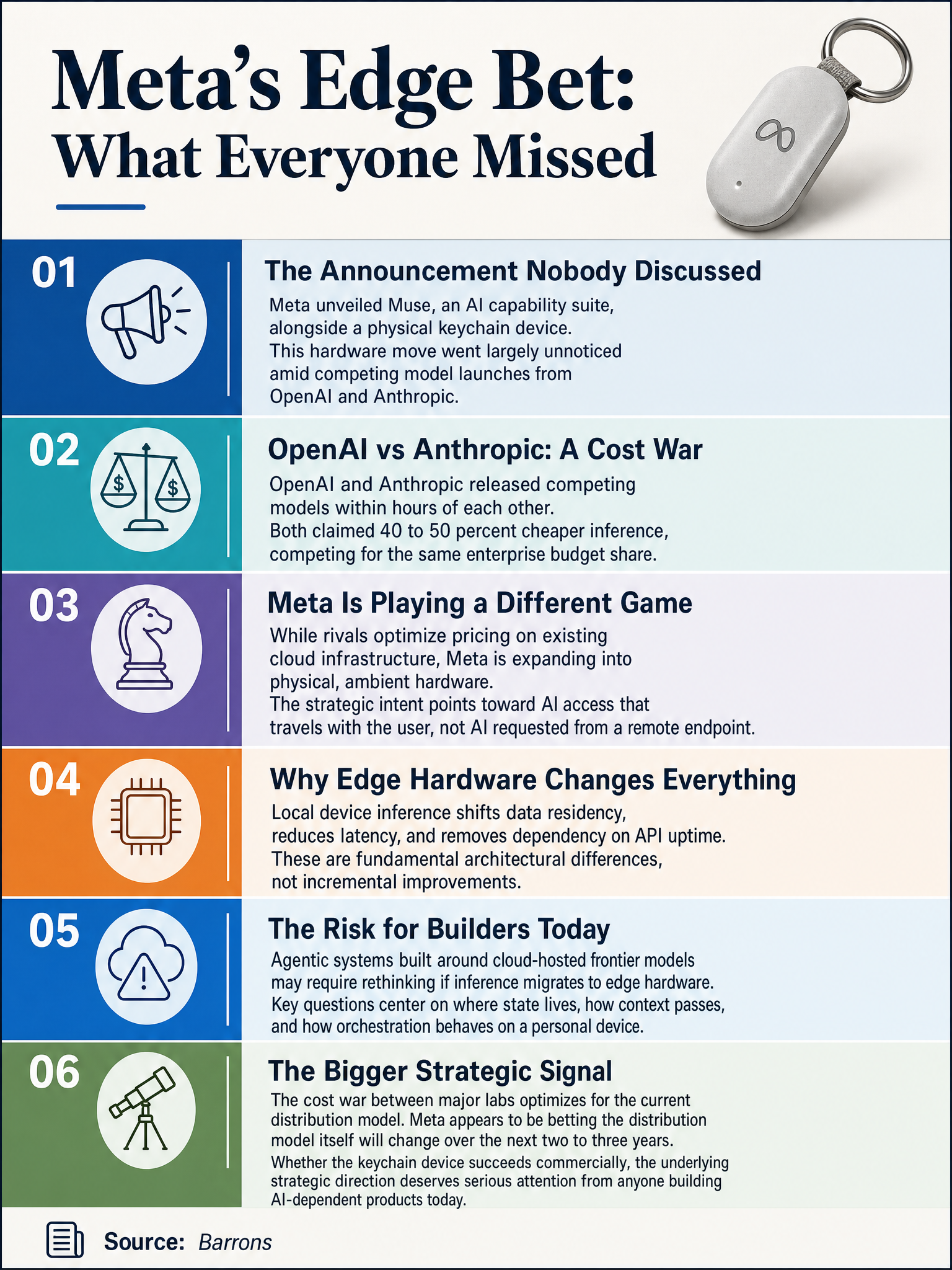
Meta Muse and keychain device launch as an edge AI distribution play while OpenAI and Anthropic fight a frontier model cost war
The Move Everyone Missed While Watching the AI Price War
While OpenAI and Anthropic were trading model announcements within hours of each other last Tuesday, Mark Zuckerberg walked out with a keychain.
Not a new API tier. Not a benchmark claim. A physical device you clip to your keys.
That’s the story. And almost nobody is telling it.
The Cost War Is Real, But It’s a Defensive Play
GPT-6 Sol and Luna dropped on September 22nd. Claude Opus 5.5 dropped the same day. Both companies claimed 40-50% cheaper inference than previous versions. Both positioned their releases as bringing frontier-level capability to everyday work at lower cost. Fortune covered it as a price war heating up over enterprise wallet share.
That framing is accurate. Businesses are getting squeamish about token costs, and both OpenAI and Anthropic are responding to pressure from cheaper open-weight competitors. The new models are real, the savings are real, and the competitive pressure driving those releases is real.
But here’s what that battle actually is: a fight over margin on existing infrastructure. Cloud-hosted inference, API pricing, enterprise contracts. The whole contest plays out inside a model that Meta doesn’t need to win because Meta is building something structurally different.
🔑 What the Keychain Actually Means
Meta’s Muse announcement came with a physical keychain device. Let that sit for a second.
The device runs AI at the edge, meaning computation happens on hardware you carry rather than in a data center you pay by the token to access. This is not a gimmick. It’s a distribution strategy.
Every time OpenAI or Anthropic cuts inference costs, they’re still selling you access to their centralized compute. Their business model requires you to send data to their servers. Edge AI breaks that dependency entirely. If the model runs on a device in your pocket, the pricing conversation changes completely. There’s no token bill to negotiate.
Meta has been moving toward this for a while. Their open-weight Llama releases made sense in retrospect as groundwork. Get the models small enough, efficient enough, and widely distributed enough to run on consumer hardware. The keychain is where that strategy becomes a physical product.
Why This Changes the Competitive Picture
OpenAI and Anthropic are fighting over enterprise contracts. Meta is going after something broader: the distribution layer itself.
If AI becomes a thing that runs on devices people already carry, then the race to cut cloud inference costs becomes less relevant. The question stops being “which API is cheapest” and starts being “whose hardware is already in your pocket.”
Apple figured this out years ago with the neural engine in their chips. Google has been pushing on-device inference through Pixel. Meta is now entering that space directly, with Muse capabilities attached to a consumer form factor.
Barron’s noted that the OpenAI and Anthropic launches posed no real threat to Meta’s Muse announcement, and I think that’s right, though the reason matters. It’s not that the models are bad. It’s that they’re competing in a different category.
🤔 What I Think This Signals
The frontier model cost war is a real battle. But it’s a battle over a shrinking piece of what AI distribution will look like in three to five years.
If edge inference becomes good enough to handle the majority of routine tasks, centralized cloud inference becomes a specialist tool. You’d use it the way you use a high-powered render farm: for specific jobs that need it, not for everyday interactions. The 40-50% cost reductions that OpenAI and Anthropic are competing over matter a lot less in that world.
Meta’s keychain device might be clunky. Version one of almost everything is. But the strategic logic behind it is sound, and it’s the move in this week’s news cycle that I think deserves more attention than it got.
The companies racing to be the cheapest cloud API are optimizing for a world that Meta is trying to make irrelevant.
Sources
#AIStrategy #MachineLearning #EdgeAI #MetaAI #OpenAI #Anthropic #ArtificialIntelligence
Sources & Further Reading
- OpenAI launches GPT-6 Sol and Luna, boasting lower cost and fewer mistakes
- OpenAI and Anthropic Reveal Cheaper AI Models
- What slowdown? OpenAI, Anthropic release dueling models as AI price wars heat up
- Why AI model releases feel nonstop
- OpenAI and Anthropic Launch New Models. Why They’re No Threat to Meta’s Muse.