Hot take: collapsing model prices create new vendor lock-in through behavioral coupling, not cost
The Lock-In Nobody Talks About
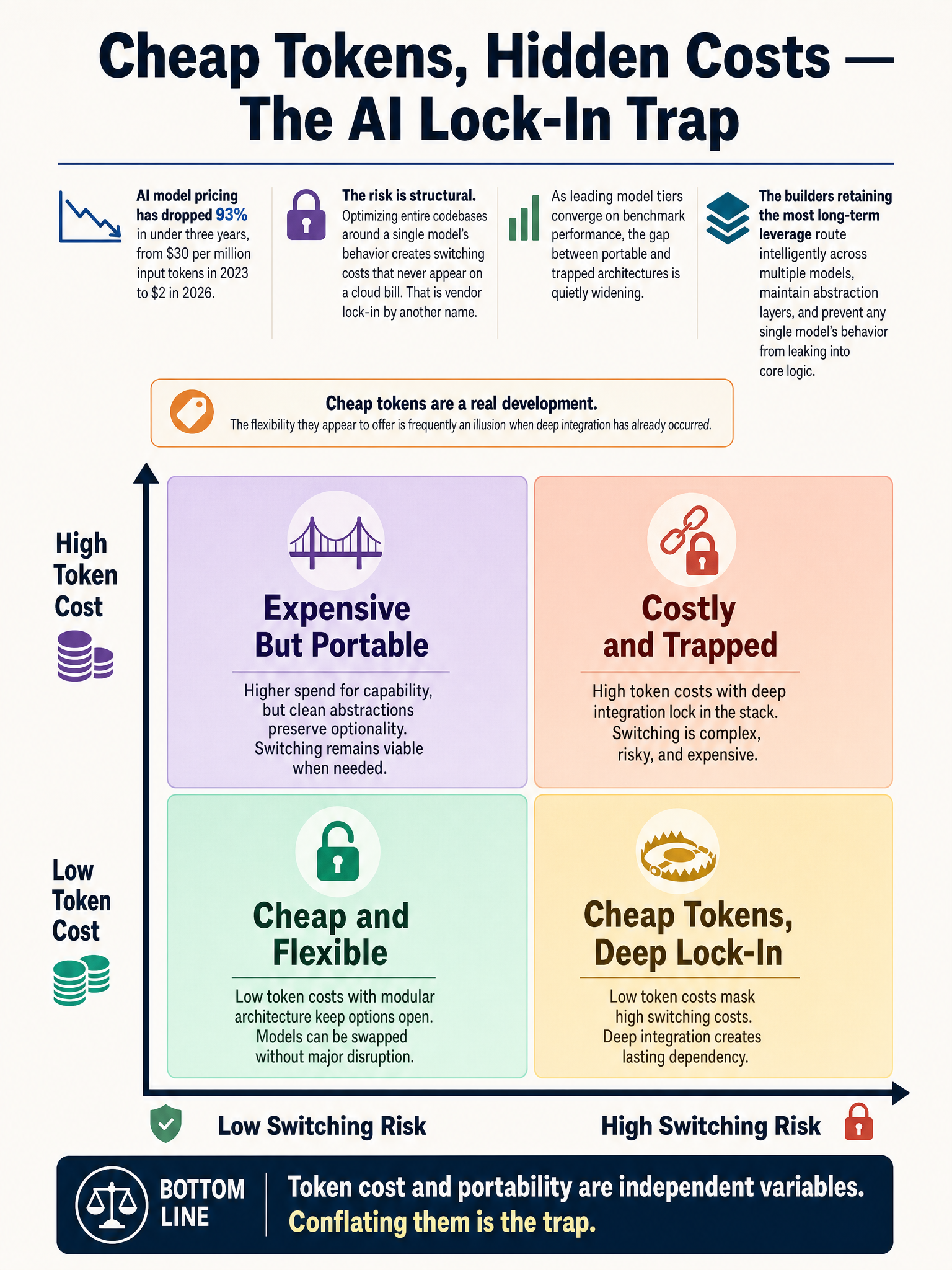
GPT-4 launched in 2023 at $30 per million input tokens. GPT-5.6 in 2026 costs $2. That’s a 93% price drop in under three years, and nearly every builder I know treated it as pure good news. I did too, for a while.
But I’ve been watching something happen underneath those falling prices, and I think we’re all walking into a trap.
The Money Has to Go Somewhere
Commodity pricing on compute doesn’t make the economics disappear. It shifts them. When margin collapses at the token layer, the business model migrates toward volume, toward the application layer, toward proprietary integrations that slowly rebuild the switching costs you thought you’d escaped.
The “models are commodities now” narrative assumes that because you can route to Claude Opus 5 at $5/million input or Grok 4.6 at aggressive new price points, the market is genuinely fluid. It isn’t. Not for most production systems.
Behavioral Coupling Is the Real Lock-In
Here’s what actually happens when you build on cheap tokens. You optimize your prompt engineering around one model’s quirks. You tune your parsing logic to its output formatting. You build tool-calling flows that depend on how it handles ambiguous instructions. You get comfortable with its context window behavior.
None of this is explicit lock-in. There’s no contract. But after six months, switching to a different model isn’t a pricing decision anymore. It’s a re-engineering project. The behavioral fingerprint of your chosen model is baked into your stack.
I’ve watched teams discover this when they tried to swap providers for cost reasons and found that their evals collapsed, their edge cases broke, and their output parsing failed on 15% of responses because the new model structured things differently. The token price was lower. The migration cost was not.
The Ecosystem Play Is Already Happening
Look at where Grok 4.6 landed after its August 12, 2026 release. Amazon Bedrock. GitHub Copilot. The Gemini Enterprise Agent Platform. Cursor Pro. That’s not distribution strategy, that’s integration strategy. Get the model into the tools where developers already live, and the switching cost shifts from “change your API key” to “change your entire development environment.”
OpenAI is doing the same thing, just more quietly. GPT-5.6 launched with government-tier access restrictions and enterprise privacy protections designed specifically to make it the compliant, integrated choice for organizations that can’t easily leave once they’re in.
Anthropic’s angle is privacy differentiation. Each of them is building moats that have nothing to do with token price.
What This Actually Means for Builders
The price collapse is real and it does benefit you in the short run. Longer context, cheaper experimentation, faster iteration cycles. I’m not arguing against using these models.
But if you’re building production systems without an abstraction layer between your application logic and any specific model’s behavior, you are accumulating lock-in debt. Every optimization you make to one model’s output format is a future migration tax.
The practical response is boring but true: test your critical flows against at least two frontier models regularly, not because you’ll switch tomorrow, but because the day you need to switch, you want the decision to be about capability and price, not sunk cost in behavioral tuning.
The 93% price drop is the headline. The behavioral coupling is the fine print. Right now, most builders are reading the headline.
Sources & Further Reading
#AIEngineering #MachineLearning #LLMs #BuildingWithAI #AIStrategy